
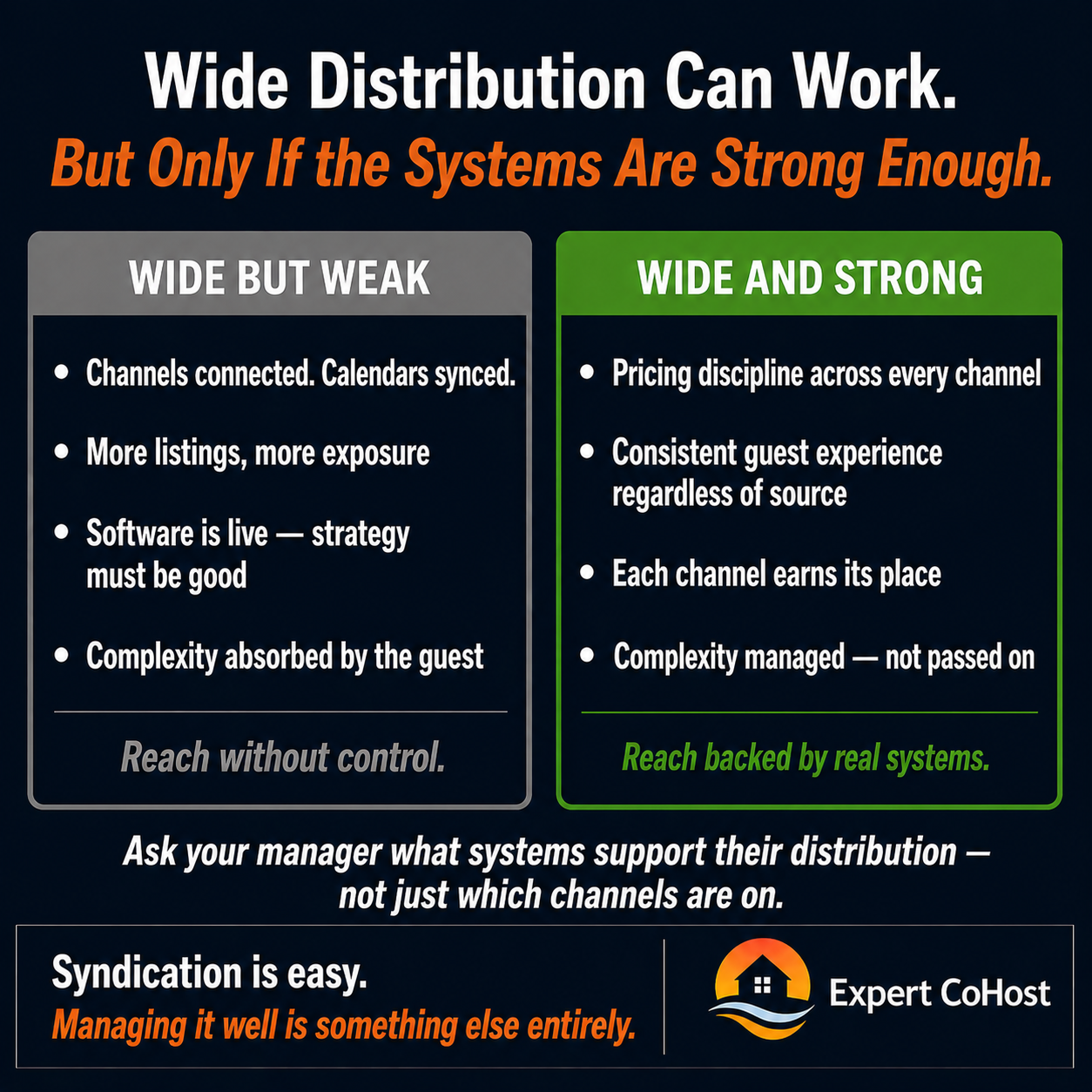
A lot of property managers love to talk about wide distribution.
It sounds impressive.
Your property is on Airbnb.
It is on Vrbo.
It is on Booking.com.
Maybe it is on Google Vacation Rentals.
Maybe there is a direct-booking site.
Maybe there are specialty or curated channels in the mix too.
On the surface, that sounds like sophistication.
And sometimes it is.
But not always.
Because wide distribution is one of the easiest things in this industry to make sound strategic while managing it very badly in practice.
That matters.
Because wide distribution really can work. In many cases, it is a smart idea. A property that appears in more of the right places can reduce dependence on a single booking source, capture more demand, smooth risk, and create a healthier long-term booking mix.
But only if the systems behind the property are strong enough to support it.
That is the part many property managers gloss over.
They like the idea of broad reach.
They like the sales language around exposure.
They like the appearance of sophistication.
What they do not always have is the operational depth required to make wide distribution perform the way it should.
And owners should care about that gap.
Wide Distribution Is Not the Same as Strong Distribution
This is the first distinction owners need to understand.
A property can be distributed widely and still be managed shallowly.
That happens all the time.
The channels are connected.
The software is live.
The listing is syndicated.
The calendars are synced.
The rates are pushed out.
Everything looks active.
But activity is not the same as strategy.
And reach is not the same as control.
A strong distribution strategy is not just about putting the property in more places. It is about making sure each channel adds useful reach, supports the overall booking mix, and can be managed without degrading the guest experience or operational stability of the property.
That is a much higher standard.
Many property managers do not meet it.
Why Wide Distribution Can Be a Very Good Idea
Let’s be clear about something.
Wide distribution is not the problem.
In many cases, it is the right move.
A property that depends too heavily on one booking platform is exposed. Changes in ranking, policy shifts, fee structures, guest behavior, seasonality, or platform dynamics can all create unnecessary risk when too much demand is concentrated in one place.
A broader channel mix can help reduce that risk.
It can also create meaningful upside.
More visibility can bring more booking opportunities.
Different channels can reach different kinds of travelers.
Some channels can support seasonal strength.
Some can create better diversification.
Some can open pathways to repeat or direct demand over time.
That is all real.
So the argument is not against wide distribution.
The argument is against pretending wide distribution works automatically.
It does not.
The Problem Is Usually Not the Reach — It Is the Systems
This is where the conversation usually gets shallow.
A lot of property managers think wide distribution is mostly a software problem.
Get the channel manager.
Connect the listings.
Sync the calendar.
Push rates and availability.
That is useful.
But it is only the beginning.
Because once a property is live across multiple channels, the real challenge starts.
Can pricing stay coherent across platforms?
Can listing quality remain strong across platforms?
Can communication stay clear and timely across platforms?
Can guest expectations be managed consistently?
Can operational friction be reduced across different booking paths?
Can the team respond well when the complexity increases?
Those are systems questions.
And that is where weak managers get exposed.
Because many of them are good at the setup.
Far fewer are good at the management that follows.
More Channels Create More Complexity
This should be obvious, but many people still underestimate it.
Every additional channel can create more moving parts.
More guest pathways.
More message flows.
More booking behavior differences.
More listing variations.
More policy considerations.
More payment differences.
More chances for confusion.
More chances for friction.
That does not mean more channels are bad.
It means complexity rises faster than many managers admit.
And if the systems are not ready, that complexity does not stay contained inside software.
It leaks into the guest experience.
A guest gets mixed signals.
A question gets answered too slowly.
A listing detail is unclear.
A pricing issue creates distrust.
A check-in process feels less polished.
An exception gets handled inconsistently.
That is how weak systems quietly turn wide distribution into weaker performance.
This Is Why Some Property Managers Secretly Underperform at Scale
A lot of managers like to sound big.
They talk about channel reach.
They talk about software.
They talk about automation.
They talk about visibility.
But scale reveals weakness.
And wide distribution is one of the fastest ways to expose it.
Because once the property is present across multiple platforms, simple oversight is no longer enough. The manager has to be able to maintain consistency, protect listing quality, keep pricing disciplined, reduce confusion, and deliver a strong stay experience no matter where the booking originated.
That requires real systems.
Not just tools.
And that is where many managers quietly fail.
They can connect channels.
They cannot always manage the complexity those channels create.
Owners should understand that difference.
Wide Distribution Only Helps When the Added Reach Is Useful
This is one of the most important strategic points.
Not all exposure is equally valuable.
A channel can expand reach without improving results.
It can add bookings without adding good-fit bookings.
It can create more activity without creating more stability.
It can increase volume while also increasing operational drag.
That is why more channels are not automatically better.
Better channels are better.
And the only way to know whether added reach is useful is to have the systems and judgment to evaluate what that channel is actually contributing.
What kind of bookings is it bringing?
How well do those bookings fit the property?
How much friction comes with them?
Does the channel support a healthier mix?
Or does it simply create more noise?
A manager who cannot answer those questions is not really managing distribution strategically.
They are just expanding it.
What Strong Systems Actually Look Like
This is where owners should pay close attention.
When a property manager talks about wide distribution, the real question is not whether the property can be listed in more places.
The real question is whether the systems behind the property are strong enough to support it well.
That usually means things like:
-
clear pricing discipline across channels
-
strong listing presentation and positioning
-
reliable calendar and availability control
-
fast, consistent communication
-
polished pre-arrival and check-in systems
-
channel-aware guest expectation management
-
operational consistency after the booking is made
-
real monitoring of performance by channel
-
ongoing refinement rather than passive syndication
Those are the systems that make wider distribution work.
Without them, broad exposure often creates more operational pressure than strategic value.
Weak Managers Confuse Software Capability With Strategic Capability
This happens constantly.
A property manager has good software.
They have integrations.
They have automations.
They have channel connections.
They have all the language to make the operation sound modern.
And sometimes that is enough to impress an owner.
But software capability is not the same as strategic capability.
Being able to turn channels on is not the same as knowing which ones should be on, what role they should play, how they should be managed, and whether the property is operationally ready for the added complexity.
That distinction matters a lot.
Because weak managers often hide behind tools.
The channels are live, so the strategy must be good.
The listings are synced, so the execution must be strong.
The system is connected, so the distribution must be sophisticated.
Not necessarily.
A connected system can still be managed badly.
Wide Distribution Should Make the Business Stronger, Not Just Busier
This is another important lens.
A lot of managers evaluate wide distribution mostly by activity.
More inquiries.
More bookings.
More channel presence.
More visibility.
But a stronger standard is this:
Does wider distribution make the business healthier?
Does it reduce concentration risk?
Does it improve the booking mix?
Does it support smoother occupancy?
Does it strengthen resilience?
Does it create better long-term positioning?
Does it build toward a more durable operation?
Those are better questions.
Because a business can get busier without getting stronger.
And wide distribution that creates more movement without better structure is not nearly as valuable as it sounds.
What Owners Should Ask Their Property Manager
Owners do not need to become distribution experts.
But they should ask better questions.
For example:
Why is my property on each channel it is currently on?
What role does each one play?
What systems do you have in place to manage wide distribution well?
How do you prevent added channel complexity from hurting the guest experience?
How do you know whether a channel is adding value or just adding noise?
How does broader distribution improve the health of the booking mix?
What operational issues tend to show up as channel count increases?
How are you managing those?
Those questions matter because they reveal whether the manager is actually equipped to support a broad strategy.
A weak manager usually answers with generalities.
A strong one can explain the structure clearly.
The Bigger Point
Wide distribution works.
But only when it is supported by real systems.
That is the point many property managers do not want owners thinking too hard about.
Because it is easy to sell exposure.
It is harder to build the infrastructure that exposure requires.
And that is where real management depth shows up.
The issue is not whether a property should have broad reach.
The issue is whether the person managing that reach knows how to control complexity, protect quality, and turn channel breadth into actual strategic advantage.
That is a much more serious standard.
And owners should hold managers to it.
Final Thought
Wide distribution can absolutely be a strength.
It can diversify demand, reduce dependence, improve resilience, and give a property more ways to win.
But none of that happens just because the channels are connected.
It happens when the systems behind the property are strong enough to support the added complexity without weakening the operation.
That is what the best property managers understand.
They do not confuse visibility with strategy.
They do not confuse syndication with control.
They do not confuse software with management.
They know that broad channel reach only becomes a real advantage when the infrastructure behind it is just as strong as the exposure in front of it.
That is what owners should be paying for.
Not just more places to be seen.
The systems required to make wider distribution actually work.