
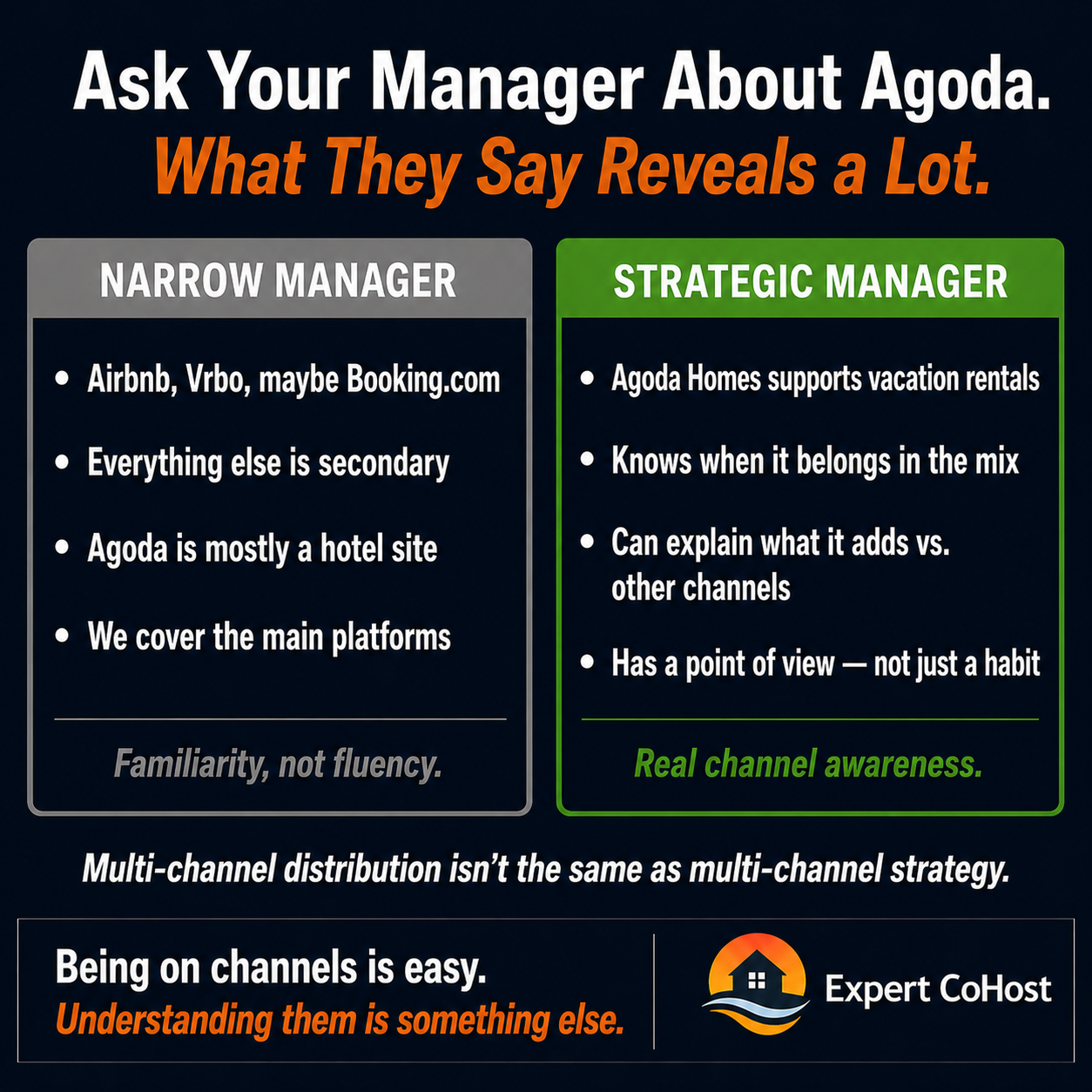
A lot of property managers barely think about Agoda.
That alone should get an owner’s attention.
Because when a manager claims to understand distribution strategy but only talks about the same few platforms over and over, it usually reveals something important: their thinking may be narrower than it sounds.
Agoda is a good example of that.
Agoda clearly supports vacation rental and home-style listings through Agoda Homes, invites property owners to list directly, and provides host-side management through its YCS extranet. Agoda also explicitly allows hosts to create listings manually or import them from Airbnb or Booking.com, which makes clear that it sees itself as part of the broader vacation-rental distribution landscape, not just the hotel world.
That matters.
Because a lot of property managers still talk as if the entire booking universe begins and ends with Airbnb, Vrbo, and maybe Booking.com. But Agoda’s own host-facing materials make it clear that it is a real listing channel for homes, with calendar connections, reservations management, messaging, and host tools designed for active property partners.
That means Agoda is not the kind of platform a serious manager should ignore casually.
Agoda Is Not Just “Another Place to List”
This is the first thing owners should understand.
A weak property manager often thinks about channels in the simplest possible way:
Airbnb for vacation rentals.
Vrbo for vacation homes.
Booking.com for broader travel.
Everything else is secondary.
That is not very sophisticated.
Agoda is better understood as a real booking and distribution channel that may matter more in some travel flows than many U.S.-centric property managers realize. Agoda markets Agoda Homes as a way to “reach millions of global travelers,” and its partner tools are built around listing management, availability, bookings, reviews, and communication.
That does not mean every property should rush onto Agoda.
It does mean a serious manager should at least understand what it is, what it does, and when it may deserve a place in the mix.
What Agoda Is Best For
Agoda appears strongest as a broader travel-distribution channel that can complement the more familiar vacation-rental platforms. Agoda’s own host materials emphasize global traveler reach, and its systems are built to let hosts manage listings, rates, availability, bookings, reviews, and messaging through YCS.
That suggests Agoda is best understood as useful for owners and managers who care about wider distribution, especially when they do not want their channel thinking to stop with the same standard platforms everyone else mentions.
In practical terms, Agoda makes the most sense as part of a broader channel-awareness conversation:
- not as a replacement for every other platform
- not as a magical fix
- not as a vanity add-on
- but as one more potential source of demand that a thoughtful manager should know how to evaluate
That is the right frame.
What Most Property Managers Miss About Agoda
This is where the real issue starts.
A lot of property managers either dismiss Agoda because it feels less familiar in their usual sales conversations, or they never form a real opinion about it at all.
That is a problem.
Because owners are not paying a property manager to be familiar only with the channels they personally like best. They are paying for judgment about the broader distribution landscape.
And Agoda’s own materials show enough to make one thing clear: it is not some fringe or accidental platform from a host-management standpoint. Agoda provides listing creation, listing import from Airbnb or Booking.com, calendar connections with other websites, booking management in YCS, and guest communication tools.
So when a property manager acts as though Agoda is not even worth understanding, owners should wonder whether the manager is thinking deeply enough about channels in general.
Agoda Reveals Whether a Manager Thinks Narrowly or Broadly
This may be the most useful way to think about it.
Agoda is not just interesting because of Agoda itself.
It is interesting because it exposes how a property manager thinks.
A narrow manager usually stays inside a small comfort zone:
Airbnb, Vrbo, maybe Booking.com, maybe direct bookings.
A stronger manager understands that real distribution strategy includes knowing what else exists, what each channel is actually for, and when a platform deserves to be considered even if it is not part of the most common owner conversations.
That is what Agoda tests.
Not whether every property needs it.
But whether the manager is curious and strategic enough to understand the wider channel landscape.
Agoda Is Also a Good Example of Why Software Access Is Not Strategy
A lot of managers like to sound sophisticated by pointing to software.
They can connect channels.
They can sync calendars.
They can import listings.
They can manage multiple properties.
Agoda certainly supports that infrastructure. Hosts can use YCS to manage rates and availability, connect calendars with other sites, and monitor bookings and messages.
But that still does not answer the strategic question:
Should this property be on Agoda, and if so, why?
That is where weak managers usually run out of depth.
They know a channel can be turned on.
They do not always know what role it should play.
And owners should understand that those are two very different levels of capability.
Agoda Should Be Evaluated as a Role in the Mix
This is the right standard.
Not:
Is Agoda good or bad?
Not:
Is Agoda better than Airbnb?
Not:
Should every property be on Agoda?
The better question is:
What would Agoda add to this property’s distribution mix that is not already being captured well enough elsewhere?
That is a strategic question.
A good property manager should be able to answer it clearly.
Maybe Agoda adds useful reach.
Maybe it adds incremental visibility.
Maybe it belongs in the mix only for certain properties or management models.
Maybe it is worth testing.
Maybe it is not worth the added complexity for a particular asset.
All of those can be serious answers.
What is not a serious answer is pretending the platform does not matter simply because the manager has not spent time understanding it.
Agoda Also Fits the Broader Theme: Wider Distribution Only Helps When Systems Are Strong
Like any additional channel, Agoda is not valuable just because it exists.
If a property manager adds a platform without clear purpose, broad distribution can become sloppy distribution.
Agoda supports calendar connections to other websites and host-side management through YCS, which helps operationally. But even with those tools, the bigger issue is still management quality, not just technical access.
That means Agoda belongs in the same larger conversation as every other platform:
- what kind of reach does it add?
- what kind of complexity does it add?
- what systems are in place to support it?
- what is the actual reason for including it?
That is how real channel strategy works.
Where Owners Get Misled
Owners often assume that if a property manager mentions “multi-channel distribution,” then they must already understand platforms like Agoda.
That is not necessarily true.
Sometimes “multi-channel” really just means:
the same few mainstream platforms, connected through software.
That is useful, but it is not the same thing as broad channel fluency.
Agoda makes this easier to see.
A manager who really understands the platform should at least be able to explain:
- what Agoda Homes is
- how listings can be created or imported
- what YCS does
- how Agoda fits into the broader distribution conversation
- whether it is worth considering for the property at all
Agoda’s own partner materials make those basics clear enough that a serious manager should not be completely unfamiliar with them.
What Owners Should Ask Their Property Manager About Agoda
Owners do not need to become Agoda experts.
But they should ask better questions.
For example:
Is Agoda something you have evaluated for my property?
If not, why not?
If so, what role would it play?
What would Agoda add that other channels may not?
Would it create useful reach or just more complexity?
Do you understand how Agoda Homes and YCS work?
Are you dismissing Agoda strategically, or just because it is outside your usual habit?
Those questions matter because they reveal whether the manager is actually thinking about distribution broadly or simply operating from a narrow default.
A strong manager will have a point of view.
A weak one usually will not.
The Bigger Point
Agoda matters for a reason that goes beyond Agoda.
It reveals whether a property manager understands that strong distribution strategy is not just about naming the most famous platforms.
It is about understanding the wider landscape.
Agoda’s official materials make it clear that it supports home listings, listing import, calendar connections, booking management, and host communication. That alone makes it relevant enough to understand.
That does not mean every property should be there.
It does mean a serious property manager should know how to think about it.
And owners should notice when they do not.
Final Thought
Agoda should not be dismissed as “just a hotel site.”
Its own host-facing materials show that it is a real vacation-rental and home-listing platform with operational tools for hosts and managers, including Agoda Homes, YCS, listing import, calendar syncing, bookings, and messaging.
The best property managers understand that.
They do not have to force every property onto every channel.
They do not have to pretend Agoda belongs in every mix.
But they should understand what it is, what it may add, and when it deserves to be part of the conversation.
That is what owners should be paying for.
Not just familiarity with the usual platforms.
Real channel awareness.