
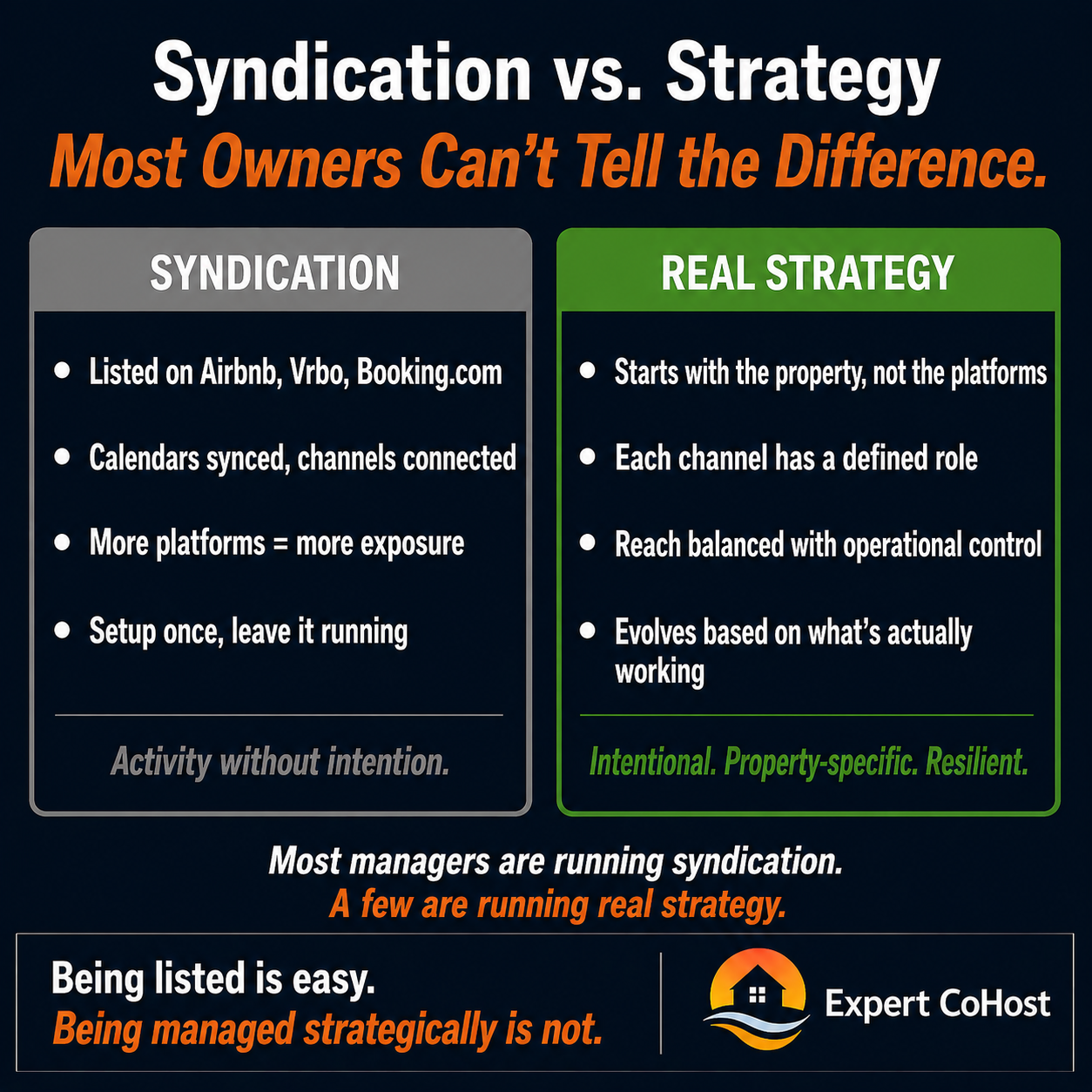
A lot of property managers talk about distribution as if it is self-explanatory.
The property is on Airbnb.
It is on Vrbo.
Maybe it is on Booking.com.
Maybe there is a direct-booking site.
Maybe there are a few other channels in the mix too.
To many owners, that sounds like strategy.
But it is not.
At least not by itself.
Because a real vacation rental distribution strategy is not just a list of platforms.
It is not just software connections.
It is not just synced calendars.
It is not just pushing a property into as many places as possible.
A real strategy is a set of deliberate decisions about where a property should appear, why it should appear there, what kind of demand each channel is supposed to bring, how the complexity is being managed, and how the entire mix supports the long-term health of the asset.
That is a much higher standard than simple listing syndication.
And it is one that many property managers do not meet.
A Real Strategy Starts With the Property, Not the Platforms
This is one of the biggest mistakes in the industry.
A lot of property managers start with the platforms.
They ask:
Which channels should we turn on?
Which major sites should we connect?
Where can we get more exposure?
That is backward.
A real strategy starts with the property.
What kind of home is this?
What kind of stay does it naturally support?
What kind of guest is the best fit?
What kind of market is it in?
What seasonality patterns matter?
What operational strengths and weaknesses shape what the property can support well?
Only after that should the platform decisions come into focus.
Because the channels are tools.
And tools only make sense when they are chosen in response to the job that needs to be done.
A Real Strategy Assigns a Role to Each Channel
This is where a lot of managers fall short.
They know how to add channels.
They do not always know how to define them.
A real distribution strategy gives each channel a purpose.
Not just:
We are on Airbnb.
We are on Vrbo.
We are on Booking.com.
But:
Why are we on Airbnb?
Why are we on Vrbo?
Why does Booking.com belong here, if it does?
What role does Google visibility play?
What is the direct-booking path supposed to accomplish?
Should there be any specialty or curated channels in the mix?
That is what real channel judgment looks like.
Each channel should earn its place.
One may be there for broad visibility.
One may help diversify demand.
One may support search discovery.
One may fit medium-term occupancy.
One may help with direct-booking growth over time.
One may reinforce brand positioning.
That is a strategy.
Anything less is usually just distribution by habit.
A Real Strategy Understands That Not All Exposure Is Good Exposure
This is a point many property managers avoid because it complicates the sales pitch.
It is easy to say that more exposure is always good.
But that is not always true.
A channel can increase visibility without increasing useful visibility.
It can create activity without improving the booking mix.
It can bring more bookings while also bringing more confusion, more friction, and more operational drag.
That is why a real strategy does not just ask:
Can we be there?
It asks:
Should we be there?
What will it contribute?
What tradeoffs come with it?
Will the added reach actually strengthen the property’s performance?
Those are serious questions.
And serious managers should be able to answer them.
A Real Strategy Balances Reach With Control
This is one of the clearest signs of maturity.
Weak distribution strategies tend to focus almost entirely on reach.
More channels.
More visibility.
More booking sources.
More exposure.
A real strategy respects reach, but it also protects control.
Because broad distribution without strong control can create real problems.
Pricing drifts.
Listings become inconsistent.
Guest expectations split across channels.
Messaging gets weak.
Operational friction increases.
The guest experience starts to feel less polished.
That is what happens when a manager values breadth more than operational discipline.
A real strategy balances both.
It expands reach carefully while maintaining pricing integrity, listing quality, communication consistency, and guest confidence.
That takes more than software.
It takes management depth.
A Real Strategy Is Built Around Systems
This is where the conversation gets serious.
Wide distribution only works well when strong systems are underneath it.
That means a real strategy is supported by:
-
clear pricing discipline
-
strong listing presentation
-
accurate availability and booking controls
-
consistent communication
-
polished pre-arrival and check-in processes
-
channel-aware expectation management
-
strong internal workflows
-
real monitoring of performance by channel
-
ongoing refinement instead of passive automation
Without those systems, distribution can expand faster than quality can keep up.
That is dangerous.
Because the weakness does not stay hidden inside the software. It shows up in the guest experience, in reviews, in friction, in preventable mistakes, and in lower-quality performance over time.
A real strategy accounts for that before the channels multiply.
A Real Strategy Reduces Dependence Instead of Just Increasing Activity
This is another major distinction.
A lot of weak strategies create movement.
More bookings.
More inquiries.
More channels.
More activity.
But they do not necessarily create resilience.
A real distribution strategy should reduce unhealthy dependence on any one source.
That does not mean every property needs an equal mix from every channel.
It does mean the manager should be thinking about concentration risk.
What happens if one platform changes?
What happens if rankings shift?
What happens if guest behavior changes?
What happens if one channel suddenly weakens?
A real strategy prepares for that.
It builds a healthier mix over time.
That is not just smarter marketing.
It is smarter asset management.
A Real Strategy Includes Direct Demand — But Does Not Fantasize About It
This is where a lot of managers become more aspirational than practical.
Almost every property manager says direct bookings matter.
That is easy to say.
A real strategy goes further.
It asks:
What direct demand exists now?
What can realistically be built over time?
How do repeat guests fit in?
How do referrals fit in?
How does search visibility matter?
How does brand trust support direct bookings?
What systems are actually in place to make direct demand grow?
That is a much better conversation.
Because direct bookings are not created by having a website alone. They are created by trust, repeatability, brand strength, visibility, and a guest experience strong enough that travelers feel comfortable booking outside a major third-party platform.
A real strategy respects that.
It does not just mention direct bookings because they sound smart.
A Real Strategy Evolves
This is another sign of depth.
Weak managers often treat distribution like a setup task.
The channels are connected.
The listing is live.
The system is working.
Done.
That is not strategy.
A real strategy evolves.
It adapts to seasonality.
It reacts to performance patterns.
It learns from friction.
It refines channel mix.
It adjusts listing presentation.
It monitors which channels are truly contributing and which are not.
That means distribution is not a one-time configuration.
It is an active management function.
And owners should expect it to be treated that way.
A Real Strategy Supports the Long-Term Health of the Asset
This is the biggest point of all.
A property is not just a listing.
It is an asset.
That means the distribution strategy should not be judged only by short-term booking count.
It should be judged by how well it supports the long-term health of the property.
Does it create a healthier booking mix?
Does it reduce overdependence?
Does it support stronger guest fit?
Does it protect the guest experience?
Does it build toward repeat business and direct demand?
Does it help the property perform more consistently over time?
That is a real standard.
And it is much better than simply asking whether the property is listed in enough places.
What Weak Distribution Strategy Usually Looks Like
Sometimes it helps to say this plainly.
Weak distribution strategy often looks like:
-
defaulting to the same channels for every property
-
using software capability as a substitute for judgment
-
talking about exposure more than fit
-
adding channels without clear purpose
-
failing to account for operational complexity
-
overpromising direct bookings without real infrastructure
-
rarely reevaluating the mix
-
confusing activity with resilience
A lot of managers sound polished while doing all of this.
That is why owners need to understand the difference.
What Strong Distribution Strategy Usually Looks Like
Strong strategy tends to look different.
It is intentional.
It is property-specific.
It assigns purpose to each channel.
It recognizes tradeoffs.
It protects operational quality.
It supports both wide visibility and long-term resilience.
It includes direct demand without being naive about how it is built.
It evolves over time.
And it connects channel decisions to the bigger health of the asset.
That is what owners should be looking for.
Not just more channels.
Better thinking.
Final Thought
A real vacation rental distribution strategy is not complicated because it uses a lot of platforms.
It is complicated because it requires judgment.
Judgment about the property.
Judgment about the market.
Judgment about the guest.
Judgment about channel fit.
Judgment about operational readiness.
Judgment about what creates resilience instead of just activity.
That is what separates real strategy from simple listing syndication.
And that is what owners should be paying attention to.
Because being listed is easy.
Being managed strategically is not.