A lot of property managers have become very good at sounding sophisticated.
They talk about automation.
They talk about integrations.
They talk about dynamic pricing.
They talk about channel managers.
They talk about synced calendars, unified inboxes, direct-booking engines, smart locks, workflows, and streamlined operations.
To many owners, that sounds like strategy.
It sounds modern.
It sounds scalable.
It sounds like the property is being handled by a company with real infrastructure and serious capability.
And sometimes that is true.
But not always.
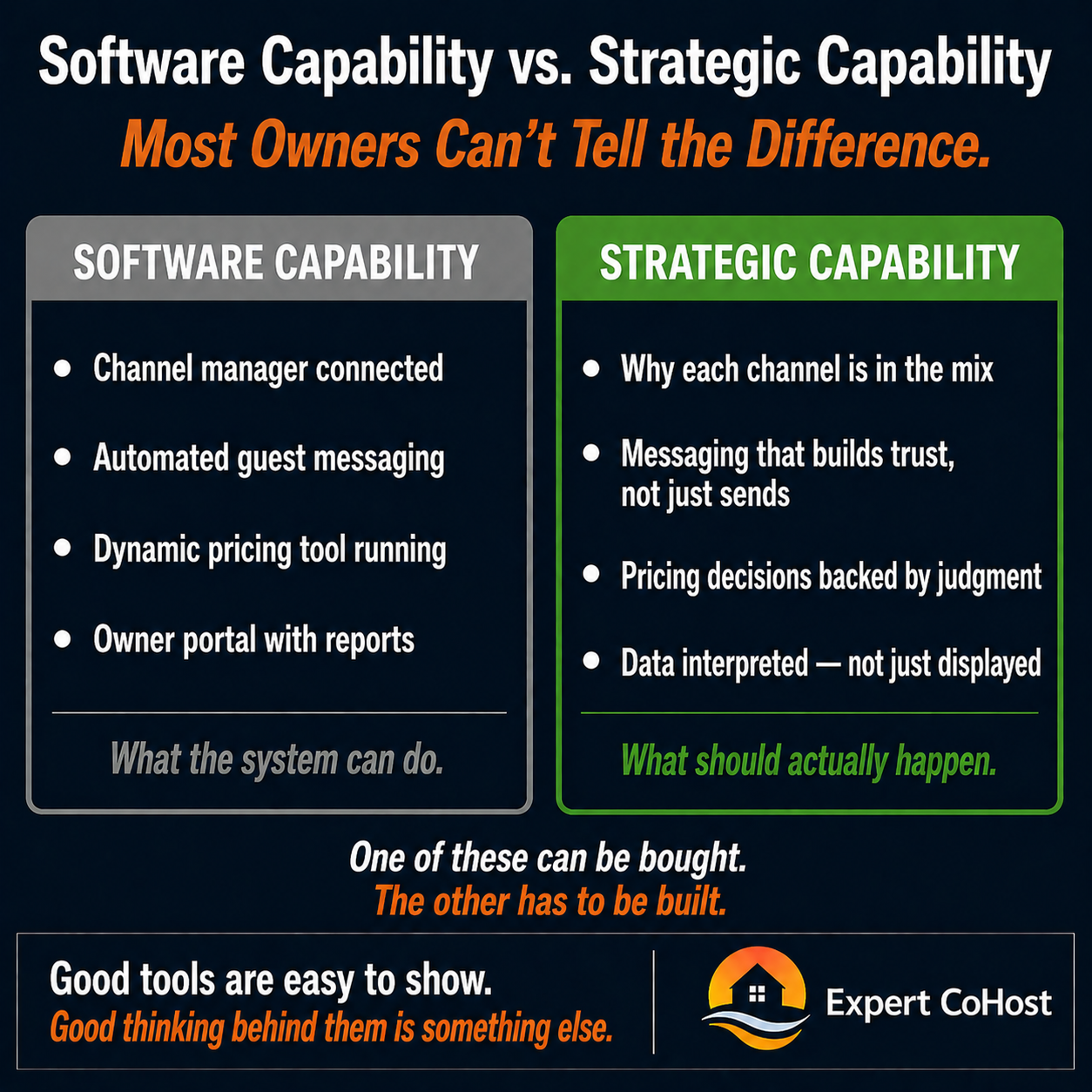
Because software capability and strategic capability are not the same thing.
Not even close.
A property manager can have impressive tools and still make shallow decisions. They can have strong software and weak judgment. They can have modern systems and still manage a property with very little real thought about positioning, guest fit, distribution, communication, operational tradeoffs, or long-term asset health.
That distinction matters more than most owners realize.
Because one of the easiest ways to create the appearance of expertise in this industry is to stack good software on top of mediocre thinking.
And a lot of property managers do exactly that.
Good Software Can Make Weak Management Look Strong
This is the first thing owners need to understand.
Software can create the appearance of sophistication very quickly.
A manager can connect the property to multiple platforms.
They can automate guest messages.
They can use pricing tools.
They can sync calendars.
They can send digital guidebooks.
They can route turnovers and maintenance tasks through apps.
They can offer an owner portal with reports and dashboards.
All of that is useful.
It can absolutely improve an operation.
But none of it proves the manager is thinking strategically.
That is the key distinction.
Because software helps execute.
It does not automatically decide well.
And many property managers rely on that confusion.
They want owners to assume that because the operation looks technologically advanced, it must also be strategically advanced.
That is not a safe assumption.
Software Makes Things Possible. Strategy Decides What Should Happen.
This is the clearest way to think about it.
Software capability is about what the system can do.
Can it connect channels?
Can it automate pricing updates?
Can it send messages?
Can it manage check-ins?
Can it support direct bookings?
Can it centralize tasks and communication?
Those are capability questions.
Strategic capability is different.
Should the property be on that channel?
What pricing approach actually fits the asset?
What message tone builds trust instead of friction?
What kind of guest is the property best suited for?
What should be automated and what should stay more hands-on?
What systems protect the guest experience as complexity rises?
Those are judgment questions.
And judgment is where the real value lives.
A manager who has software but lacks judgment is still limited.
In some cases, they are just a limited manager with better tools.
A Channel Manager Is Not a Distribution Strategy
This is one of the most common examples of the confusion.
A lot of property managers have software that lets them distribute listings broadly across multiple booking channels.
That sounds sophisticated.
And again, it can be useful.
But a channel manager is not a distribution strategy.
It is a tool that supports distribution.
That difference matters.
Because the software can push a property to Airbnb, Vrbo, Booking.com, Google Vacation Rentals, a direct-booking site, and maybe more.
But it cannot answer the deeper questions:
Why is the property on each one?
What role is each one supposed to play?
How much complexity is too much?
What kind of booking mix is healthiest?
Which channels are worth keeping?
Which ones are creating more noise than value?
Those are strategic decisions.
A lot of property managers blur that line because it helps them sound more advanced than they really are.
Owners should not let them.
Automated Messaging Is Not Guest Communication Strategy
This is another place weak thinking hides behind good tools.
A manager may have beautifully automated guest messaging.
The messages go out on time.
The check-in instructions are triggered automatically.
The reminders are scheduled.
The templates are built.
That all sounds good.
But automation is not the same as communication strategy.
The important questions are still:
Does the tone build trust?
Does the sequence reduce confusion?
Does the information arrive when the guest actually needs it?
Does the messaging feel polished, calm, and confidence-building?
Does it anticipate friction, or just react to it?
Those are not software questions.
They are strategy questions.
A manager can automate weak messaging just as easily as strong messaging.
In fact, weak thinking often scales very efficiently when good software is involved.
That is part of the problem.
Dynamic Pricing Software Is Not Revenue Strategy
This is another major one.
A lot of property managers like to point to pricing software as evidence that revenue management is being handled intelligently.
Sometimes it is.
But not automatically.
Pricing software can adjust rates.
It can respond to demand signals.
It can suggest changes.
It can help automate parts of pricing execution.
That is useful.
But revenue strategy is still a human judgment function.
How aggressively should the property be priced?
What is the positioning strategy?
What occupancy tradeoffs are acceptable?
When should the manager protect rate instead of chasing occupancy?
How should seasonality, stay patterns, and guest quality factor into pricing decisions?
Those are strategic decisions.
The software can support them.
It cannot replace them.
A weak manager with pricing software does not become a revenue strategist just because the rates are updating automatically.
A Direct-Booking Website Is Not a Direct-Booking Strategy
This confusion shows up constantly.
A property manager launches a direct-booking site and suddenly starts talking as though direct demand is now part of the business model in a meaningful way.
Maybe it is.
But not necessarily.
A website is a tool.
A direct-booking strategy requires much more:
-
visibility
-
search presence
-
trust
-
branding
-
repeat guest systems
-
referral pathways
-
confidence in the booking process
-
follow-up and retention
Without those things, the site is just infrastructure waiting for a strategy.
This is a good example of the broader problem.
Software can create the shell of a capability.
Strategy is what makes that capability real.
Owners should understand the difference.
Dashboards and Reports Are Not Insight
A lot of managers also hide behind reporting.
They offer dashboards.
They offer owner portals.
They provide charts, metrics, and financial summaries.
That can be helpful.
But having data visible is not the same as having insight.
The strategic question is not whether the manager can show numbers.
It is whether they can interpret them well.
Can they explain why performance is changing?
Can they connect channel decisions to guest quality and operational smoothness?
Can they explain whether the booking mix is getting healthier or just busier?
Can they identify whether the property is becoming too dependent on one platform?
Can they make good decisions based on what the data is really saying?
That is a very different level of value.
Software displays information.
Strategic capability turns information into judgment.
Software Capability Without Strategy Often Creates Expensive Noise
This is one of the reasons the distinction matters so much.
Weak managers with modern tools can create a lot of motion.
The property is live in more places.
The rates are moving.
The messages are automated.
The reports are flowing.
The workflows are active.
Everything looks busy.
Everything looks efficient.
Everything looks professional.
And yet the operation may still be underthinking the fundamentals.
Wrong channels.
Weak positioning.
Generic messaging.
Poor-fit bookings.
Too much complexity.
Shallow direct-booking efforts.
Weak guest confidence.
Little real refinement over time.
That is not strong management.
That is just expensive noise running through good systems.
Owners should be very careful not to mistake movement for depth.
Strong Managers Use Software as Leverage, Not as a Substitute for Thought
This is what owners should actually be looking for.
The best property managers do not reject software.
They use it well.
But they understand its role.
Software should support strategy.
It should increase consistency.
It should reduce manual drag.
It should help strong decisions scale.
It should make thoughtful management more powerful.
It should not replace thinking.
That is the difference.
A strong manager asks:
What should happen here, and how can technology help us do it well?
A weak manager asks:
What can the system do, and how can we make that sound strategic?
Those are very different mindsets.
And the second one is much more common than owners realize.
What Owners Should Ask to See the Difference
Owners do not need to become software experts.
But they should ask sharper questions.
For example:
How are you using your software to support a specific strategy for my property?
What decisions are being made by judgment rather than default settings?
What are the biggest strategic choices behind my pricing, distribution, and guest communication?
How do you know your automations are improving the guest experience rather than just saving time?
How do you decide when the software’s default approach is not good enough?
What parts of management still require active human thinking and refinement?
Those questions matter because they reveal whether the manager sees software as a tool or as a shield.
A strong manager will usually answer with clarity.
A weak one often falls back on features.
The Bigger Point
Technology is not the problem.
Good software is often a real advantage.
The problem is the industry’s tendency to confuse technological polish with strategic depth.
That is where owners get misled.
A manager can have a very modern operation and still make mediocre decisions.
A manager can have strong tools and weak judgment.
A manager can sound advanced while still relying on defaults, automation, and broad software capability to cover up shallow thinking.
That is the risk.
And it is exactly why owners need to understand the difference between software capability and strategic capability.
Because one can be bought.
The other has to be built.
Final Thought
Most property managers do not fail because they lack software.
They fail because they mistake software for strategy.
They believe that connected systems, automation, pricing tools, direct-booking engines, and channel integrations are enough to create a sophisticated business.
They are not.
Those things can support good management.
They can amplify it.
But they cannot replace judgment, positioning, channel strategy, guest-experience thinking, communication quality, or operational discipline.
That is what owners should be paying for.
Not just better tools.
Better thinking behind the tools.