
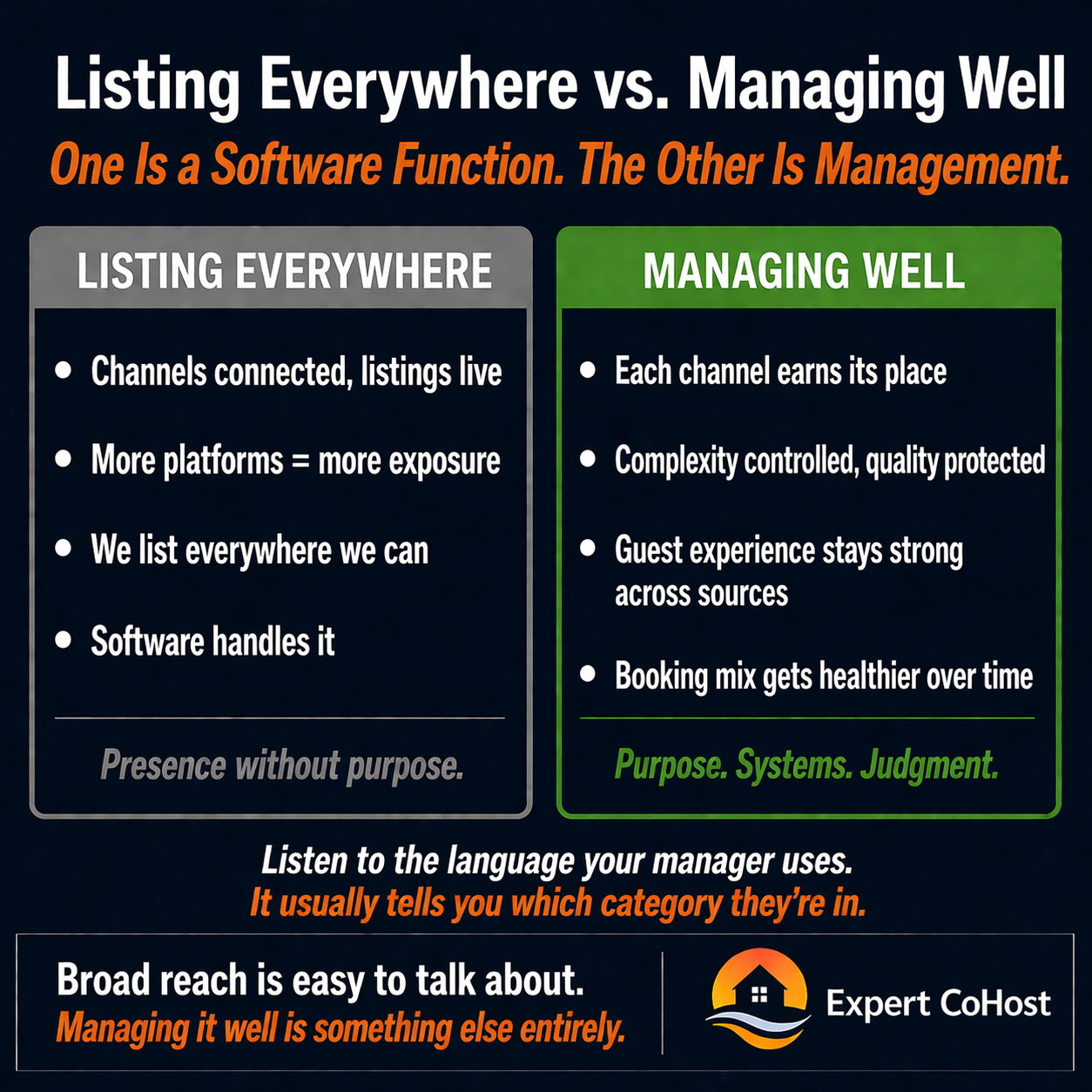
A lot of property managers want owners to be impressed by one thing:
Exposure.
Your property is on Airbnb.
It is on Vrbo.
It is on Booking.com.
It may be on Google Vacation Rentals.
There may be a direct-booking site.
There may even be specialty or curated channels in the mix.
To many owners, that sounds like strong management.
It sounds modern.
It sounds sophisticated.
It sounds like the property is being aggressively marketed and intelligently positioned.
But there is a problem.
Listing a property in a lot of places is not especially hard anymore.
Managing distribution well is.
And the difference between those two things is much larger than many owners realize.
Because one is mostly a software function.
The other is a management function.
And many property managers are much stronger at the first one than the second.
Listing a Property Everywhere Is Mostly About Connectivity
This is the first thing owners should understand.
Today, a lot of managers have access to software that makes broad listing distribution fairly easy.
Connect the channels.
Sync the calendars.
Push the rates.
Map the listing details.
Turn things on.
That is useful.
It absolutely has value.
But it should not be confused with strategic depth.
Because none of that, by itself, answers the harder questions.
Why is the property on each channel?
What role is each one supposed to play?
What kind of guest is each one likely to bring?
How is complexity being controlled?
How is quality being protected as visibility expands?
How is the booking mix becoming healthier over time?
Those are the questions software does not answer.
That is management.
And that is where the real difference begins.
Distribution Is Easy to Expand and Easy to Mismanage
This is what makes the issue so important.
It is easier than ever to create the appearance of sophistication.
A manager can point to a wide set of platforms and say:
Look how much reach your property has.
And sometimes that reach is useful.
But wider distribution also creates more moving parts.
More guest entry points.
More listing contexts.
More communication paths.
More pricing considerations.
More chances for mismatch.
More chances for friction.
More opportunities for weak execution to show up.
That means broader distribution is not automatically a sign of stronger management.
In some cases, it is simply a sign that the manager has more software than judgment.
Owners should understand that.
Listing Everywhere Focuses on Presence
Managing distribution well focuses on purpose.
That is the cleanest way to explain the difference.
Weak property managers tend to think in terms of presence.
Are we on the channel?
Is the listing live?
Is availability synced?
Can a guest book there?
That is the baseline.
But it is not strategy.
Strong managers think in terms of purpose.
Why are we on this channel?
What does it contribute?
What kind of demand does it create?
How does it fit the property?
What complexity does it introduce?
Is it improving the booking mix or just adding movement?
That is a very different way of thinking.
And it is usually what separates thoughtful operators from managers who are simply distributing inventory broadly and hoping for the best.
Listing Everywhere Treats Channels Like Duplicates
Managing distribution well understands that channels do different jobs.
This is one of the biggest gaps in the industry.
A weak manager often treats channels like interchangeable traffic sources.
More places.
More eyeballs.
More chances to book.
That sounds logical.
But it is too shallow.
Different channels can create different expectations.
Different channels can attract different booking behavior.
Different channels can serve different roles in the booking funnel.
Different channels can support different property types, stay types, and long-term goals.
That means a real manager should not just know how to turn a channel on.
They should know what that channel is actually for.
Because if every channel is treated the same, then the distribution strategy is probably not very strategic.
It is just broad.
Listing Everywhere Often Ignores Tradeoffs
This is another major difference.
A lot of weak managers sell the upside of broad distribution without talking honestly about the tradeoffs.
They talk about more exposure.
They talk about more opportunities.
They talk about more bookings.
What they often do not talk about is what broader distribution can also create:
-
more complexity
-
more chances for inconsistent expectations
-
more operational strain
-
more guest communication pressure
-
more opportunities for listing-quality drift
-
more risk that volume increases faster than systems mature
That does not mean wider distribution is bad.
It means real management requires the ability to weigh upside against complexity.
A weak manager adds channels because they can.
A strong manager adds channels when they should.
That is a big difference.
Listing Everywhere Relies on Software
Managing distribution well relies on systems.
This is where weak managers get exposed.
A lot of them hide behind their tools.
They have integrations.
They have automations.
They have channel managers.
They have property management systems.
They have connected software.
And all of that can make the operation sound sophisticated.
But software is not the same thing as systems.
Systems are what protect quality after the channels multiply.
Systems are what keep pricing disciplined.
Systems are what keep listing content accurate.
Systems are what keep communication timely and clear.
Systems are what make sure pre-arrival information stays strong.
Systems are what prevent broad distribution from creating a worse guest experience.
Systems are what allow complexity to rise without letting performance slip.
That is not just a tech issue.
That is management depth.
Listing Everywhere Can Create Activity Without Creating Strength
This is an important idea for owners.
A property can get busier without getting healthier.
It can have more exposure without becoming more resilient.
It can have more bookings without having a better booking mix.
It can have more channel presence without developing stronger long-term performance.
That is why owners should be careful not to confuse movement with strength.
A weak distribution approach often creates a lot of visible activity.
The listings are live.
The channels are active.
The software is working.
Bookings are coming in.
But that still does not tell you whether the channel mix is good, whether the guest fit is improving, whether dependence is being reduced, whether direct demand is strengthening, or whether the overall health of the asset is becoming more stable.
That is the deeper standard.
And many managers do not operate at it.
Managing Distribution Well Means Making Deliberate Choices
A real manager does not just accumulate channels.
They make choices.
They choose where the property belongs.
They choose what role each platform should play.
They choose what not to use.
They choose how much complexity the operation can support well.
They choose how to balance visibility, control, guest fit, and resilience.
That is what owners should expect.
Not just channel count.
Judgment.
Because good distribution is not just about adding.
It is also about filtering, refining, and sometimes saying no.
A manager who never removes a channel, never questions a channel, and never explains the logic behind the mix is probably not doing much real strategy.
They are just expanding presence.
Managing Distribution Well Protects the Guest Experience
This is one of the biggest differences of all.
Weak managers often think of distribution mostly as a marketing or visibility issue.
Strong managers understand that distribution affects operations too.
Every new booking source has the potential to shape guest expectations differently. Every new channel adds another path into the stay experience. Every new layer of complexity increases the chances that communication, check-in, pricing clarity, or expectation-setting can weaken if the systems are not strong enough.
That means real distribution management is partly guest-experience management.
A strong manager knows that broader reach is only valuable if the guest experience stays strong after the booking happens.
A weak manager often ignores that until reviews, friction, or performance issues start to show up.
By then, the damage is already visible.
Managing Distribution Well Builds Long-Term Resilience
This is another distinction owners should care about.
Weak distribution strategy often focuses on short-term booking activity.
Strong distribution strategy builds long-term resilience.
It reduces overdependence on one platform.
It creates healthier channel balance.
It supports direct demand over time.
It strengthens search visibility where appropriate.
It gives the property more than one way to win.
It helps protect the asset from sudden channel volatility.
That is a very different objective from simple listing expansion.
And it is much more valuable.
Because the point is not just to get more bookings this month.
The point is to build a healthier business around the property over time.
What Owners Should Listen for in a Property Manager’s Language
This is a practical way to spot the difference.
Weak managers often say things like:
“We list everywhere.”
“We maximize exposure.”
“We push your property to all the major channels.”
“We have the software to distribute broadly.”
That may be true.
But it does not tell you very much.
Stronger managers tend to say things like:
“This is why your property is on these channels.”
“This is what each one is supposed to contribute.”
“This is how we control complexity as distribution expands.”
“This is how we protect the guest experience.”
“This is how we reduce dependence and strengthen the booking mix over time.”
That is the language of actual management.
Owners should notice the difference.
The Bigger Point
The industry makes it very easy to confuse syndication with strategy.
That is the real problem.
Because software has made syndication more accessible, many managers now offer broad channel presence that looks impressive from the outside.
But the difficult part was never simply getting the listing into more places.
The difficult part is managing the consequences of that reach well.
That means controlling complexity.
Protecting quality.
Choosing channels intentionally.
Evaluating tradeoffs.
Supporting direct demand where appropriate.
Keeping the guest experience strong no matter where the booking came from.
That is real distribution management.
And it is not nearly as common as owners should assume.
Final Thought
Listing a property everywhere is easy to talk about.
Managing distribution well is much harder.
One is mostly about software, connectivity, and presence.
The other is about judgment, systems, guest experience, channel purpose, tradeoffs, and long-term asset health.
That is the difference owners should care about.
Because a property manager who knows how to list broadly is not necessarily a property manager who knows how to build a strong distribution strategy.
And those are two very different levels of value.