
A lot of property managers know how to sound strategic.
They talk about visibility.
They talk about reach.
They talk about being on multiple channels.
They mention Airbnb, Vrbo, Booking.com, direct bookings, Google visibility, maybe even a few premium or specialty platforms.
To most owners, that sounds reassuring.
It sounds modern.
It sounds sophisticated.
It sounds like the property is being handled by someone who understands distribution.
But there is a problem.
A lot of that language is easy to say.
And some of the people saying it are not actually managing distribution with much depth at all.
They are syndicating listings.
They are pushing inventory through software.
They are turning channels on.
They are repeating industry language that sounds strategic.
That is not the same thing as having a real distribution strategy.
And if owners want to know the difference, they need to ask better questions.
Why This Matters More Than Many Owners Realize
Distribution is not a side issue.
It affects who sees the property.
It affects where bookings come from.
It affects guest expectations.
It affects channel dependence.
It affects operational complexity.
It affects the long-term health of the booking mix.
That means weak distribution strategy can quietly create a lot of damage.
A property may be visible but poorly positioned.
Widely listed but badly managed.
Busy but dependent on the wrong channels.
Active but not resilient.
That is why owners should not settle for vague language.
If a manager cannot explain the strategy behind the distribution, there may not be much strategy there at all.
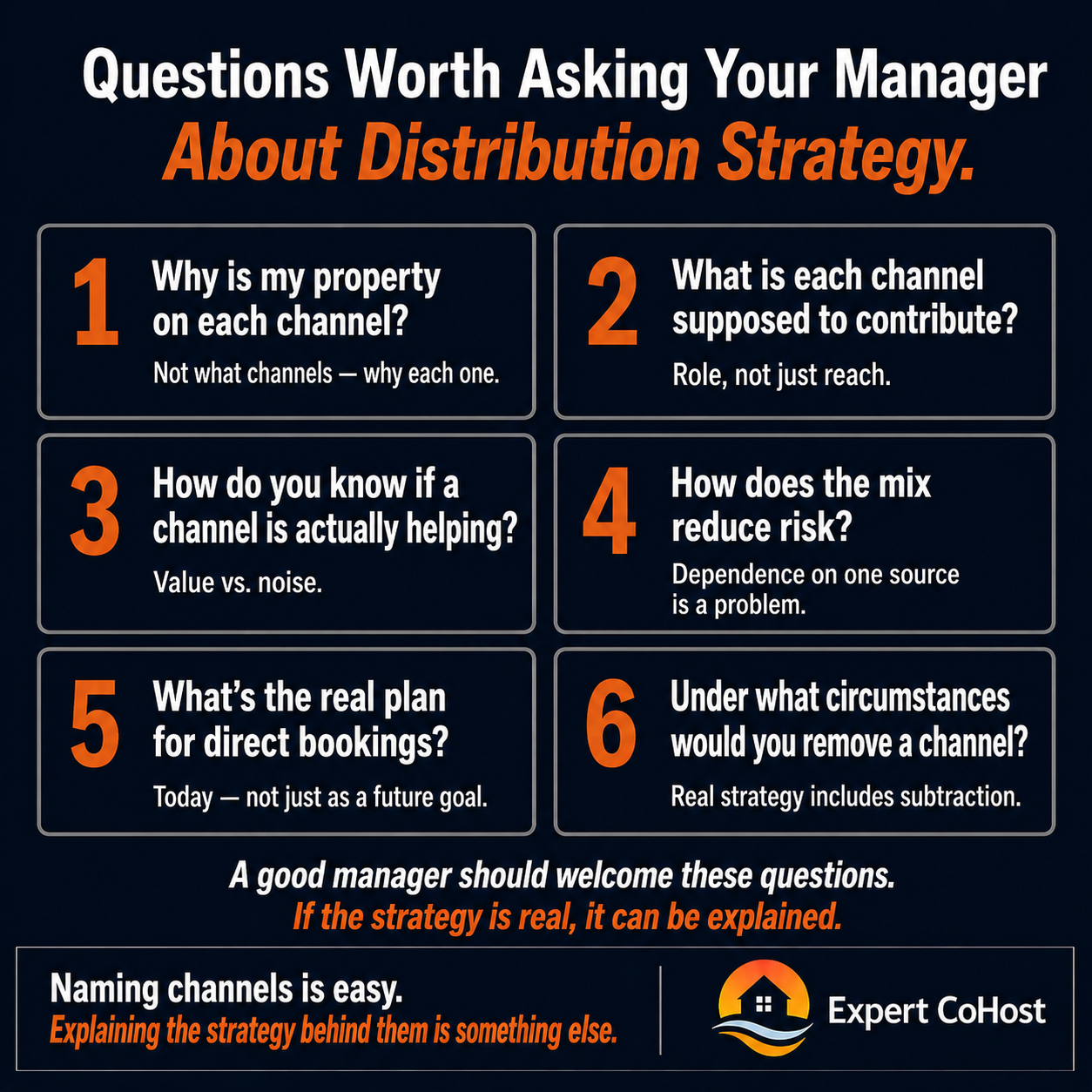
The First Question: Why Is My Property on Each Channel It Is On?
This is one of the simplest and most important questions an owner can ask.
Not:
What channels are you using?
But:
Why is my property on each one?
That question forces the manager to move beyond naming platforms.
A strong answer sounds like strategy.
A weak answer sounds like habit.
A strong manager should be able to explain what role each channel plays. Why Airbnb matters. Why Vrbo matters. Whether Booking.com belongs in the mix. Whether Google visibility matters. Whether direct bookings are realistic and how they are being developed. Whether specialty or premium channels have a role.
If the answer is basically:
“We put all our listings everywhere we can,”
that is not a strategy.
That is distribution by default.
The Second Question: What Is Each Channel Supposed to Contribute?
This question goes one level deeper.
It is not enough for the manager to say your property is on several platforms.
They should be able to explain what each one is supposed to add.
Is one channel helping with broad consumer visibility?
Is one helping diversify away from overdependence on another?
Is one useful for a certain type of traveler?
Is one mainly supporting discovery?
Is one supporting direct-booking growth over time?
Is one better for medium-term stays?
Is one only relevant if the property meets a more selective standard?
That is what channel judgment looks like.
Without that, the manager may be managing software connections, not strategy.
The Third Question: How Do You Decide Whether a Channel Is Actually Helping?
This is where a lot of managers start to get uncomfortable.
Because many of them know how to add channels, but not necessarily how to evaluate them thoughtfully.
Owners should ask:
How do you know whether a platform is adding real value or just adding complexity?
That is an important question.
A channel can create visibility without creating better bookings.
It can produce activity without improving the booking mix.
It can generate more demand while also increasing confusion, friction, or operational drag.
A strong manager should understand that.
They should be able to explain how they judge whether a channel is truly useful for the property instead of assuming that more exposure is always automatically better.
The Fourth Question: How Does My Channel Mix Reduce Risk?
This is a very smart owner question.
Because one of the biggest hidden problems in vacation-rental distribution is concentration risk.
If too much performance depends on one channel, then policy changes, ranking shifts, fee changes, seasonality, or platform-level volatility can hit the property harder than they should.
Owners should ask:
How does my distribution strategy reduce dependence on any one platform?
A strong manager should be able to explain whether your property has a healthy mix, whether there is too much reliance on one source, and how broader channel strategy supports resilience.
A weak manager often has never thought about the issue very deeply.
The Fifth Question: What Systems Do You Have in Place to Support Wide Distribution?
This is one of the most important questions in the entire conversation.
Because a lot of managers talk confidently about broad exposure without talking honestly about the complexity that comes with it.
Every new channel can create more:
-
message paths
-
booking patterns
-
guest expectations
-
settings to manage
-
listing details to maintain
-
operational opportunities for friction
That means owners should ask:
What systems do you have in place to make sure wide distribution does not weaken pricing, communication, guest experience, or operations?
This is where real management depth starts to show.
A strong manager will talk about process, consistency, oversight, guest communication, listing quality, and channel-aware operational discipline.
A weak manager will usually retreat into vague language about software.
The Sixth Question: How Do You Prevent Distribution Complexity From Hurting the Guest Experience?
This question is better than many owners realize.
A lot of managers treat distribution like a marketing issue only.
But distribution affects operations too.
The more booking channels a property has, the more chances there are for:
-
mixed expectations
-
unclear information
-
different booking behaviors
-
communication gaps
-
check-in friction
-
inconsistent support
That means owners should ask:
How do you make sure broader distribution does not create a worse guest experience?
If the manager has not thought about that, then the strategy is probably not nearly as mature as it sounds.
The Seventh Question: How Do You Refine Performance by Channel Over Time?
This question separates active management from passive setup.
A lot of managers launch listings and then basically leave them alone unless something obvious goes wrong.
That is not real optimization.
Owners should ask:
How do you monitor and improve the performance of each channel over time?
That might include:
-
whether the listing presentation is being refined
-
whether certain channels are producing more friction
-
whether some channels are delivering better-fit bookings
-
whether messaging is being improved
-
whether the mix should change seasonally or strategically
A strong manager should be able to explain how channel strategy evolves.
A weak one often treats distribution like a one-time setup.
The Eighth Question: What Is the Plan for Direct Bookings?
This is a very revealing question.
Almost every property manager likes to mention direct bookings.
Far fewer are building them seriously.
Owners should ask:
What is the real plan for direct bookings, and what exists today versus what is just a future goal?
That question matters because it exposes the difference between aspiration and execution.
A strong manager should be able to talk about:
-
repeat guests
-
referrals
-
website trust
-
search visibility
-
brand-building
-
long-term independence from pure third-party reliance
A weak manager usually just repeats general benefits without a real path behind them.
The Ninth Question: What Would Make You Remove a Channel?
This is one of the most underrated questions an owner can ask.
Why?
Because it reveals whether the manager thinks critically or just accumulates channels by default.
Owners should ask:
Under what circumstances would you decide a channel is not worth using for my property?
That is a smart question because real strategy includes subtraction, not just addition.
A strong manager knows that not every channel belongs in every mix forever.
A weak manager often acts as though every extra channel must be positive simply because it exists.
That is not disciplined thinking.
The Tenth Question: How Does My Distribution Strategy Support the Long-Term Health of the Asset?
This is the big one.
Not just:
How do we get bookings?
But:
How does the distribution strategy support the long-term health, resilience, and value of the property?
That question changes the conversation.
It pushes beyond raw activity and into bigger concerns:
Is the property too dependent on one source?
Is the guest mix healthy?
Is the booking mix resilient?
Are direct relationships being built?
Is the brand getting stronger?
Are systems improving as the strategy expands?
That is the level owners should care about.
Because a lot of managers know how to create motion.
Far fewer know how to create durable strength.
What Strong Answers Sound Like
Owners do not need their property manager to sound academic.
But strong answers usually have certain qualities.
They are specific.
They are thoughtful.
They explain roles, not just channels.
They connect distribution to guest experience and operations.
They show that the manager is evaluating tradeoffs, not just adding exposure.
They make it clear that the channel mix is intentional.
That is what confidence should sound like.
Not buzzwords.
Not name-dropping platforms.
Not general claims about visibility.
Real clarity.
What Weak Answers Sound Like
Weak answers usually have a pattern too.
They are vague.
They rely on generic claims about more exposure.
They avoid specifics.
They sound heavily dependent on software language.
They do not explain tradeoffs.
They do not show much thought about guest fit, channel purpose, or long-term resilience.
Sometimes the manager still sounds polished.
That is what makes this tricky.
But polish is not the same as depth.
Owners should remember that.
The Bigger Point
Owners do not need to become experts in every booking platform.
But they do need to stop confusing activity with strategy.
A lot of managers can connect channels.
Far fewer can explain, with real clarity, why those channels are in the mix, what they are supposed to do, how the complexity is being controlled, and how the strategy is making the property stronger over time.
That is the real difference.
And the only way to see it clearly is to ask better questions.
Final Thought
A good property manager should not be threatened by thoughtful questions about distribution.
They should be ready for them.
Because if the strategy is real, it can be explained.
And if it cannot be explained clearly, owners should at least consider the possibility that what looks like sophisticated distribution may really just be simple listing syndication dressed up in modern language.
That is a distinction worth understanding.
Especially when the performance of the asset depends on it.