
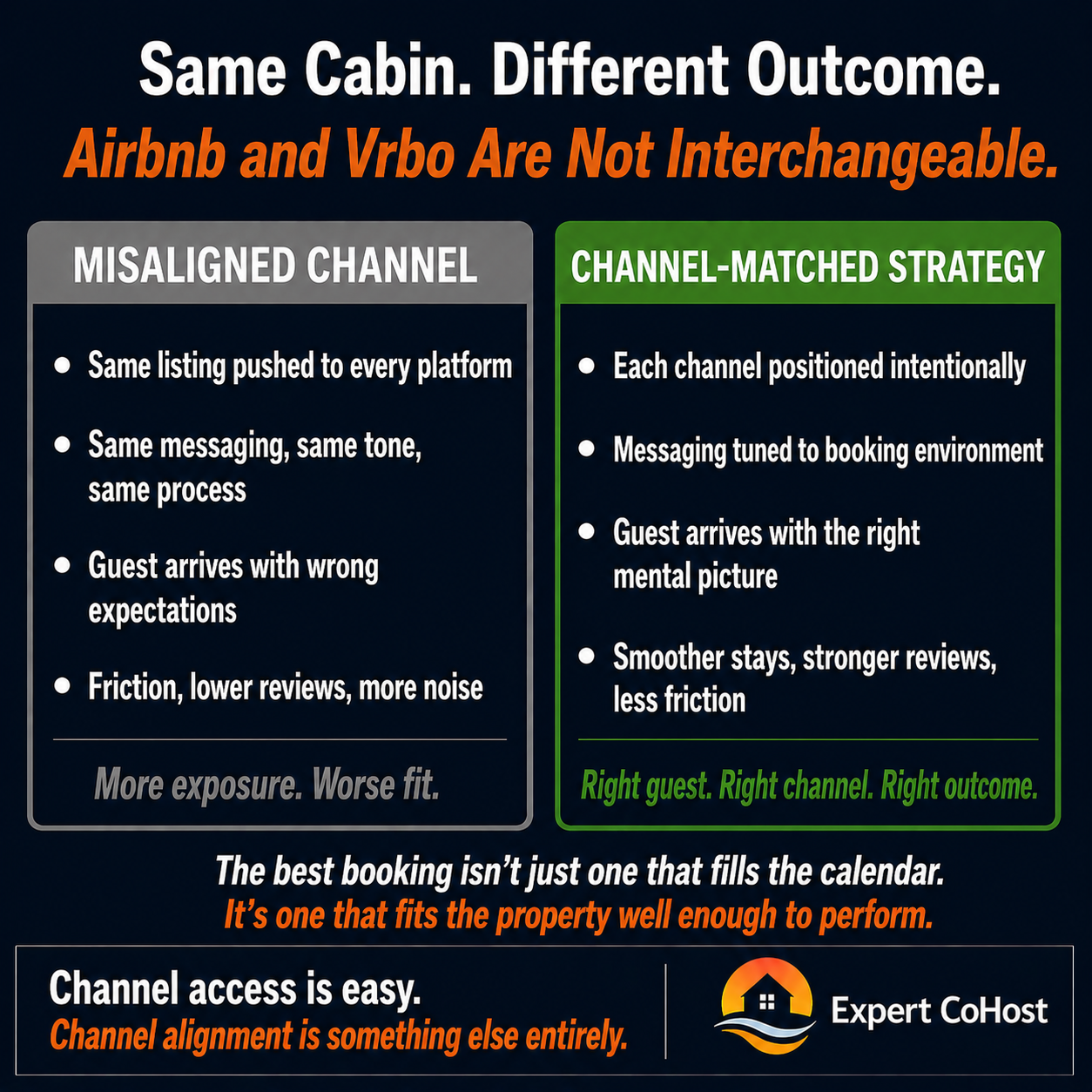
Many owners treat Airbnb and Vrbo as if they are simply two versions of the same thing.
List the same property on both. Sync the calendars. Use the same photos. Use the same pricing logic. Use the same messaging. Then wait for the bookings to come in.
On the surface, that seems reasonable.
But it misses something important.
Airbnb and Vrbo are not just two websites where travelers happen to find vacation rentals. They are two different booking environments, and those environments can shape guest expectations, booking behavior, and property performance in different ways.
That matters more than most owners realize.
Because when owners think of channels as interchangeable, they often make a costly mistake: they assume that if a property underperforms on one platform, the answer is simply more exposure. In reality, the issue may be that the property, the guest, and the platform are not aligned.
Same cabin.
Same market.
Same stay dates.
Different channel.
Different outcome.
The Mistake Many Owners Make
A lot of owners compare Airbnb and Vrbo in overly simple terms.
They ask:
-
Which one has more users?
-
Which one charges lower fees?
-
Which one gives me more visibility?
-
Which one should I prioritize first?
Those are not bad questions. But they are incomplete.
The better question is this:
What kind of booking behavior does each channel tend to produce, and how does that interact with my property, my systems, and my guest experience?
That is where the real difference starts.
Because bookings do not arrive in a vacuum. They arrive with assumptions attached. And those assumptions affect everything that happens next.
The Channel Shapes the Guest Before They Arrive
By the time a guest books, they have already formed expectations.
Not just about the property itself, but about the overall experience.
They have expectations about how professional the communication will feel. How polished the check-in process will be. How quickly small issues will be resolved. Whether the stay will feel casual, transactional, or highly managed. Whether the property will feel exactly as presented, or just close enough.
Owners often focus only on the listing.
But the platform helps shape the lens through which the listing is interpreted.
That means two guests can book the same property, pay similar rates, and still arrive with very different mental frameworks.
And when expectations are different, the same experience is not judged the same way.
The Same Cabin Can Perform Differently on Different Channels
This is where many owners get confused.
They assume that if a property looks good and is priced correctly, performance should be roughly the same everywhere.
But often, it is not.
Because performance is not only a function of the property. It is also a function of the fit between:
-
the guest’s expectations
-
the booking environment
-
the communication style
-
the arrival experience
-
the way small frictions are perceived
That last point matters a lot.
The same friction can feel minor to one guest and trust-breaking to another.
A slightly unclear parking instruction.
An entry process that takes a few extra minutes.
A thermostat setting that feels off on arrival.
A place that technically matches the photos but does not feel as ready as the guest expected.
These issues do not affect every guest equally.
And they do not affect every channel equally either.
That is why owners sometimes say things like:
“Everything is the same, but somehow the guests from one platform seem easier.”
Or:
“The bookings are coming in, but the quality of the experience feels less predictable on one channel.”
That is not always luck.
Sometimes it is channel fit.
Airbnb and Vrbo Do Not Always Bring the Same Booking Behavior
This is where the difference becomes practical.
Even when the property is the same, the guest may not be.
Some channels may produce guests who book more quickly and with less deliberation. Others may produce guests who compare options more carefully before committing. Some guests arrive expecting a more app-driven, highly streamlined experience. Others may behave more like traditional vacation renters evaluating a specific home for a specific trip.
Those differences influence what matters most.
On one channel, speed and ease may matter more. On another, reassurance and clarity may matter more. One booking source may be more forgiving of small imperfections if the experience feels intuitive. Another may be more sensitive to anything that creates uncertainty before arrival.
The point is not that one platform always brings one type of guest and the other always brings another.
The point is that the booking environment shapes expectations, and expectations shape outcomes.
More Exposure Is Not Always Better Exposure
One of the most common assumptions in short-term rentals is that wider distribution automatically improves results.
Sometimes it does.
But not always.
More exposure only helps when the added exposure is bringing in the right bookings for the property and the systems behind it.
If it brings in more mismatched expectations, more avoidable friction, or more guests who interpret the experience through a different lens than the property is designed to satisfy, broader distribution can create noise instead of strength.
This is why channel strategy matters more than many owners think.
A property is not just competing for clicks.
It is competing for alignment.
The best booking is not simply the one that fills the calendar.
It is the one that fits the property well enough to produce a smooth stay, a strong review, and a repeatable outcome.
Why This Matters Operationally
When owners think Airbnb and Vrbo are interchangeable, they often standardize too aggressively.
They use the same positioning.
The same message flows.
The same assumptions about guest education.
The same arrival process.
The same tone.
The same follow-up cadence.
That sounds efficient.
But efficiency is not always the same as effectiveness.
Different channels can reward different strengths and expose different weaknesses.
A property with strong visuals may convert well on one platform but still struggle if the operational experience does not support the expectations created there. A property with excellent systems may perform better where clarity, reliability, and consistency matter more than emotional merchandising alone.
This is where many owners misdiagnose the problem.
They think they have a pricing issue.
Or a photography issue.
Or a ranking issue.
Sometimes they do.
But sometimes the real issue is that they are treating all channel traffic as equal when it is not.
Fees Are Not the Main Question
A lot of owners start with fees because fees feel concrete.
But channel performance is not decided by fee percentage alone.
What matters more is what happens after the booking arrives.
Does the guest arrive with the right expectations?
Does the communication flow reinforce trust?
Does the property experience match the mental picture created before arrival?
Do small issues get interpreted as manageable, or as signs that something feels off?
Those are the questions that affect outcomes.
Because the real cost of a channel mismatch is not just a line item.
It can show up as:
-
more guest hand-holding
-
more pre-arrival confusion
-
more friction at check-in
-
more reactive messaging
-
lower review consistency
-
more operational stress
-
less reliable long-term performance
That is a much bigger issue than comparing percentages in a vacuum.
What Owners Should Actually Compare
If you want to compare Airbnb and Vrbo well, start here:
-
Which channel brings the smoother guest experience for this property?
-
Which one produces fewer pre-arrival questions?
-
Which one creates less check-in friction?
-
Which one gives you more predictable reviews?
-
Which one aligns better with the type of stay this property delivers?
Those answers are often more useful than raw visibility or fee comparisons.
The Better Question
There is no universal answer to whether Airbnb or Vrbo is “better.”
That is the wrong question.
The better question is:
Which channel is the better fit for this specific property, this specific guest experience, and this specific operating model?
Airbnb and Vrbo may both generate bookings.
But a booking is not the end of the sales process. It is the beginning of the guest experience.
And the guest experience is where performance is actually decided.
So if the same property seems to perform differently across Airbnb and Vrbo, do not assume it is random.
Look deeper.
Look at the type of expectations each channel may be creating. Look at how those expectations interact with your communication style, your check-in process, your guest experience, and your operational consistency.
Because the real difference between Airbnb and Vrbo is not just where the booking came from.
It is what the guest believed they were booking before they ever arrived.
And in short-term rentals, that difference can change everything.