
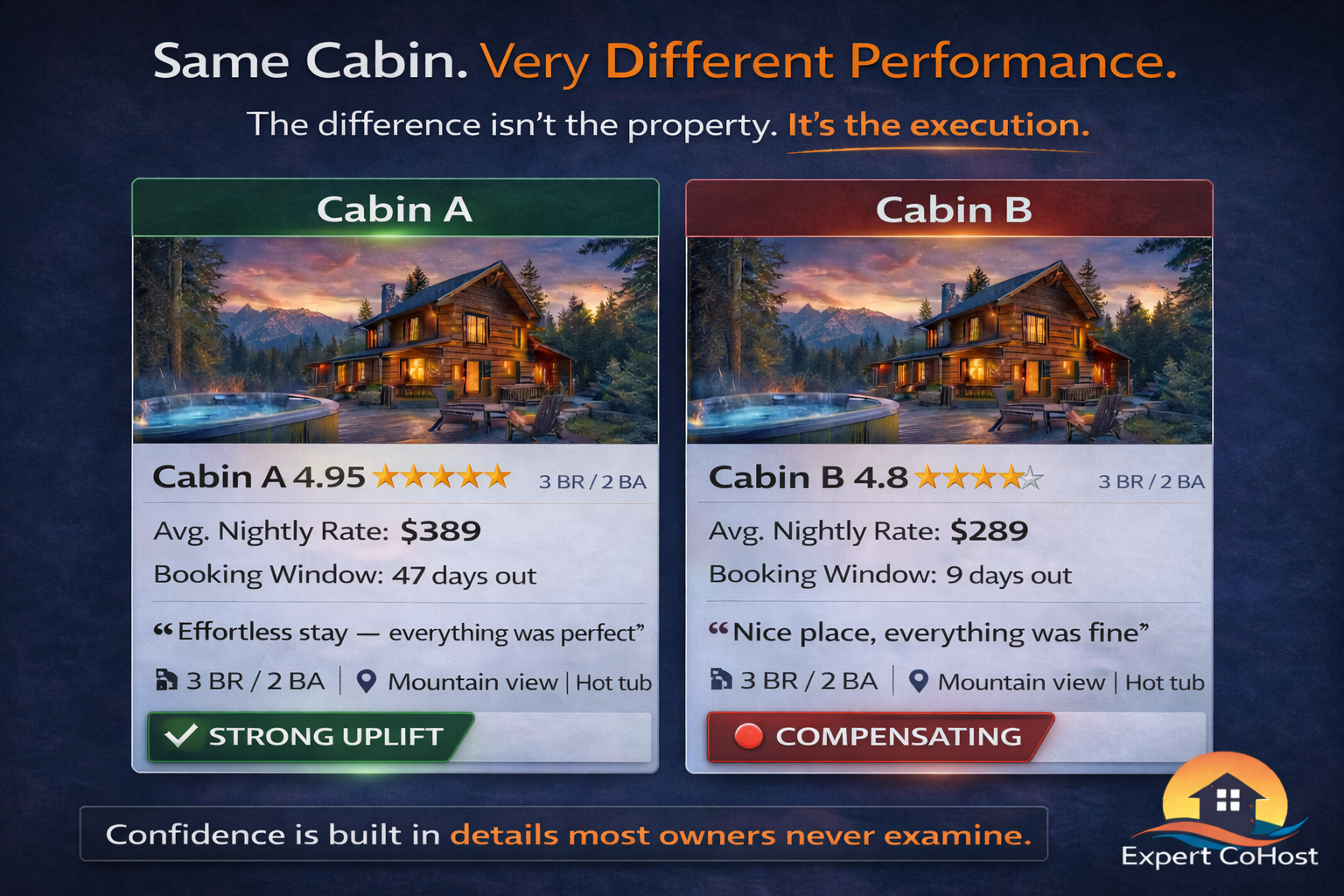
Two cabins.
Same neighborhood.
Same bedroom count.
Similar square footage.
Comparable amenities.
Similar pricing.
And yet one consistently outperforms the other.
Higher nightly rates.
Stronger reviews.
Earlier bookings.
Calmer operations.
The difference isn’t luck.
It’s leverage.
Features Don’t Create Separation
Most owners assume performance differences come from obvious variables:
-
Better photos
-
More amenities
-
Lower price
-
Nicer décor
But once listings are roughly comparable, those factors rarely explain large gaps in results.
Because Airbnb doesn’t reward features alone.
It rewards how confidently guests choose one property over another.
And confidence is built in the details.
The Marketplace Is Relative, Not Absolute
Airbnb guests don’t evaluate listings in isolation.
They compare.
They:
-
open multiple tabs
-
scan reviews
-
read descriptions
-
imagine arrival
-
look for reassurance
Two listings may look similar in photos, but if one feels clearer, calmer, and more reliable — that’s the one that converts.
In a winner-take-most market, small confidence advantages compound.
The Hidden Difference: Experience Design
Identical properties often perform differently because one is better at:
-
Setting expectations clearly
-
Removing ambiguity before arrival
-
Reducing check-in friction
-
Aligning listing language with reality
-
Refining communication over time
These aren’t cosmetic upgrades.
They’re execution upgrades.
And execution is what moves listings into higher uplift tiers.
The Power of Small Frictions
The underperforming property often doesn’t have glaring flaws.
Instead, it has small, invisible friction points:
-
Instructions that require rereading
-
House rules discovered too late
-
Amenities that feel unclear
-
Slight mismatches between description and experience
Guests rarely complain about these directly.
But they affect:
-
enthusiasm
-
forgiveness
-
willingness to pay premium rates
-
booking confidence
One property accumulates confidence.
The other accumulates hesitation.
Ratings Reflect Confidence, Not Just Satisfaction
Two similar homes may both earn positive reviews.
But one consistently earns:
-
enthusiastic praise
-
5-star ratings with emotion
-
early repeat bookings
The other earns:
-
“Everything was fine”
-
polite but restrained reviews
-
higher price sensitivity
Both are “good.”
Only one builds leverage.
As discussed earlier in this series, even a 0.1-star difference can unlock disproportionate uplift — not because of perfection, but because of perceived reliability.
Why the Gap Widens Over Time
Once separation begins, it compounds.
The stronger listing:
-
earns better reviews
-
gains more visibility
-
supports stronger pricing
-
attracts better-aligned guests
The weaker listing:
-
relies more on pricing adjustments
-
attracts more comparison shoppers
-
experiences more operational strain
-
struggles to build momentum
The properties don’t drift apart because of size or amenities.
They drift apart because of confidence loops.
Why This Matters for Larger or Premium Homes
The higher the base rate, the more important confidence becomes.
Premium guests:
-
compare more carefully
-
expect clarity
-
tolerate less friction
-
respond strongly to trust signals
In these scenarios, execution differences don’t shrink — they expand.
Identical luxury homes can produce radically different outcomes based solely on how the experience is managed.
What Owners Often Misdiagnose
When two similar properties perform differently, owners often blame:
-
seasonality
-
market saturation
-
demand fluctuations
-
pricing tools
While those factors influence activity, they rarely explain sustained separation.
More often, the difference lies in:
-
expectation alignment
-
communication refinement
-
friction removal
-
consistency over time
In other words — management.
The Better Question to Ask
Instead of asking:
“Why is their property doing better?”
A more useful question is:
“What about their experience builds more confidence than mine?”
That shift changes everything.
Because once you recognize that performance separation is driven by leverage — not luck — you stop chasing surface adjustments and start examining systems.
Final Thought
Identical properties don’t perform identically.
In a concentrated marketplace like Airbnb, small execution differences create structural separation.
One property feels easier.
One feels clearer.
One feels safer to book.
And that feeling compounds.
The market doesn’t reward similarity.
It rewards confidence.