
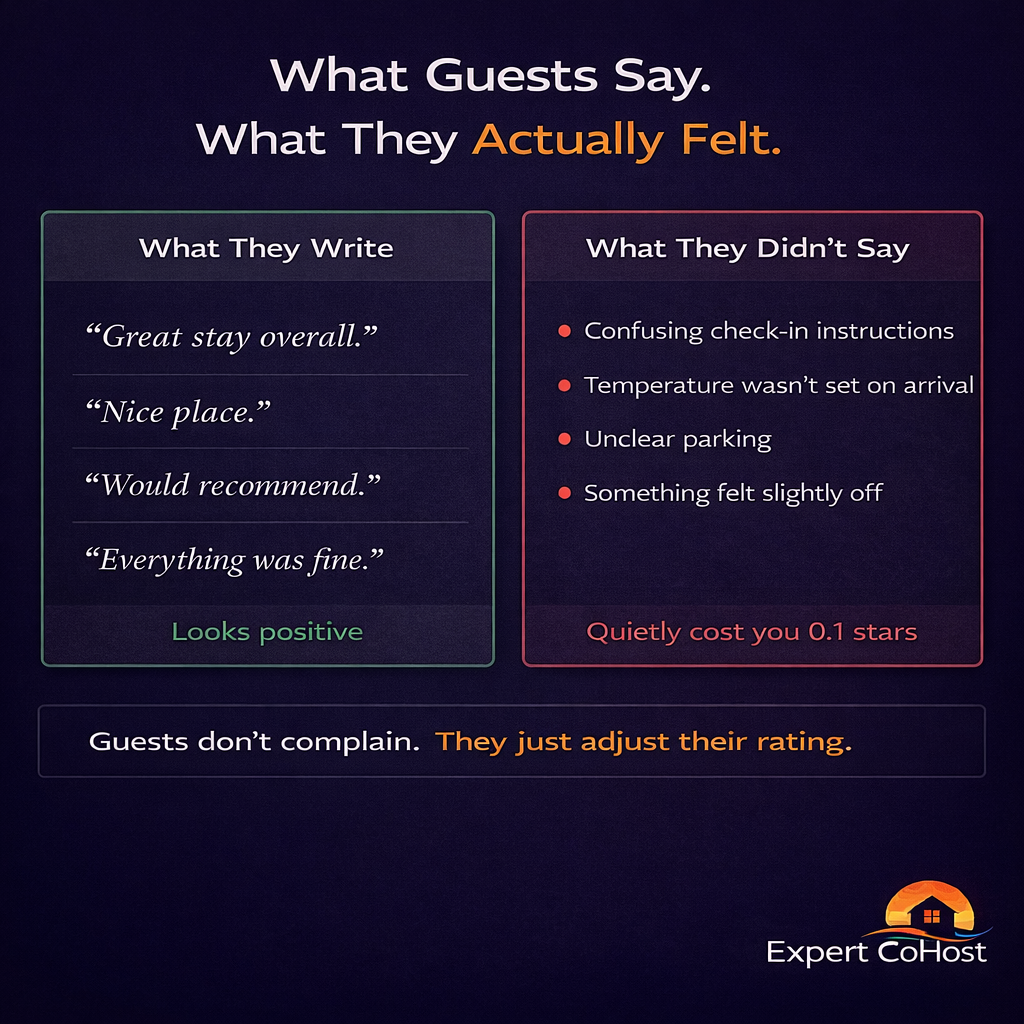
Most hosts believe that if something truly bothered a guest, it would show up clearly in the review.
It rarely does.
Guests are polite.
They are busy.
They avoid conflict.
They don’t want to harm someone’s livelihood over something “minor.”
So instead of detailed criticism, you often receive:
“Great stay overall.”
“Nice place.”
“Would recommend.”
On the surface, nothing appears wrong.
Underneath, friction may be accumulating.
And the things guests don’t articulate are often the ones quietly costing you 0.1 stars at a time.
Guests Avoid Confrontation
The average Airbnb guest does not want to leave a harsh review.
Even when something felt inconvenient or slightly disappointing, they often rationalize it:
-
“It wasn’t a big deal.”
-
“Maybe that’s just how cabins are.”
-
“I don’t want to be difficult.”
So instead of documenting the issue, they adjust their rating slightly.
You don’t get a complaint.
You get a softer five-star review — or an unexpected four-star.
That subtle shift is where performance erosion begins.
Polite Reviews Mask Friction
Read your last ten reviews carefully.
Look for language patterns such as:
-
“As described.”
-
“Good stay.”
-
“Met expectations.”
-
“Everything was fine.”
These are not negative reviews.
But they are not enthusiastic either.
Enthusiasm drives conversion.
Politeness maintains average.
If guests are not emotionally compelled to praise the experience, something likely interrupted ease — even if they never named it.
Category Ratings Tell a Quiet Story
Airbnb’s overall rating often masks category-level feedback.
A guest may leave:
-
5 stars overall
-
4 stars for cleanliness
-
4 stars for accuracy
-
4 stars for value
Individually, those category ratings feel minor.
Collectively, they reveal friction.
And category ratings influence long-term positioning more than many hosts realize.
Guests may not explain why they chose 4 stars in a category.
But the choice reflects perception.
Perception affects confidence.
Confidence affects pricing power and visibility.
Guests Adjust Internally Before They Complain Externally
When something feels slightly off, guests don’t immediately think:
“This deserves a lower rating.”
Instead, they recalibrate internally.
They lower enthusiasm.
They compare more carefully next time.
They hesitate slightly before recommending the listing.
These internal adjustments rarely appear in review text.
But they appear in behavior.
Behavior drives performance.
The Emotional Memory Principle
Guests do not remember stays as a checklist.
They remember them emotionally.
If the stay felt:
-
Effortless
-
Clear
-
Calm
-
Thoughtful
the memory strengthens.
If the stay felt:
-
Slightly confusing
-
Mildly inconvenient
-
A bit transactional
-
Just “fine”
the memory flattens.
Flat memories produce neutral reviews.
Neutral reviews cap uplift.
Why Most Friction Is Invisible to Hosts
Hosts see the property operationally.
Guests experience it emotionally.
You know:
-
Where the light switch is.
-
How the thermostat works.
-
Which cabinet holds extra linens.
-
That the driveway slope is manageable.
Guests do not.
What feels intuitive to you may feel uncertain to them.
And uncertainty rarely becomes a complaint.
It becomes a quiet downgrade.
The Cost of Unspoken Friction
Unspoken friction leads to:
-
Slightly softer reviews
-
Reduced forgiveness for small issues
-
Increased price sensitivity
-
Slower booking velocity
-
Performance ceilings
None of these outcomes feel dramatic.
But they compound.
And in a concentrated marketplace, compounding differences separate listings over time.
How to Detect What Guests Aren’t Saying
Instead of asking, “What went wrong?” ask:
-
Where might a first-time guest hesitate?
-
What might require rereading?
-
What assumptions are we making that guests may not share?
-
Where could expectations and reality subtly diverge?
Study patterns in review language.
Look for recurring neutral phrases.
Notice where enthusiasm drops.
The absence of excitement is often the signal.
Why This Matters More at 4.8
At a 4.8 rating, nothing feels broken.
But if enthusiasm is inconsistent, uplift stalls.
The difference between 4.8 and consistent 4.95+ performance is often found in:
-
Friction removal
-
Tone refinement
-
Expectation alignment
-
Experience clarity
Not in amenities.
Not in price.
In refinement.
Final Thought
Guests don’t usually tell you what actually bothered them.
They adjust quietly.
They rate subtly.
They soften enthusiasm instead of criticizing.
The most expensive problems in short-term rentals are rarely dramatic.
They are quiet.
And the hosts who outperform consistently are not the ones who fix obvious failures.
They are the ones who remove the friction guests never mention.