
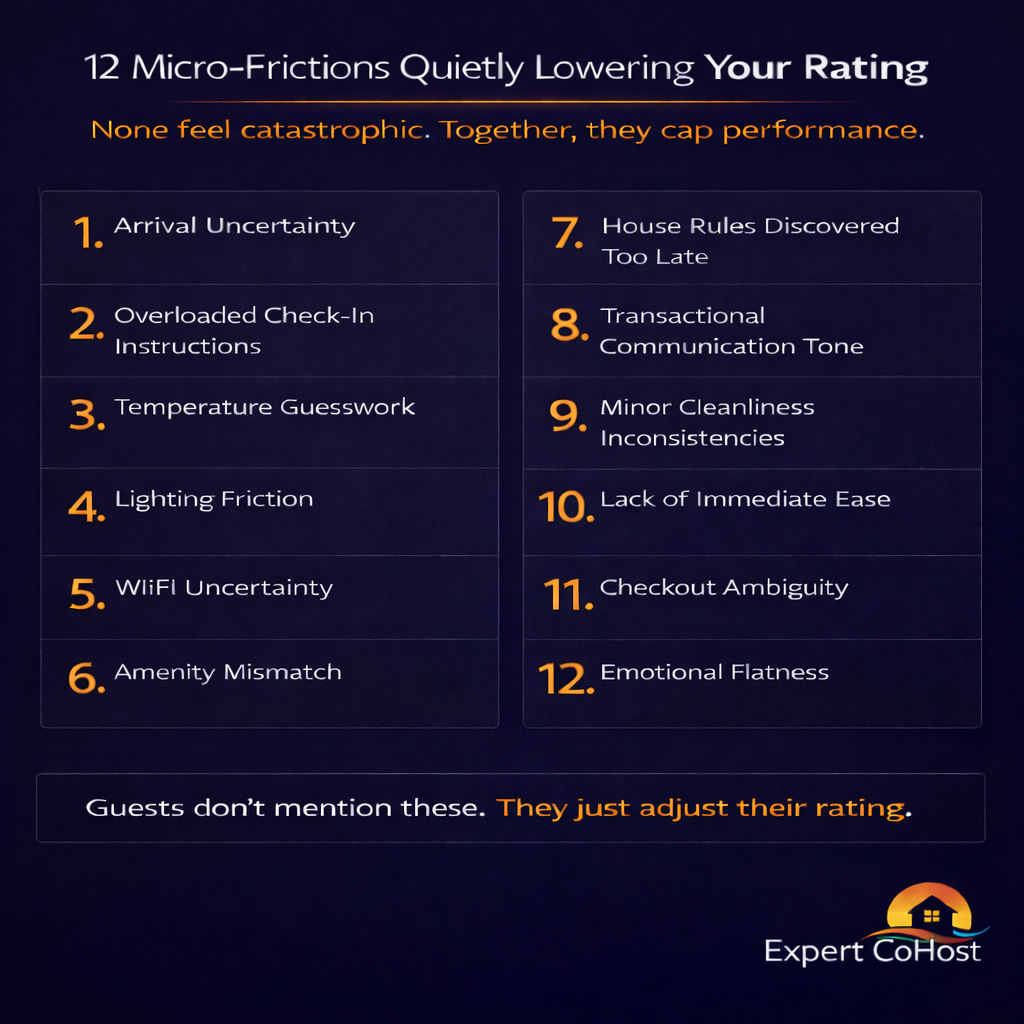
Most Airbnb listings don’t lose stars because of catastrophic mistakes.
They lose them because of small moments.
Moments that don’t feel dramatic.
Moments guests rarely mention directly.
Moments that create subtle hesitation, confusion, or disappointment.
These are micro-frictions.
And in a marketplace where 0.1 stars can shift pricing power and visibility, micro-frictions compound.
What Is Micro-Friction?
Micro-friction is any small point of uncertainty, inconvenience, or misalignment that interrupts the guest experience.
Individually, these issues feel minor.
Collectively, they shape:
-
Guest confidence
-
Review enthusiasm
-
Forgiveness tolerance
-
Willingness to pay premium rates
Most guests won’t say, “This 0.1 star is because of the thermostat instructions.”
They’ll say:
“Great stay overall.”
But they won’t feel compelled to leave a glowing 5-star review either.
That difference matters.
The 12 Most Common Micro-Frictions
Below are the friction points that most often separate 4.8 listings from consistent 4.95+ performers.
1. Arrival Uncertainty
Is parking clearly marked?
Is the driveway obvious at night?
Is the entrance unmistakable?
The first 90 seconds shape emotional tone. Confusion at arrival lingers longer than most hosts realize.
2. Overloaded Check-In Instructions
Long paragraphs.
Multiple apps.
Too many steps.
Guests want clarity — not complexity. If they have to reread instructions, friction has already occurred.
3. Temperature Guesswork
Is the thermostat easy to use?
Is it preset comfortably?
Is its operation clearly explained?
A slightly cold or overly warm first impression affects perceived comfort immediately.
4. Lighting Friction
Dim entryways.
Hard-to-find switches.
Harsh overhead lighting.
Lighting influences emotional response more than décor. A space can be beautiful and still feel uncomfortable.
5. WiFi Uncertainty
If guests have to search for:
-
Network name
-
Password
-
Reliable signal
confidence dips. WiFi clarity should be immediate and effortless.
6. Amenity Mismatch
Photos suggest abundance.
Reality feels adequate.
Examples include:
-
A smaller-than-expected hot tub
-
A view slightly overstated
-
A “fully stocked” kitchen that feels minimal
Expectation gaps are more expensive than missing features.
7. House Rules Discovered Too Late
Guests should never discover rules after booking.
Unexpected:
-
Checkout tasks
-
Trash requirements
-
Parking restrictions
-
Noise policies
reduce enthusiasm. Clarity builds trust. Surprises erode it.
8. Transactional Communication Tone
Automated messages that sound efficient — but not warm.
Professional is not the same as reassuring. Hospitality is emotional, not mechanical.
9. Minor Cleanliness Inconsistencies
Not dirty — just not flawless.
A missed dust corner.
A smudge on glass.
A forgotten lint roll.
Guests rarely complain directly, but perception shifts.
10. Lack of Immediate Ease
Does the home feel settled within five minutes?
Are lighting, temperature, and staging aligned for comfort? Guests should feel oriented quickly. If they do not, friction has begun.
11. Checkout Ambiguity
Unclear expectations at departure create stress.
Guests should never wonder:
-
“Am I supposed to strip beds?”
-
“Do I start laundry?”
-
“Where does trash go?”
Clarity protects reviews.
12. Emotional Flatness
This is the most overlooked friction of all.
Does the stay feel intentional?
Thoughtful?
Designed?
Or simply functional?
A stay can meet expectations and still feel forgettable. Forgettable rarely earns enthusiastic 5-star reviews.
Why Micro-Friction Matters More Than Amenities
Amenities attract bookings.
Execution earns reviews.
Guests expect:
-
Hot tubs
-
Game rooms
-
Views
-
Smart TVs
Those are baseline features.
Micro-frictions determine whether the experience feels effortless or merely acceptable.
In a winner-take-most marketplace, acceptable competes.
Effortless separates.
The Compounding Effect
Micro-frictions rarely create dramatic 3-star reviews.
They create:
-
Softer 5-star reviews
-
Occasional 4-star overall ratings
-
Slightly weaker enthusiasm
-
Lower pricing tolerance
-
Reduced forgiveness
Over time, that 0.1 difference influences:
-
Visibility
-
Conversion
-
Booking velocity
-
Long-term leverage
That is why refinement matters even when nothing feels broken.
A Simple Diagnostic Question
Ask yourself:
If a guest arrived tonight, where would they hesitate?
Where would they reread something?
Where would they feel slightly uncertain?
Those are the pressure points.
Not dramatic.
Not obvious.
But expensive.
Final Thought
Most listings do not lose performance because of major failures.
They lose it because of small frictions that quietly accumulate.
The hosts who move beyond the middle tier are not adding more features.
They are removing hesitation.
In today’s Airbnb marketplace, leverage is built in the details.
And the details guests do not mention are often the ones costing you the most.