
Most hosts pay attention to what their messages say.
Far fewer consider how their messages feel.
But tone shapes perception.
And perception shapes reviews.
In short-term rentals, communication is not just informational. It is emotional.
The difference between a 4.8 listing and a consistent 4.95+ performer is often found in subtle refinements — including the tone of every guest interaction.
Professional Is Not the Same as Reassuring
Many hosts prioritize efficiency.
Automated messages are optimized for:
-
Speed
-
Clarity
-
Coverage
-
Liability protection
All of those matter.
But efficiency without warmth feels transactional.
Guests do not want a transaction.
They want hospitality.
A message can be clear — and still feel cold.
It can be detailed — and still feel impersonal.
When tone feels mechanical, the experience begins to feel standardized rather than intentional.
The Emotional Context of Guest Communication
Remember when guests are reading your messages:
-
Before arrival, they may be traveling.
-
Upon arrival, they may be tired.
-
During the stay, they may be navigating unfamiliar systems.
-
Before checkout, they may be rushed.
Tone either reduces stress or amplifies it.
A message that feels calm and confident reassures.
A message that feels rigid or overly directive creates subtle friction.
Guests rarely say:
“The message tone bothered me.”
They simply feel less at ease.
That feeling affects enthusiasm.
Where Tone Quietly Slips
Tone friction often appears in predictable places.
1. Overly Directive Language
“DO NOT…”
“Failure to comply…”
“Guests must…”
Clear rules are necessary.
But how they are phrased matters.
There is a difference between:
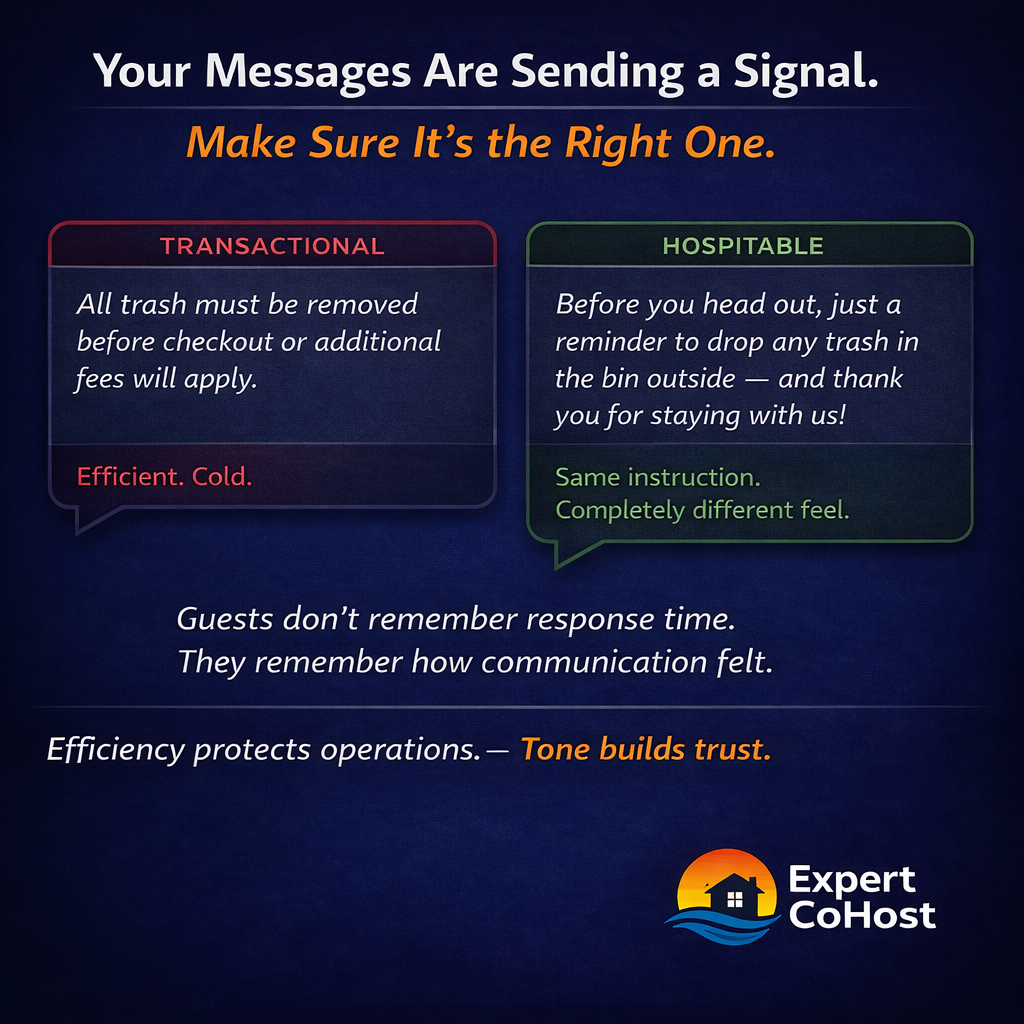
“Please remember to place trash in the outside bin before checkout.”
And:
“All trash must be removed or additional fees will apply.”
Both communicate the same instruction.
Only one feels hospitable.
2. Over-Automation
Automation is efficient.
But if every message feels templated and identical, guests sense it.
They do not expect personal essays.
They expect presence.
A small personalized detail — using the guest’s name naturally, referencing their arrival time, acknowledging their trip purpose — signals attentiveness.
3. Defensive Messaging
Messages written to prevent problems often feel defensive.
Examples include:
-
Extensive liability disclaimers
-
Overemphasis on penalties
-
Long lists of what not to do
While policies are important, tone should not feel preemptively confrontational.
Guests who feel distrusted are more likely to become guarded themselves.
4. Delayed Warmth
Sometimes communication is technically responsive but emotionally flat.
Quick replies without acknowledgment can feel abrupt.
For example:
“Yes, that is correct.”
Versus:
“Yes, that’s correct — and you’ll find everything clearly labeled when you arrive. Let me know if anything feels unclear.”
The second builds reassurance.
The first simply answers the question.
Why Tone Affects Reviews
Guests evaluate more than the property.
They evaluate the interaction.
If communication feels:
-
Calm
-
Attentive
-
Respectful
-
Thoughtful
they interpret the entire stay more generously.
If communication feels:
-
Transactional
-
Rigid
-
Impersonal
-
Reactive
enthusiasm softens.
The difference may not be visible in the review text.
But it appears in star ratings.
Tone Influences Forgiveness
When small issues arise — and they always do — tone becomes critical.
A thoughtful, composed response to a minor problem can transform irritation into appreciation.
A defensive or curt response can escalate it.
Guests do not expect perfection.
They expect care.
Tone is how care is communicated.
Why This Matters More at 4.8
Many 4.8 listings operate efficiently.
They respond quickly.
They provide clear instructions.
But communication feels standardized.
It feels managed.
It does not always feel hosted.
The difference between competent and exceptional communication often explains why some listings generate enthusiastic loyalty while others remain stable but capped.
A Simple Audit
Review your last ten guest message threads.
Ask:
-
Does the tone feel calm and welcoming?
-
Does it anticipate guest uncertainty?
-
Does it sound human — or procedural?
-
Would you feel reassured receiving it after a long day of travel?
Wherever tone feels slightly rigid, there may be a hidden 0.1 star.
Final Thought
Guests do not separate communication from experience.
To them, it is all one system.
The way you speak is part of the stay.
Efficiency protects operations.
Tone builds trust.
And trust is what moves listings beyond “good” into “preferred.”
In a competitive marketplace, the smallest refinements — even in phrasing — can produce disproportionate effects.
Because hospitality is not only what guests see.
It is what they feel.