
Most Airbnb hosts focus on what is wrong.
Broken items.
Missed cleanings.
Major complaints.
But the most expensive performance loss rarely comes from obvious failures.
It comes from something far subtler:
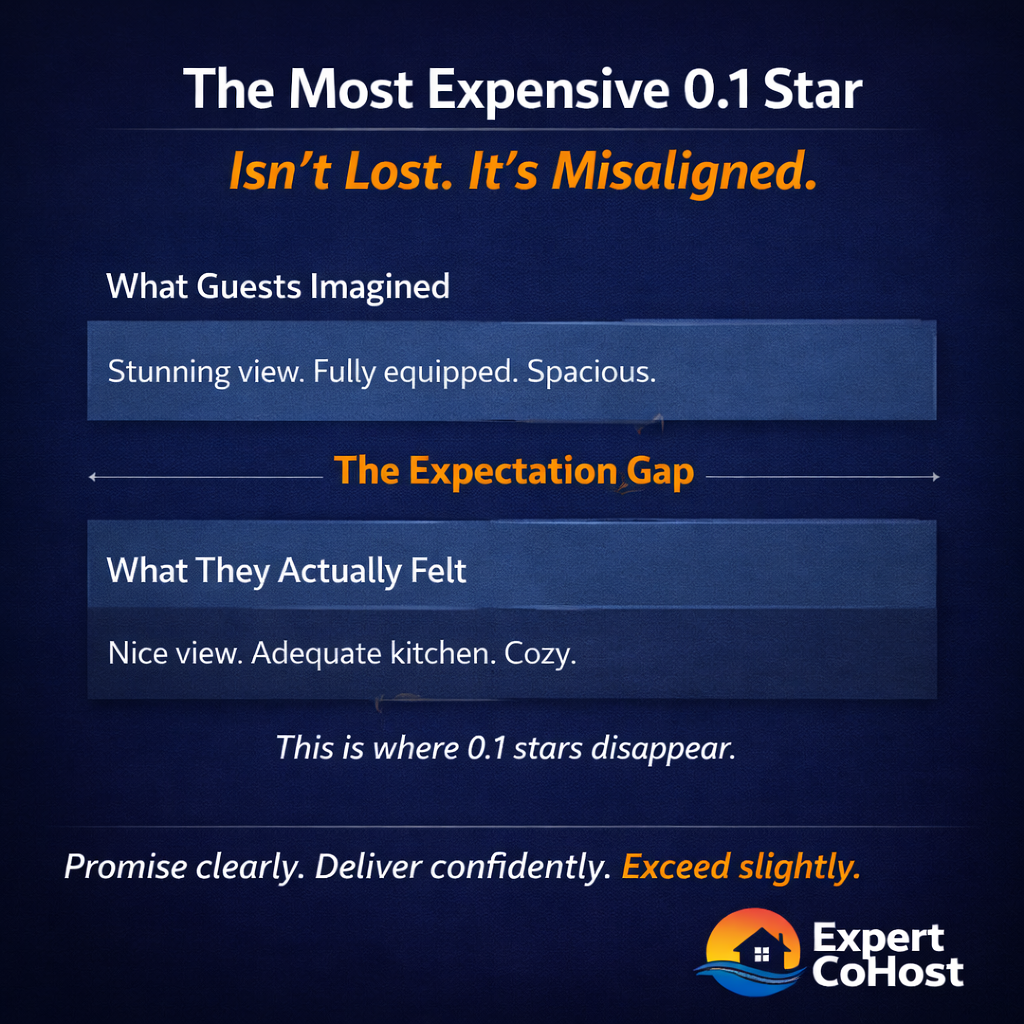
The expectation gap.
The expectation gap is the difference between what a guest imagines before arrival and what they feel once they’re inside.
That gap — even when small — is often the source of the most costly 0.1 stars.
What Is an Expectation Gap?
An expectation gap forms when:
-
Photos imply something slightly more elevated than reality
-
Descriptions emphasize strengths that feel overstated
-
Amenities sound abundant but feel minimal
-
Location language feels closer than it is
-
“Luxury” feels standard
Nothing is technically inaccurate.
Nothing is deceptive.
But something feels misaligned.
Guests rarely articulate this directly.
They simply adjust their rating.
Why Expectation Gaps Hurt More Than Flaws
A minor flaw is often forgiven.
A small mismatch is not.
For example:
-
A modest kitchen described modestly can earn praise.
-
A modest kitchen described as “fully gourmet-equipped” creates disappointment.
The problem isn’t the kitchen.
It’s the expectation.
Guests judge experiences relative to what they were promised.
When reality exceeds expectation, enthusiasm rises.
When reality merely matches inflated expectation, enthusiasm flattens.
When reality falls short, even slightly, ratings soften.
Where Expectation Gaps Commonly Hide
Expectation gaps rarely appear in dramatic places.
They often live in:
-
Listing Language
Words like “luxury,” “stunning,” “private,” or “fully stocked” raise emotional stakes. -
Photography
Wide-angle lenses, perfect lighting, and curated staging can unintentionally overpromise scale. -
View Representation
A seasonal view described as constant.
A partial view described as panoramic. -
Proximity Claims
“Minutes from downtown” that feels farther in practice. -
Cleanliness Standards
A space described as spotless that feels simply clean.
Each example feels small.
Each creates subtle recalibration in the guest’s mind.
Why 0.1 Stars Matter
Most hosts do not lose half-star ratings from dramatic issues.
They lose 0.1 at a time.
A slight overstatement.
A mild surprise.
A small misalignment.
Over time, that difference affects:
-
Pricing resilience
-
Conversion confidence
-
Visibility positioning
-
Review enthusiasm
The listing still performs.
But it stops separating.
The Psychology Behind the Gap
Guests arrive with a mental movie already playing.
They have visualized:
-
The view at sunrise
-
The spacious living room
-
The relaxing hot tub
-
The effortless arrival
If the reality matches or exceeds that internal movie, satisfaction feels high.
If reality feels smaller, tighter, dimmer, or less impressive, the internal score drops slightly — even if the stay is objectively good.
This adjustment is rarely verbalized.
It simply influences tone.
Why Inflated Marketing Is Expensive
In competitive markets, the temptation to elevate language is strong.
Words are free.
Hyperbole attracts clicks.
But over time, inflation increases vulnerability.
Listings that describe honestly — and deliver slightly more than expected — build trust.
Listings that describe aspirationally — and deliver accurately — risk creating small disappointment.
Trust compounds.
Disappointment accumulates.
How to Close the Expectation Gap
To reduce the gap, refine in three areas:
-
Precision in Language
Describe clearly, not dramatically.
Let photos and reviews create elevation. -
Alignment Between Photo and Reality
If a space feels intimate, photograph it honestly.
If a feature is seasonal, note it. -
Deliver Slightly More Than Promised
Small welcome details.
Slightly clearer instructions.
Better-than-expected cleanliness.
The goal is not to under-sell.
It is to align and slightly exceed.
Why This Matters at 4.8
Many 4.8 listings are not operationally weak.
They are slightly inflated in presentation.
The property is good.
The experience is good.
But expectation ran slightly higher than execution.
That subtle gap prevents the listing from moving into consistent 4.95+ performance.
And in a concentrated marketplace, that difference compounds.
A Diagnostic Question
Review your listing description and photos as if you were booking for the first time.
Ask:
If I arrived tomorrow, would anything feel smaller, darker, farther, or less dramatic than I imagined?
Wherever the answer is yes, there is a potential 0.1 star hiding.
Final Thought
The most expensive stars are not lost through failure.
They are lost through misalignment.
An expectation gap does not produce angry reviews.
It produces restrained ones.
And restrained reviews cap pricing power and momentum.
In today’s Airbnb marketplace, the safest path to leverage is simple:
Promise clearly.
Deliver confidently.
Exceed slightly.
Because when expectation and experience align perfectly, enthusiasm follows.
And enthusiasm is what separates good listings from dominant ones.