
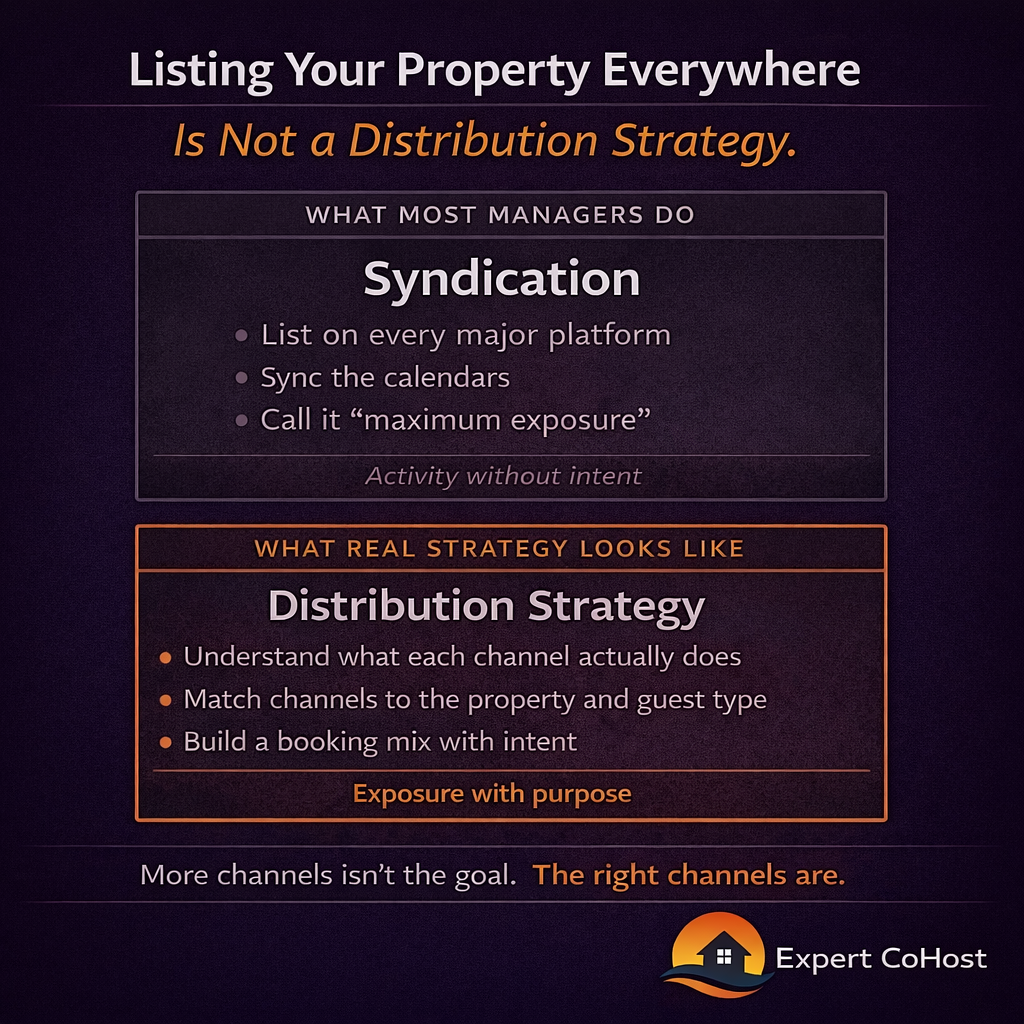
A surprising number of property managers still talk about booking platforms as if they all do the same thing.
List the property on Airbnb.
Push it to Vrbo.
Maybe turn on Booking.com.
Sync the calendars.
Call it “maximum exposure.”
On paper, that sounds strategic.
In practice, it often is not.
Because simply listing a property on multiple channels is not the same as having a real distribution strategy.
And that distinction matters more than most owners realize.
The major booking platforms are not interchangeable. They do not all attract demand the same way. They do not create the same guest expectations. They do not fit every stay type equally well. They do not require the same operational discipline. And they do not all play the same role in a healthy booking mix.
Yet many property managers still approach them as if they are just duplicate traffic sources.
That is a problem.
Because if your property manager cannot clearly explain what each booking channel is doing for your property, there is a good chance they are not managing distribution strategically. They are simply syndicating inventory.
Those are not the same thing.
Exposure Is Not a Strategy
One of the easiest ways to sound sophisticated in this industry is to talk about distribution.
The property is listed in multiple places.
The calendars are synced.
The booking software is connected.
The channel manager is working.
That all sounds impressive.
But none of it answers the real question:
Why is this property on each channel, and what role is each one supposed to play?
That is the question many property managers never answer.
Instead, they default to a shallow framework:
More channels = more exposure
More exposure = more bookings
More bookings = better performance
Sometimes that works.
But not always.
Because more exposure only helps when the added exposure is useful. If a channel brings the wrong kind of booking behavior, creates avoidable friction, attracts lower-fit demand, or adds complexity without improving results, wider distribution can create noise instead of strength.
A real strategy is not about being everywhere.
It is about understanding what each channel actually contributes.
The Major Platforms Are Not Doing the Same Job
This is the part many property managers oversimplify.
Airbnb, Vrbo, Booking.com, Google Vacation Rentals, Furnished Finder, Homes & Villas by Marriott Bonvoy, curated channels, and direct bookings are not all versions of the same system.
They are different tools.
Some are built for broad consumer discovery.
Some are stronger for traditional whole-home vacation demand.
Some operate more like large-scale travel distribution platforms.
Some are best for medium-term stays.
Some are curated.
Some are loyalty-driven.
Some are less about direct booking and more about visibility.
When a manager treats all of those channels the same, one of two things is usually happening.
Either they do not understand the differences.
Or they do understand them, but they are not managing your property with enough intentionality for the distinction to matter.
Neither answer should make an owner comfortable.
What a Real Distribution Strategy Looks Like
A real distribution strategy starts with a different set of questions.
Not:
Which platform is biggest?
Which one gets the most traffic?
Which one should we turn on next?
But:
What kind of guest demand does this property need?
What kind of stays is this property best suited for?
Which channels support that best?
Which ones add useful reach?
Which ones introduce operational complexity without enough upside?
How should the mix change over time?
That is what strategic channel management looks like.
It is not glamorous. It is not as easy to sell as “we put your property everywhere.” But it is far more important.
Because the goal is not just to generate bookings.
The goal is to generate the right bookings through the right mix of channels, in a way that supports pricing power, guest fit, smoother operations, and stronger long-term performance.
Airbnb: Broad Visibility and Consumer Comfort
Airbnb remains one of the most important consumer-facing booking platforms in vacation rentals.
For many properties, it plays a major role in visibility and booking volume. It is familiar. It is widely used. It is often one of the first places travelers look when they are open to a range of property types and trip styles.
That makes Airbnb a meaningful part of many distribution strategies.
But that is exactly the point.
It should be part of a strategy.
Not an automatic default.
A thoughtful manager should be able to explain why Airbnb matters for your property specifically. Is it helping with broad discovery? Is it performing well for shorter lead times? Is it supporting occupancy in softer periods? Is it converting efficiently because the listing presentation and guest journey fit the platform well?
If the answer is simply, “Of course we’re on Airbnb,” that is not very strategic.
That is just habit.
Vrbo: Whole-Home Vacation Demand Still Matters
Vrbo still plays an important role in the vacation-rental landscape, especially for whole-home leisure stays.
For some properties, Vrbo may be a major source of valuable demand. For others, it may be more complementary. But either way, it should not be treated as just a duplicate copy of Airbnb.
A manager with real channel awareness should be able to explain what Vrbo contributes to the mix.
Does it attract a different segment of travelers?
Does it perform differently for certain stay lengths or family-oriented bookings?
Does it broaden reach in a way that actually improves portfolio performance?
Those are the right questions.
Too often, managers skip them and jump straight to syndication.
The listing gets pushed live, but no real thought is given to how the channel functions differently or what role it should play.
That is not strategy. That is distribution by default.
Booking.com: Powerful, But Not Plug-and-Play
Booking.com is one of the clearest examples of why experience matters.
Many owners still think of it primarily as a hotel platform. In reality, it can be a valuable source of travel demand for vacation rentals. But it also tends to come with a different operational feel, different controls, and different expectations than Airbnb or Vrbo.
That means Booking.com can absolutely be useful.
It also means it should not be activated casually.
A manager who really understands distribution should know when Booking.com is worth the complexity and when it is not. They should be able to explain why the property is there, what kind of demand it is expected to bring, and whether the systems behind the listing are strong enough to support it well.
Too many managers act as though adding a channel is always progress.
It is not.
Sometimes adding a channel improves performance.
Sometimes it just multiplies friction.
Google Vacation Rentals: Visibility Matters Even When the Booking Happens Elsewhere
Google Vacation Rentals is important for a different reason.
It is less about being a traditional booking marketplace and more about appearing where search-driven travel decisions begin.
That means it plays a discovery role.
And that role matters.
A smart property manager should understand that not every platform is meant to function as a standalone booking engine in the same way. Some channels help travelers find the property. Others help convert the booking. Others strengthen brand presence. Others serve niche use cases.
This is exactly why channel strategy should be more nuanced than “list everywhere.”
Different visibility layers do different jobs.
A real strategy accounts for that.
Furnished Finder: Different Demand, Different Purpose
Furnished Finder is another good test of whether a manager actually understands channels.
It is not built for the same job as Airbnb or Vrbo.
It serves a different demand type entirely: furnished stays of 30 days or longer, often for relocating professionals, travel nurses, academic visitors, and others looking for flexibility without a traditional long-term lease.
That means it should not be evaluated with the same logic as nightly vacation-rental platforms.
For the right property, in the right season, or in the right market, Furnished Finder may be a very smart part of the mix.
But again, that requires thought.
If a property manager talks about every platform as if it belongs in the same category, that is a warning sign.
It usually means they are thinking in software terms, not strategy terms.
Curated and Loyalty-Driven Channels Serve Different Functions
Not every platform is trying to maximize raw volume.
Some channels are curated.
Some are selective.
Some are tied to broader hospitality brands or loyalty ecosystems.
That changes the role they play.
For some homes, curated placement may improve positioning. For others, loyalty-driven distribution may add brand context and reach. For still others, those channels may not be relevant at all.
That is why owners should be skeptical of any property manager who acts as though every additional channel is automatically beneficial.
More channels are not always better.
Better channels are better.
And the only way to know the difference is to have an actual point of view about what each one is for.
Direct Bookings Are Not Optional in a Serious Long-Term Strategy
Even owners who rely heavily on third-party booking platforms should understand the strategic role of direct demand.
That does not mean every operator should expect huge direct-booking volume right away.
It does mean every serious manager should be thinking about how repeat guests, referrals, branded search, and website traffic fit into the long-term mix.
Third-party platforms are useful. Often essential.
But they are still rented ground.
A manager who thinks only in terms of external booking channels is thinking too narrowly.
Real strategy includes both.
Third-party booking platforms generate reach.
Direct channels build resilience.
If your manager has no meaningful plan for direct demand over time, that is another sign that the strategy may not be very deep.
What Owners Should Be Asking Their Property Manager
Owners do not need to become channel experts overnight.
But they should ask better questions.
For example:
Why is my property listed on each platform it is currently on?
What role is each channel supposed to play?
Which ones bring the best-fit bookings?
Which ones add complexity without much benefit?
How does the channel mix affect guest quality, pricing power, and operational smoothness?
What is the long-term plan beyond just third-party platforms?
Those questions matter.
Because a manager who cannot answer them clearly is probably not making distribution decisions at a very high level.
And if channel strategy is shallow, performance often is too.
The Real Problem
Most owners do not have a visibility problem.
They have a management-depth problem.
Their property is being distributed, but not necessarily managed with real strategic intent.
It is being listed.
It is being synced.
It is being pushed out to multiple channels.
But that is not the same as having someone who understands how different booking platforms work, how they shape demand, and how to use them together intelligently.
That gap is easy to miss because syndication looks sophisticated from the outside.
But owners should not confuse activity with expertise.
A lot of property managers know how to turn channels on.
Far fewer know how to use them well.
Final Thought
If your property manager talks about Airbnb, Vrbo, Booking.com, Google Vacation Rentals, direct bookings, and specialty channels as if they are all just interchangeable sources of exposure, that should raise questions.
Because they are not interchangeable.
And the difference between simple syndication and real strategy can affect everything from booking mix to guest expectations to operational stress to long-term performance.
The best managers do not just push listings out everywhere.
They understand what each channel is for, how each one fits the property, and how to build a booking mix that is intentional, resilient, and aligned with the bigger goals of the asset.
That is what owners should be looking for.
Not just exposure.
Strategy.