
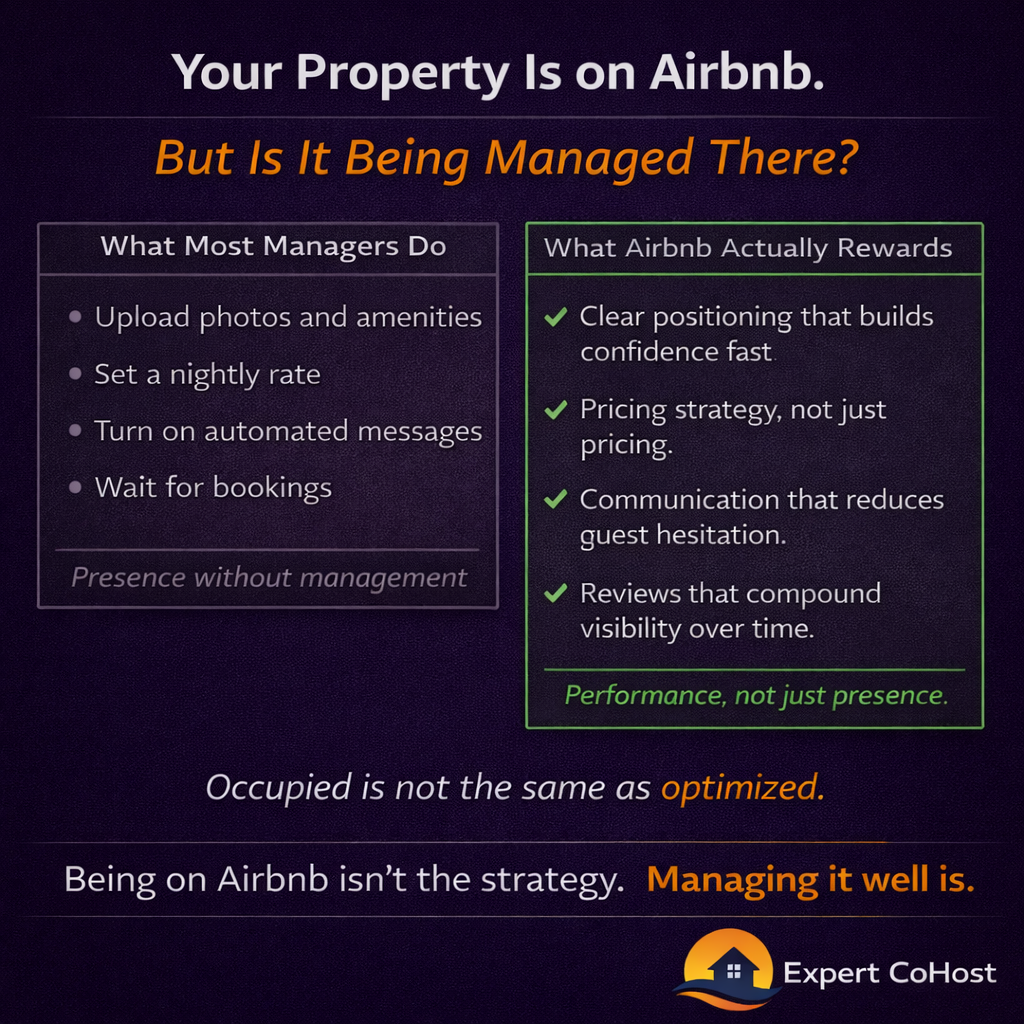
Airbnb is so widely used that many property managers stop thinking critically about it.
They treat it like a default.
Of course the property should be on Airbnb.
Of course it should be optimized there.
Of course it matters.
And to be fair, it usually does.
But that is exactly why owners should look deeper.
Because Airbnb is not just a place to “put the listing.” It is a consumer platform with its own guest expectations, browsing behavior, ranking dynamics, and operational demands. And the managers who understand those things tend to get more out of it than the ones who simply treat it like a box to check.
That distinction matters.
A lot of property managers know that Airbnb is important.
Far fewer know what it is actually best for, how it should fit into a larger distribution strategy, and what kinds of performance mistakes quietly reduce results over time.
If your manager cannot explain those things clearly, there is a good chance they are using Airbnb without really managing it.
Airbnb Is Powerful — But Not Magic
Airbnb is one of the most important consumer-facing booking platforms in vacation rentals for a reason.
It is familiar.
It is easy for travelers to browse.
It has enormous consumer awareness.
It is often one of the first places people look when planning a stay.
That gives Airbnb a major role in visibility.
For many properties, it is one of the strongest channels for discovery and one of the most important sources of booking volume.
But that does not mean Airbnb automatically performs well just because the property is listed there.
And that is where many property managers get lazy.
They assume the brand name does the heavy lifting.
They assume that being on Airbnb is the strategy.
It is not.
Airbnb is powerful when it is actively managed well. Otherwise, it is just a large marketplace where your property is competing against many others that are being merchandised, priced, and operated more intentionally.
What Airbnb Is Best For
Airbnb is especially strong as a broad-consumer discovery platform.
It works well when you want your property exposed to travelers who are actively browsing, comparing, and shopping inside a familiar booking environment. It is also useful for reaching guests who may not begin their search with a single property in mind, but instead start by exploring an area, a trip type, a date range, or a lifestyle-oriented stay.
That matters because Airbnb often works best when the property can compete well in that kind of environment.
In other words, Airbnb tends to be strongest when a listing can quickly create confidence.
That usually comes from a combination of:
-
strong visual presentation
-
clear positioning
-
strong reviews
-
good pricing discipline
-
polished communication
-
a smooth arrival and stay experience
That does not mean every property needs to be flashy.
It does mean Airbnb tends to reward properties that feel easy to understand, easy to trust, and easy to book.
A lot of managers stop at the listing photos.
The better ones understand that Airbnb performance is not just about being attractive.
It is about being confidence-building.
Airbnb Is Often a First Impression Channel
One of the most important things owners should understand is that Airbnb often creates the first impression long before a guest ever arrives.
The platform itself shapes the shopping experience.
The listing layout, the way the photos are consumed, the way reviews are read, the price comparisons, the map browsing, the filters, the messaging flow, the booking process — all of that influences how the property is perceived.
This is one reason Airbnb matters so much.
It is not just generating bookings.
It is shaping expectations.
And expectation-setting is one of the most important parts of performance in vacation rentals.
A property manager who really understands Airbnb should understand that the work is not finished when the listing goes live. The listing needs to be positioned in a way that creates the right kind of expectation for the stay that follows.
If it overpromises, guests arrive disappointed.
If it underexplains, guests arrive uncertain.
If it looks appealing but the experience behind it is sloppy, the platform will amplify that weakness through reviews, lower conversion, and weaker long-term momentum.
That is why Airbnb cannot be treated like a passive channel.
What Airbnb Tends to Reward
Many owners have a vague sense that Airbnb rewards “good listings.”
That is true, but not specific enough to be useful.
What Airbnb often rewards is clarity, trust, responsiveness, consistency, and a listing experience that reduces hesitation.
That usually shows up in practical ways:
The cover photo makes sense immediately.
The title is not generic.
The first five photos answer the right questions.
The description is easy to scan.
The amenities are accurate.
The pricing feels believable.
The reviews reinforce confidence.
The communication feels timely and professional.
The check-in experience does not introduce doubt.
When those pieces work together, Airbnb can be a very effective channel.
When they do not, many managers blame the market, seasonality, or “the algorithm” before they ever look at the actual guest journey.
That is a mistake.
Because what Airbnb really exposes is operational truth.
If the property is being presented well and delivered well, Airbnb can amplify that.
If it is not, Airbnb can expose that too.
What Most Property Managers Miss
This is where owners should pay attention.
A lot of property managers think Airbnb management means:
-
uploading the photos
-
filling out the amenities
-
setting the nightly rate
-
turning on automated messages
-
responding when needed
That is not enough.
What they miss is that Airbnb is not just a listing platform. It is a performance environment.
And performance inside that environment is shaped by dozens of details that are easy to overlook.
For example:
A manager may use decent photos, but lead with the wrong ones.
They may have a clean listing, but weak positioning.
They may have acceptable pricing, but no real pricing strategy.
They may automate messages, but in a tone that feels generic or unhelpful.
They may get bookings, but create avoidable friction that hurts reviews and repeatability.
In other words, they may be “using Airbnb” without actually managing the experience Airbnb is rewarding.
That gap is where a lot of underperformance lives.
Airbnb Is Not Just a Booking Platform — It Is a Merchandising Platform
This is one of the clearest ways to think about Airbnb.
It is not just where guests transact.
It is where properties are merchandised.
That means presentation matters more than many property managers admit.
A home may be excellent in person and still underperform if it is merchandised weakly.
The first image may not create enough interest.
The title may sound like every other title.
The visual sequence may fail to answer obvious questions.
The description may bury the strongest selling points.
The listing may not clearly explain who the stay is best for.
This is not superficial.
It is strategic.
Because guests are constantly making snap judgments while browsing.
Managers who understand Airbnb know they are not just managing a property. They are managing the digital first impression of that property inside a competitive marketplace.
That requires more thought than many owners realize.
Airbnb Can Be Excellent for Wide-Net Exposure
If your goal is broad visibility, Airbnb is often one of the strongest tools available.
That is one reason it should usually be part of the conversation.
For many properties, it is not a niche platform. It is a core one.
It can bring in travelers who would never have found the property otherwise. It can support occupancy during softer periods. It can help a new listing gain early traction if the setup is strong. It can introduce the property to guests who later become repeat direct-booking guests.
That is all valuable.
But wide-net exposure only helps when the operational systems behind it are ready.
If the listing creates more demand than the manager can support smoothly, Airbnb will not hide that. It will expose it.
That is why some managers love wide distribution in theory but struggle with the consequences in practice.
They know how to chase reach.
They do not always know how to support the experience that reach creates.
Where Airbnb Can Create Problems
This is another place where honest managers separate themselves from average ones.
Airbnb is powerful, but it is not effortless.
If the property is not priced well, it can attract the wrong expectations.
If the listing is too broad, it can create weak-fit bookings.
If the communication flow is too thin, guests may feel uncertain before arrival.
If the check-in process is not polished, friction shows up early.
If the stay experience does not match the tone of the listing, reviews suffer.
In other words, Airbnb can magnify both strengths and weaknesses.
That is not a reason to avoid it.
It is a reason to manage it with more depth than many property managers do.
What Owners Should Ask Their Property Manager About Airbnb
Owners do not need to become platform experts.
But they should ask better questions.
For example:
Why is Airbnb important for my property specifically?
What role does it play in the overall booking mix?
What kind of guest does it tend to bring for this property?
How is the listing being positioned to compete well?
How often are the photos, title, and description being refined?
How are pricing decisions being made?
How are guest questions and pre-arrival concerns being reduced?
What is being done to improve not just bookings, but booking quality?
Those are the kinds of questions that reveal whether a manager is thinking strategically or simply operating by routine.
A manager who really understands Airbnb should be able to answer them clearly.
The Bigger Point
Airbnb is important.
But the real issue is not whether a property is on Airbnb.
The real issue is whether the person managing that Airbnb presence actually understands what the platform is good at.
Because a property can absolutely be on Airbnb and still be under-managed.
It can be visible but poorly positioned.
Booked but poorly matched.
Occupied but leaving performance behind.
And that is the trap many owners fall into.
They assume Airbnb performance is mostly about being present on the platform.
In reality, a lot depends on how intelligently that presence is managed.
Final Thought
Airbnb is one of the most powerful tools in vacation-rental distribution.
But it is only a tool.
And like any tool, its value depends on how well it is used.
The best property managers do not just put homes on Airbnb and wait for bookings. They understand how the platform shapes guest expectations, how listing presentation affects trust, how operations affect reviews, and how Airbnb fits into a larger booking strategy.
That is what owners should be paying for.
Not just access to the platform.
Real management of the platform.