
A lot of property managers misunderstand Furnished Finder from the start.
They try to compare it to Airbnb.
Or to Vrbo.
Or to Booking.com.
Or they dismiss it because it does not behave like a typical nightly booking platform.
That is the first mistake.
Because Furnished Finder is not just another version of the same idea. It serves a different kind of demand, supports a different kind of stay, and belongs in the strategy for very different reasons.
That matters.
Because a property manager who treats Furnished Finder like a side platform, an afterthought, or a weak substitute for nightly bookings may be revealing something bigger: they may not understand channel strategy very deeply at all.
And owners should pay attention to that.
Furnished Finder Is Not a Nightly Booking Channel
This is the first thing owners need to understand.
Furnished Finder is not really competing for the same role as Airbnb or Vrbo.
It is built around furnished stays that are typically longer than a traditional vacation rental stay. That means the guest mindset is different, the booking logic is different, and the operational purpose is different.
That alone should change how a manager thinks about it.
Because the question is not:
Should this replace nightly bookings?
The better question is:
When does medium-term furnished demand make more sense for this property than traditional short-term vacation demand?
That is a much smarter framing.
And many property managers never get there.
They are so used to thinking in nightly-booking terms that they fail to recognize when a property, a season, a regulation environment, or a market condition makes medium-term demand strategically valuable.
What Furnished Finder Is Best For
Furnished Finder is best for properties that are well-suited to medium-term stays.
That can include:
-
relocating professionals
-
travel nurses
-
visiting academics
-
corporate travelers
-
people between homes
-
guests in transition periods
-
renters who need flexibility without a traditional long-term lease
This is different demand.
And that difference matters because the value of Furnished Finder is not just that it produces bookings. It is that it can produce a different kind of occupancy pattern, a different kind of operational rhythm, and in some cases a much more useful kind of stability.
For the right property, that can be powerful.
A property that struggles with seasonality may benefit from medium-term stays during slower periods. A market facing increased scrutiny on nightly rentals may find medium-term demand strategically safer. An owner who values lower turnover frequency and less operational churn may find the model attractive even if the nightly math looks different on paper.
That is why Furnished Finder should not be evaluated with the same lens as a nightly vacation-rental platform.
It is solving a different problem.
What Many Property Managers Miss About Furnished Finder
This is where the blind spot becomes obvious.
A lot of property managers are very comfortable talking about occupancy, nightly rates, revenue management, and booking-platform visibility. But they become much less confident when the conversation shifts to medium-term stays.
Why?
Because medium-term strategy requires a different kind of thinking.
It requires a manager to understand that not every good booking mix is built around short stays. It requires them to think in terms of stability, seasonality, turnover reduction, market conditions, and demand diversification.
Many do not.
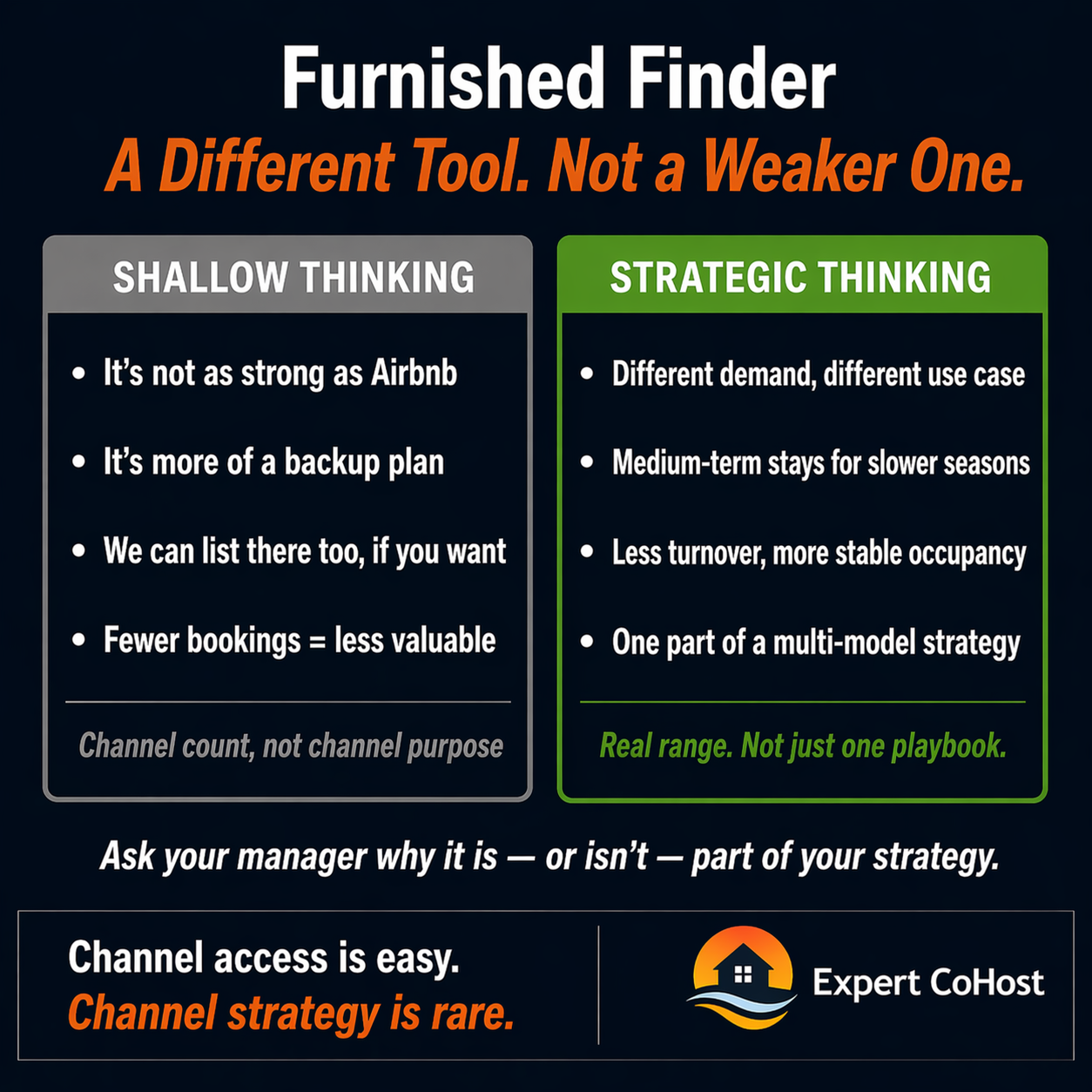
Instead, they reduce Furnished Finder to one of three shallow positions:
-
“It is not as strong as Airbnb.”
-
“It is more of a backup plan.”
-
“We can list there too, if you want.”
None of those responses is especially impressive.
Because they reveal that the manager is still thinking in terms of channel count instead of channel purpose.
That is the real issue.
Furnished Finder Is About Strategy, Not Just Listing Everywhere
A weak manager often thinks like this:
More channels means more exposure.
More exposure means more opportunities.
So let’s add Furnished Finder too.
That is not very strategic.
Furnished Finder should not simply be “added.”
It should be used intentionally.
A real manager should be able to explain:
Why this property belongs there.
When it belongs there.
What role it plays in the overall booking mix.
What kind of stay it is meant to support.
What problem it solves that the nightly channels do not.
That is what real channel strategy looks like.
Without that, the listing is not being managed thoughtfully. It is just being pushed into another system.
Furnished Finder Can Be Strong When Nightly Strategy Is Not Optimal
This is one of the most important reasons owners should understand it.
Not every property should be run the same way all year long.
Not every market supports the same kind of demand equally in every season.
Not every owner has the same goals.
And not every regulation environment favors traditional nightly stays.
That is exactly where Furnished Finder can become valuable.
It can be a smart option when:
-
slower seasons make nightly occupancy less attractive
-
turnover frequency is creating too much operational drag
-
the owner wants more predictable occupancy blocks
-
the market supports professional or transitional renters
-
the regulatory climate makes medium-term stays strategically safer
-
the property itself is especially well-suited to 30-plus-day guests
A manager who does not understand that is usually too locked into one model.
That can cost the owner options.
Furnished Finder Can Reveal Whether a Manager Thinks Beyond the Default Model
This is one reason the platform is so useful conceptually.
It acts like a test.
A test of whether the property manager can think beyond the standard short-term rental playbook.
A shallow manager often sees one model:
Nightly bookings on the major platforms.
A stronger manager sees a wider strategic landscape:
Nightly stays when they make sense.
Medium-term stays when they make sense.
Different channels for different use cases.
Different booking models for different conditions.
That is a much more mature way to think.
Owners should want that kind of flexibility in the person managing their asset.
Because markets change. Seasons change. Regulations change. Property goals change.
A manager who only knows one model is not nearly as valuable as one who understands multiple demand paths.
Furnished Finder Is Not About Volume Alone
This is another place many managers get tripped up.
They compare platforms too simplistically.
They ask:
Will it generate as many bookings?
Will it produce the same level of activity?
Will it fill the calendar the same way?
But Furnished Finder is not usually about maximizing booking count.
It is often about changing the structure of occupancy.
That is a different benefit.
Fewer turnovers.
Longer stays.
Less churn.
More predictable blocks of occupancy.
Potentially lower operational noise.
A different kind of demand exposure.
For the right owner, those benefits can matter more than raw transaction volume.
A manager who only understands revenue in terms of nightly-booking speed may miss that entirely.
Where Owners Get Misled
Owners often assume that if a property manager offers multi-channel distribution, that means the manager is already thinking about platforms like Furnished Finder intelligently.
That is often not true.
Sometimes “multi-channel” just means the manager knows how to connect the common nightly platforms.
That is useful, but it is not the same as understanding when a property should shift toward medium-term stays, when different demand types make sense, or how to evaluate a channel based on more than booking count.
This is where owners should ask sharper questions.
Because a manager who dismisses Furnished Finder too quickly may not be revealing that the platform is weak.
They may be revealing that their own framework is narrow.
What Owners Should Ask Their Property Manager About Furnished Finder
Owners do not need to become experts in medium-term rentals.
But they should ask better questions.
For example:
Is my property a good fit for Furnished Finder at any point in the year?
What kind of renter is the platform meant to attract?
Would medium-term demand improve the booking mix in slower seasons?
How would using Furnished Finder change turnover, operations, and guest management?
What markets or property types benefit most from it?
Why is it or is it not part of my strategy?
Are you evaluating it as a different model, or just comparing it to nightly channels?
Those questions matter because they reveal whether the manager actually understands the platform’s role.
A weak manager usually falls back on generic language.
A strong one can explain the use case clearly.
The Bigger Point
Furnished Finder is not for every property.
But that is not the point.
The point is whether the person managing your property knows how to think beyond the default.
Because a manager who only understands the major nightly platforms is not necessarily giving your property the most strategic options.
A manager who understands medium-term demand, seasonal shifts, regulatory flexibility, and alternative occupancy models is much more likely to protect performance over time.
That is the bigger lesson.
Furnished Finder matters not just because of what it can produce directly, but because it reveals whether the manager knows how to think in multiple dimensions.
Final Thought
Furnished Finder should not be treated like a weaker version of Airbnb or Vrbo.
It is not trying to do the same job.
It is a different tool for a different kind of demand.
And in the right property, the right season, or the right market, it can be a very smart part of the strategy.
The best property managers understand that. They do not just list properties. They think carefully about what kind of occupancy is best, what kind of demand fits the asset, and when a different model may create a stronger overall outcome.
That is what owners should be paying for.
Not just familiarity with the usual platforms.
Real strategic range.