
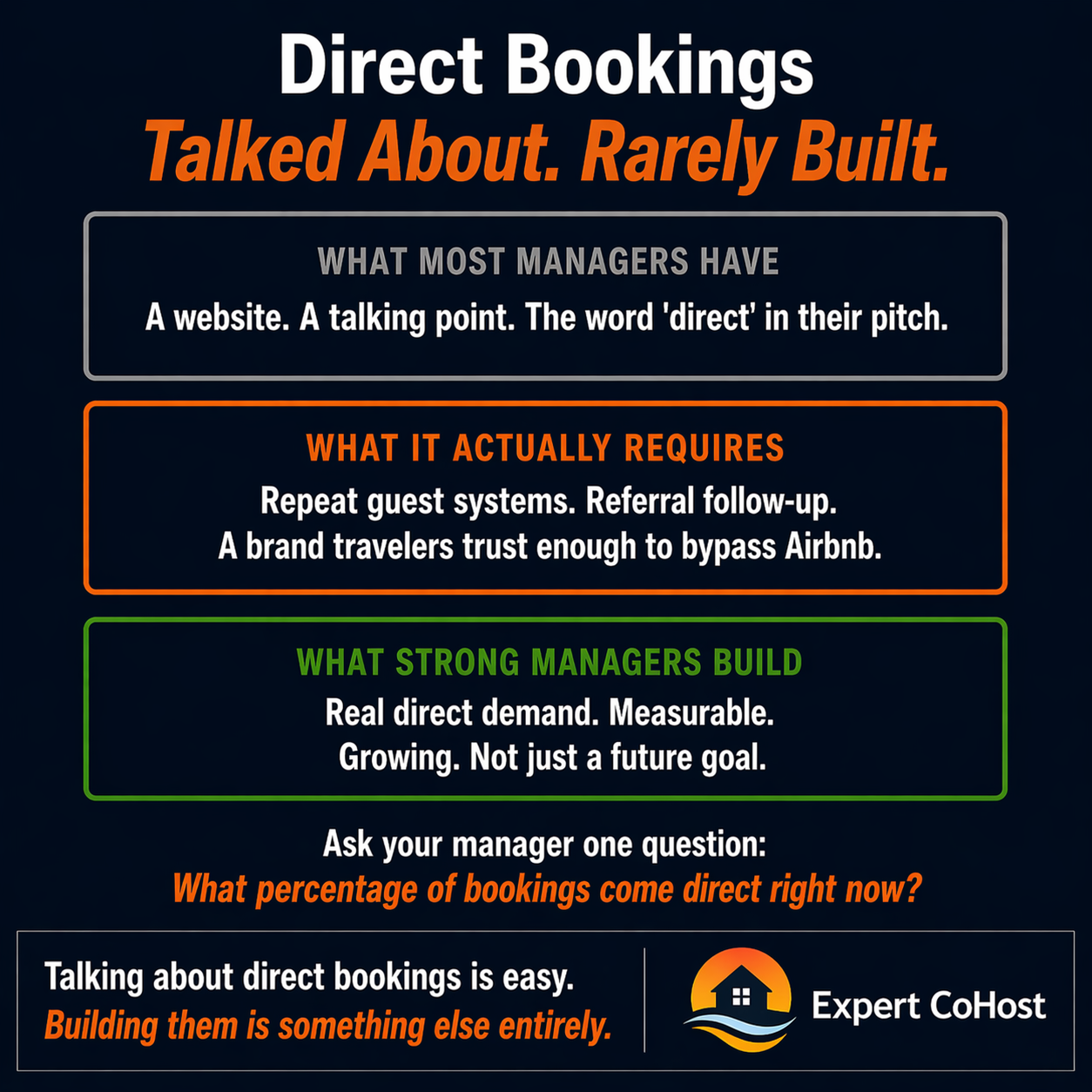
Almost every property manager says direct bookings matter.
That part is easy.
They mention lower fees.
They talk about owning the guest relationship.
They say it is important not to depend too heavily on third-party booking platforms.
They talk about brand-building and long-term control.
All of that sounds smart.
And to be fair, much of it is true.
But this is where owners should slow down and look deeper.
Because in many cases, property managers talk about direct bookings as an idea, not as an actual operating priority.
They like the concept.
They repeat the talking points.
They mention the benefits.
But they do not build the systems required to make direct bookings a meaningful part of the business.
That distinction matters.
Because direct bookings are not created by saying the words “direct bookings.”
They are created by visibility, trust, repeatability, brand strength, strong guest experience, and systems that make a traveler comfortable booking outside a major platform.
And that is exactly where many property managers fall short.
Direct Bookings Are Not Just About Saving Fees
This is one of the first places the conversation usually gets oversimplified.
A lot of managers frame direct bookings mainly as a fee issue.
If guests book directly, fewer fees go to third-party platforms.
If fewer fees go out, the owner keeps more revenue.
That sounds great.
And yes, cost is part of the picture.
But it is not the most important part.
The real value of direct bookings is not just that they may reduce dependence on outside platforms. The real value is that they give the operator more control over the relationship, more resilience over time, and more ability to build a business that is not entirely rented from someone else’s ecosystem.
That is a much bigger idea.
Because an owner who relies entirely on external booking platforms is always building on borrowed land. The bookings may be good. The reach may be valuable. The platforms may be necessary. But the relationship, the visibility, and much of the leverage live somewhere else.
Direct bookings help change that.
They give the business a chance to build something more durable.
Most Property Managers Like the Idea More Than the Work
This is the real issue.
Direct bookings sound great in conversation.
They sound sophisticated.
They sound independent.
They sound profitable.
They sound like proof that the manager is thinking beyond simple platform syndication.
But building direct bookings is a lot harder than talking about them.
Because a real direct-booking strategy requires more than a website.
It requires trust.
It requires search visibility.
It requires branded presence.
It requires guest follow-up systems.
It requires repeatability.
It requires a guest experience strong enough that people want to come back or refer others.
It requires enough operational maturity that a traveler feels safe booking outside a major third-party platform.
That is where many property managers quietly lose interest.
They want the benefits of direct bookings without doing the deeper work required to create them.
Owners should notice that.
What Direct Bookings Are Actually Best For
Direct bookings are not usually the fastest way to fill a brand-new calendar.
That is another place people get confused.
Third-party booking platforms are often much stronger for broad reach, especially early on. They can place a property in front of travelers quickly and create booking opportunities that would be difficult to produce from a brand-new website alone.
That is why smart operators usually do not think in terms of direct bookings versus major booking platforms.
They think in terms of both.
Third-party booking platforms can be excellent for demand generation.
Direct bookings are excellent for long-term resilience, repeat business, referral business, and building a stronger independent brand over time.
That is a healthier way to think about it.
Direct bookings are especially valuable for:
-
repeat guests
-
referral traffic
-
brand trust over time
-
reducing overdependence on any one platform
-
creating more control over the guest relationship
-
building a business asset that is not entirely dependent on outside marketplaces
That is what makes them strategically important.
Direct Bookings Are Built on Trust, Not Wishful Thinking
This may be the most important point in the whole article.
Guests do not book directly just because a manager would prefer them to.
They book directly when trust is strong enough.
That trust can come from several places:
A professional website
A recognizable brand
Strong reviews
Prior stay experience
Word-of-mouth referrals
Clear communication
A polished booking process
A sense that the company behind the property is legitimate and responsive
Without those things, “book direct” is often just wishful branding.
This is where many property managers get exposed.
They say direct bookings matter, but they do not invest seriously in the elements that make a traveler comfortable bypassing a major platform.
They may have a website, but it is weak.
They may have a brand name, but no real brand trust.
They may mention direct bookings, but have no meaningful traffic strategy.
They may want repeat guests, but do not operate well enough to generate them consistently.
That is not a direct-booking strategy.
That is a talking point.
Many Property Managers Confuse Having a Website With Having a Strategy
This happens all the time.
A manager launches a website.
Maybe there is a booking engine.
Maybe a few listings are there.
Maybe the company logo looks respectable.
And suddenly “direct bookings” become part of the sales pitch.
But a website by itself does not create direct demand.
A direct-booking strategy requires a full path:
Can guests find the site?
Do they trust it?
Is the company credible?
Is the property information strong?
Is the checkout process smooth?
Are repeat guests being nurtured?
Is referral traffic encouraged?
Are owners benefiting from real direct demand, or just hearing about future potential?
Those are the questions that matter.
Most property managers do not answer them very well because they are not actually building direct bookings as a serious growth engine. They are using the idea to sound more sophisticated than a manager who only mentions Airbnb and Vrbo.
That may work in a sales conversation.
It does not build a durable business.
Direct Bookings Are Often a Test of Management Quality
This is one of the clearest ways to think about them.
Direct bookings are not just another channel.
They are a test.
A test of how strong the guest experience is.
A test of whether the brand is real enough to stand on its own.
A test of whether repeat guests are being created intentionally.
A test of whether the manager is thinking beyond short-term platform dependence.
A test of whether the operation can support trust without relying entirely on someone else’s platform reputation.
That is why owners should care.
Because if a property manager talks constantly about direct bookings but has no real infrastructure behind that claim, it usually signals something broader.
It suggests they are better at talking about strategy than building it.
Where Direct Bookings Actually Come From
Owners should understand this clearly.
Direct bookings usually do not come from nowhere.
They tend to come from one of a few sources:
-
repeat guests who had a strong enough experience to come back
-
referrals from past guests or owner networks
-
branded search from people who already know the company or property
-
search visibility from a strong website and useful content
-
marketing systems that consistently reinforce trust and recognition
That means direct bookings are often the downstream result of many other things being done well.
They are not just an isolated tactic.
This is why property managers who struggle operationally often struggle with direct bookings too. If the guest experience is forgettable, if communication is mediocre, if branding is weak, and if follow-up is inconsistent, then there is very little reason for a traveler to bypass a major platform and seek the company out directly next time.
That is not a traffic problem.
That is a trust problem.
Direct Bookings Should Support the Larger Channel Strategy
This is another place the conversation gets distorted.
Some managers talk about direct bookings as if they should replace third-party booking platforms.
That is usually unrealistic.
A smarter view is that direct bookings should complement the broader distribution strategy.
Third-party platforms help create reach.
Direct bookings help create resilience.
Third-party platforms help fill the funnel.
Direct bookings help capture long-term value from the brand and the guest relationship.
That is the right framework.
When managers frame the issue as one or the other, they often miss the bigger opportunity.
The real goal is not to reject third-party platforms.
The real goal is to make sure the business is not fully dependent on them forever.
What Owners Should Ask Their Property Manager About Direct Bookings
Owners do not need to become marketers.
But they should ask better questions.
For example:
What percentage of bookings currently come direct?
What is the actual plan to grow that over time?
How are repeat guests being encouraged to return directly?
What systems are in place for referrals?
How are guests finding the website?
What makes a traveler trust the direct-booking experience enough to use it?
How does direct-booking growth fit into the overall channel strategy?
What is real today versus what is still just a goal?
Those are useful questions because they separate aspiration from reality.
A weak manager will usually answer in vague language.
A strong manager can explain the path clearly.
The Bigger Point
Direct bookings are valuable.
But the deeper issue is not whether a property manager likes the idea of them.
The deeper issue is whether they are doing the hard work required to create them.
That is where many owners get misled.
They hear the language.
They hear the promise.
They hear the positioning.
They assume the strategy exists.
Sometimes it does.
Often it does not.
And if a property manager is weak on search visibility, branding, guest experience, follow-up, repeat stays, and referral systems, then the direct-booking story is probably much weaker than it sounds.
Final Thought
Direct bookings matter.
But not because they sound smart in a pitch.
They matter because they can help build a more resilient, credible, and independent business over time.
The best property managers understand that direct bookings are not created by slogans. They are created by trust, systems, visibility, strong operations, and a guest experience that makes people want to come back without needing a third-party platform to mediate the relationship.
That is what owners should be paying attention to.
Not whether their manager talks about direct bookings.
Whether they are actually building them.