
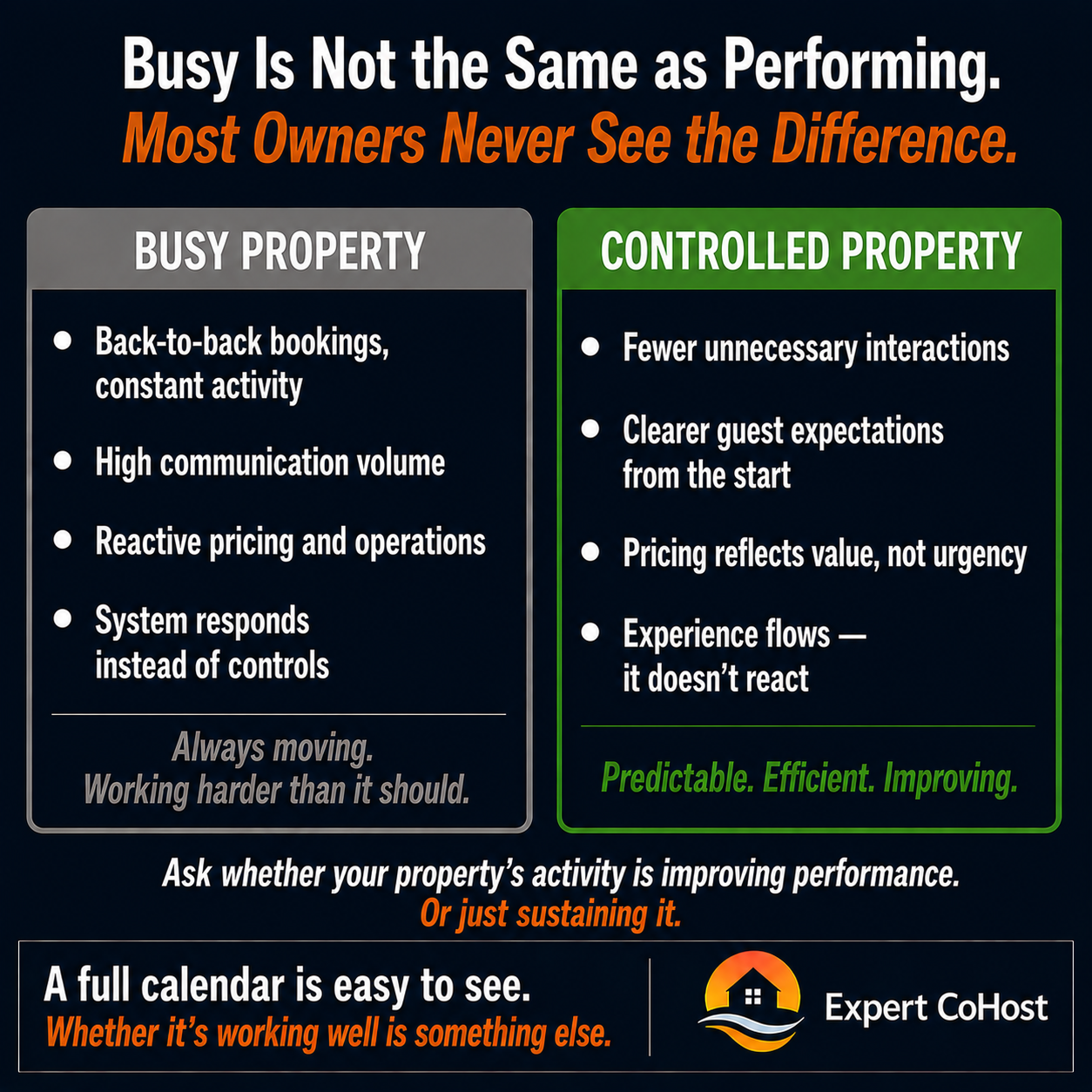
Some Airbnbs feel constantly in motion.
New bookings.
Frequent check-ins.
Ongoing guest messages.
Back-to-back turnovers.
From the outside, it looks like success.
The property is active. In demand. Always moving.
But activity isn’t the same as performance.
Busy Doesn’t Mean Efficient
A busy property often signals one thing:
It’s easy to book.
That can come from:
- competitive pricing
- broad appeal
- high availability
But ease of booking doesn’t guarantee:
- strong margins
- aligned guests
- consistent experiences
In many cases, it creates the opposite.
Where the Pressure Shows Up
High activity tends to increase:
- guest communication volume
- operational coordination
- reactive problem-solving
- dependency on quick responses
Everything feels urgent.
Everything requires attention.
And over time, that creates strain—not leverage.
More Movement, Less Control
When a property relies on constant activity to perform:
- pricing becomes reactive
- guest mix becomes inconsistent
- expectations become harder to manage
Instead of controlling performance, the system starts responding to it.
The Hidden Tradeoff
More bookings often mean:
- more variation in guest expectations
- more edge cases
- more opportunities for friction
Even if each issue is small, the volume adds up.
And that affects:
- review consistency
- operational efficiency
- long-term stability
Why It Feels Like Progress
A busy property creates visible signals:
- notifications
- reservations
- constant engagement
It feels productive.
But those signals don’t measure:
- how aligned the guests are
- how smooth the experience feels
- how sustainable the system is
What Strong Performance Actually Looks Like
High-performing Airbnbs don’t always feel busy.
They feel controlled.
They operate with:
- fewer unnecessary interactions
- clearer guest expectations
- smoother check-ins and stays
- more predictable outcomes
The experience flows instead of reacting.
This Connects Back to Occupancy
A fully booked calendar often creates this kind of busyness.
More bookings → more activity → more complexity
Which reinforces the idea that:
activity = performance
Even when it isn’t.
The Real Shift
Most owners ask:
“How do I keep my calendar full and active?”
A better question is:
“Is this level of activity actually improving performance—or just sustaining it?”
Because a property that feels busy isn’t necessarily performing well.
It may just be working harder than it should.