
Some Airbnb hosts feel exhausted even when business is performing well.
The calendar stays booked.
Revenue looks healthy.
Guests are still coming.
And yet, running the property feels emotionally draining.
Not occasionally.
Constantly.
Many hosts assume this means they simply need:
- more automation
- better staff
- more time off
- fewer responsibilities
But burnout in short-term rentals often runs deeper than workload alone.
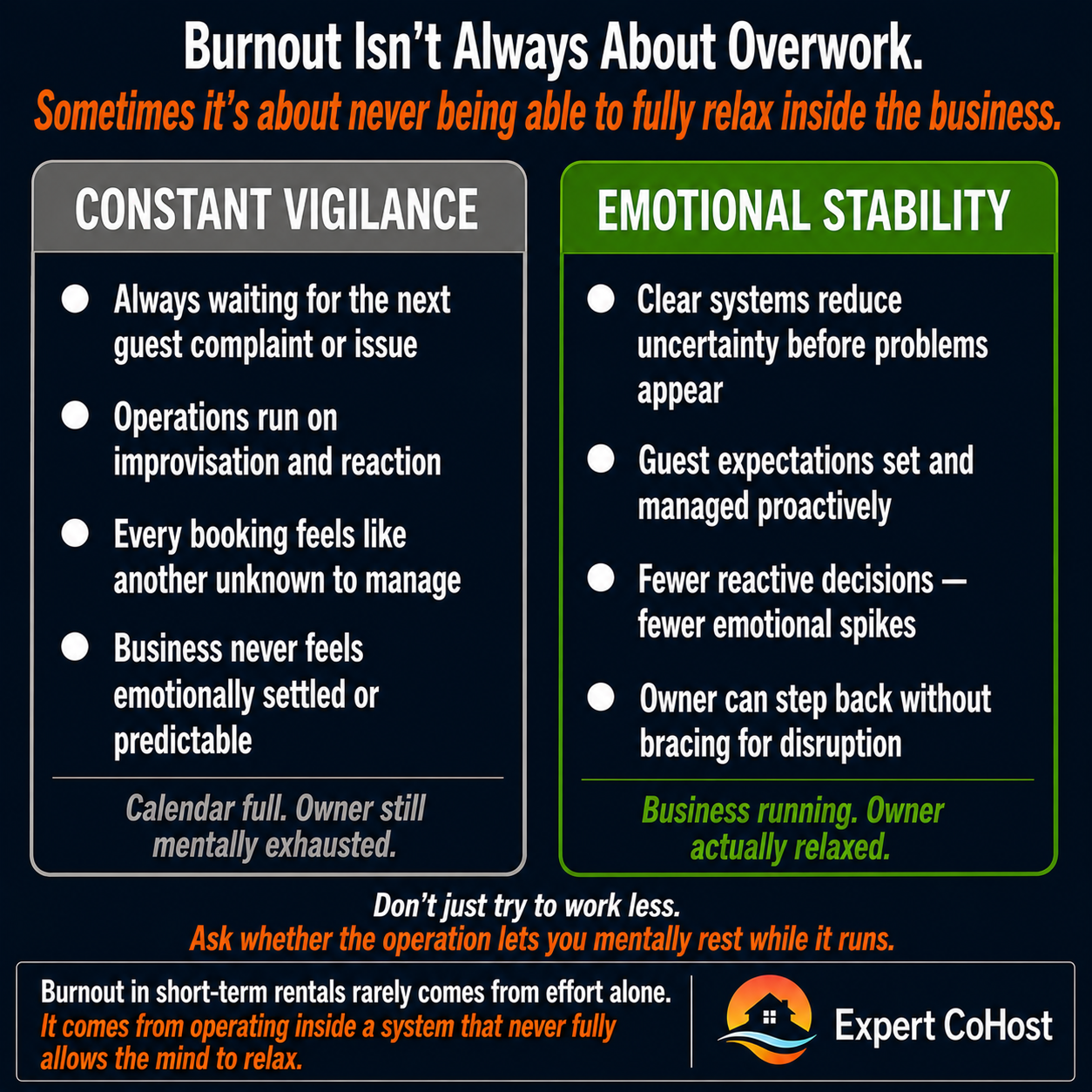
In many cases, the real problem is constant emotional vigilance.
Hosting Keeps Many Owners Mentally “On”
One of the hardest parts of short-term rentals is that the business rarely feels fully settled.
Even during successful periods, many hosts remain mentally alert:
- waiting for guest messages
- anticipating complaints
- monitoring reviews
- watching for operational issues
- worrying about unexpected problems
The property may be running.
But emotionally, the host never fully relaxes.
That constant background tension slowly becomes exhausting over time.
Burnout Is Often Emotional More Than Physical
Many hosts are not physically overworked in the traditional sense.
What drains them is the emotional unpredictability of the business.
The feeling that:
- something could go wrong at any moment
- guest satisfaction feels fragile
- one bad review could create setbacks
- small operational issues may escalate unexpectedly
This creates a persistent state of low-level stress.
And unlike temporary busy periods, chronic emotional vigilance accumulates slowly.
Reactive Operations Create Constant Pressure
Burnout often grows fastest inside reactive systems.
When operations rely heavily on:
- solving problems as they appear
- responding emotionally under pressure
- constant improvisation
- unclear processes
- inconsistent guest expectations
hosts never feel operationally stable.
Every new booking feels like another unknown variable to manage.
That unpredictability creates mental fatigue far beyond the actual workload itself.
Emotional Labor Is Part of Hospitality
Short-term rentals are not purely operational businesses.
They’re emotional businesses too.
Hosts are constantly managing:
- guest expectations
- reassurance
- communication tone
- tension during problems
- emotional perception during the stay
Even calm, professional hosting requires emotional regulation.
And emotional regulation consumes energy — especially when repeated continuously without recovery.
Small Friction Compounds Quietly
Many hosts don’t burn out from one major event.
They burn out from accumulation.
A difficult guest here.
A maintenance issue there.
Late-night communication.
Operational uncertainty.
Fear of negative reviews.
Constant decision-making.
None of these individually seem catastrophic.
But together, they slowly create emotional exhaustion.
Especially when the business never feels truly predictable.
Strong Systems Reduce Emotional Weight
The healthiest short-term rental operations often feel calmer behind the scenes.
Not because problems never happen.
But because systems reduce uncertainty.
Clear operations create:
- smoother guest experiences
- more predictable communication
- fewer preventable issues
- greater emotional stability for the host
That stability matters more than many operators realize.
Because burnout decreases significantly when the business stops feeling emotionally fragile.
Sustainable Hosting Feels Different
Long-term sustainable hosting usually feels:
- more organized
- less reactive
- emotionally steadier
- easier to mentally disconnect from
The host no longer feels constantly “on guard.”
Instead of fearing disruption constantly, they trust the systems supporting the experience.
That emotional shift changes the entire relationship with the business.
The Real Shift
Many Airbnb hosts believe burnout means they need less work.
But often, the deeper problem is something else entirely.
The business keeps demanding emotional recovery just to sustain it.
Because burnout in short-term rentals rarely comes from effort alone.
It comes from operating inside a system that never fully allows the mind to relax.