
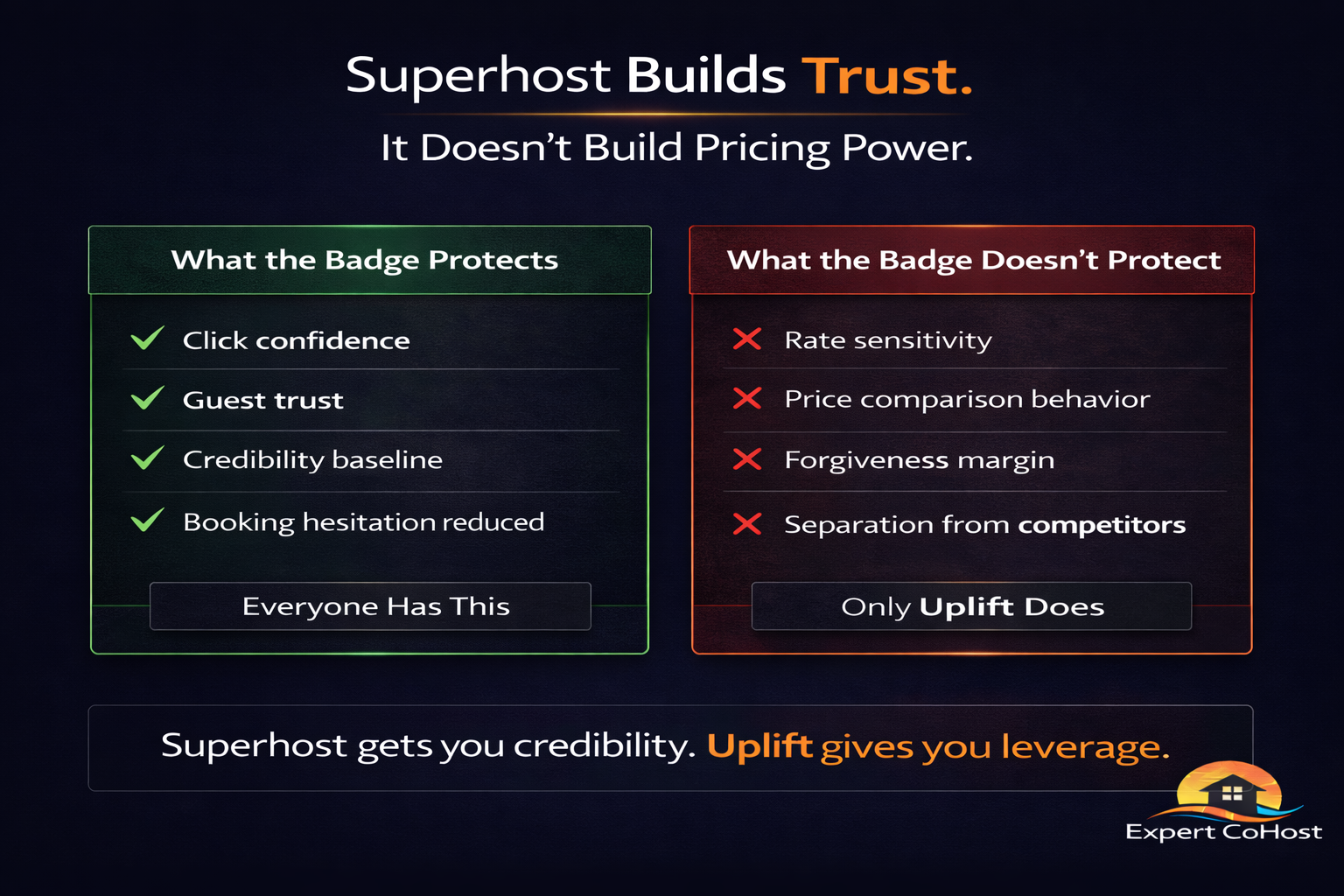
Becoming a Superhost builds trust.
The badge tells guests:
-
You’re responsive.
-
You’re reliable.
-
You consistently deliver solid stays.
That credibility matters.
But credibility is not the same as pricing power.
And this is where many experienced hosts are surprised:
You can be a Superhost — and still be highly vulnerable to price pressure.
The Badge Builds Trust. It Doesn’t Eliminate Competition.
Superhost reduces friction at the decision stage.
It may improve:
-
Click confidence
-
Baseline conversion
-
Perceived reliability
But in competitive markets, many listings carry the badge.
When everyone is credible, credibility stops being a differentiator.
And when differentiation weakens, price becomes the comparison tool.
Price Pressure Is a Signal, Not a Market Condition
Many hosts attribute pricing pressure to:
-
Seasonality
-
Market saturation
-
Economic shifts
-
Increased competition
Those factors matter.
But pricing pressure often reflects something more specific:
A lack of separation.
If your listing competes primarily on:
-
location
-
bedroom count
-
amenities
-
and rating within the 4.8 range
Guests will compare closely.
And close comparisons amplify price sensitivity.
Why 4.8-Level Performance Feels Fragile
Superhost requires a 4.8+ rating.
At that level, performance is stable.
But stable is not dominant.
Listings clustered between 4.7 and 4.9 often behave similarly:
-
Guests compare side-by-side
-
Conversion depends on small differences
-
Minor price adjustments influence decisions
At this tier, a small rate increase can stall bookings.
Not because the property isn’t good.
But because confidence is not overwhelming.
What Strong Pricing Power Actually Looks Like
Listings operating closer to 4.95+ performance often experience:
-
Earlier bookings at target rates
-
Less reactive discounting
-
Higher tolerance for premium pricing
-
Guests who compare less aggressively
These listings aren’t immune to market forces.
But they don’t rely on price to drive demand.
Their leverage absorbs fluctuations.
The Cycle of Reactive Pricing
When pricing becomes the primary lever, a pattern emerges:
-
Bookings slow
-
Price adjusts downward
-
Occupancy rises
-
Pricing confidence weakens
-
Guests become more price-sensitive
Over time, the listing becomes:
-
Busy
-
Stable
-
Price-dependent
The Superhost badge remains.
But leverage erodes.
Why Premium Properties Feel This More
Higher nightly rates increase stakes.
When guests are spending more:
-
They compare more carefully
-
They scrutinize reviews more deeply
-
They hesitate more when confidence is partial
At premium levels, a small gap in confidence creates larger pricing sensitivity.
Which means Superhost alone is not enough to sustain premium positioning.
Superhost Is a Floor, Not a Shield
The badge protects credibility.
It does not shield against commoditization.
If your listing looks interchangeable with others at the same rating tier, price becomes the tiebreaker.
True pricing resilience comes from:
-
Exceptional review enthusiasm
-
Tight expectation alignment
-
Frictionless arrival
-
Consistent operational execution
-
Clear differentiation
Those create uplift.
And uplift supports price.
The Better Question to Ask
Instead of asking:
“Should we lower rates?”
Ask:
“Why does the market hesitate at our current rate?”
That shift moves the focus from price to positioning.
And positioning is what determines pricing power.
Final Thought
Superhost status earns trust.
But trust alone doesn’t eliminate competition.
If your pricing feels fragile — if bookings require constant adjustment — the issue isn’t the badge.
It’s the absence of separation.
In a concentrated marketplace, pricing resilience belongs to listings that build confidence beyond the baseline.
Superhost gets you credibility.
Uplift gives you leverage.
And leverage is what protects you from price pressure.