
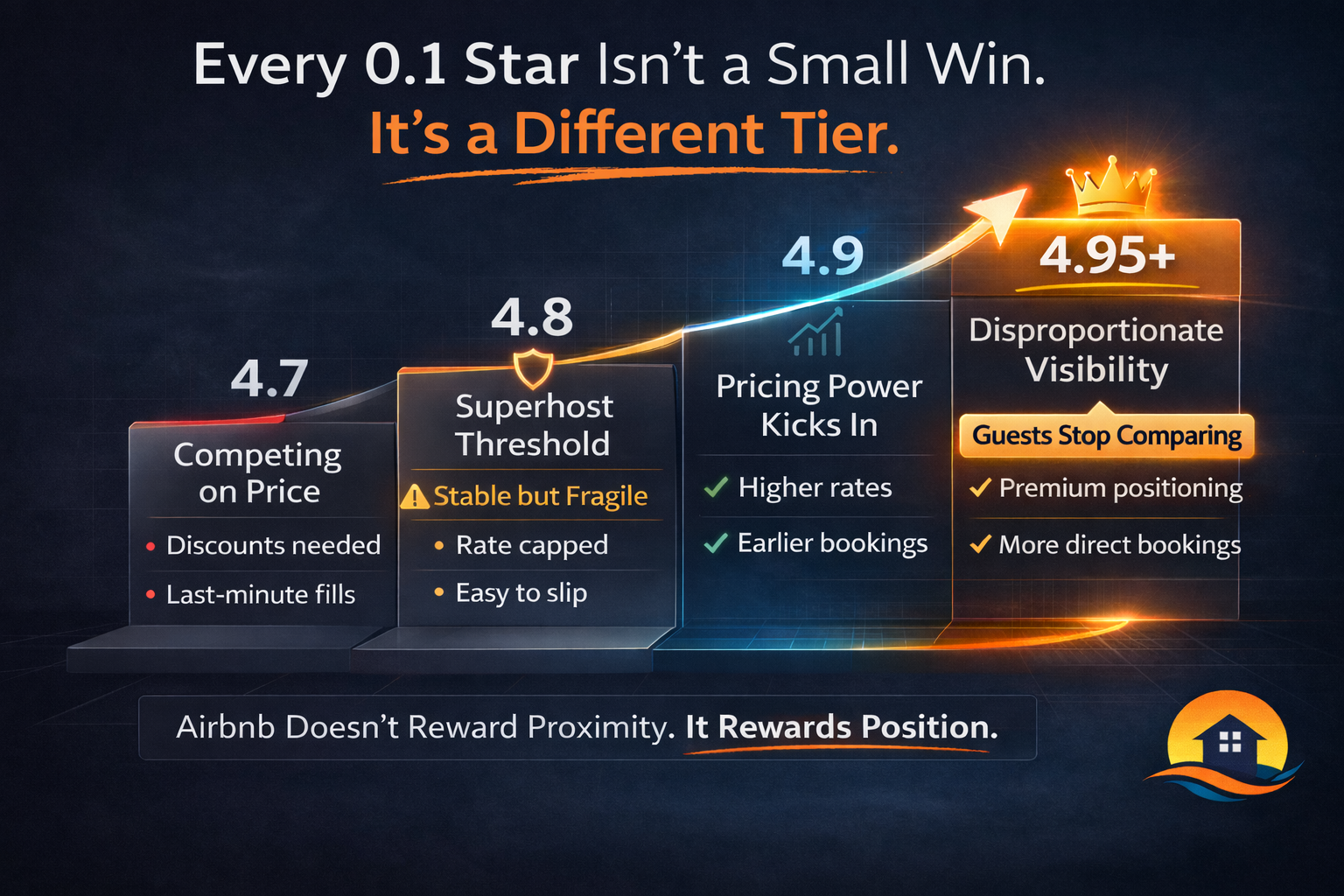
On Airbnb, ratings don’t work the way most people assume.
A 0.1-star difference sounds trivial.
It feels cosmetic — almost academic.
But in practice, every tenth of a star moves a listing into a different performance tier. And the impact is not incremental — it’s disproportionate.
Understanding why is the key to unlocking real leverage.
Airbnb Performance Is Not Linear
Most owners assume ratings work like grades:
-
4.6 = good
-
4.7 = better
-
4.8 = very good
-
4.9 = excellent
But Airbnb doesn’t treat ratings as a smooth scale.
It treats them as signals.
And signals trigger step-changes in how listings are surfaced, trusted, and converted.
That’s why two listings that look almost identical on paper can perform radically differently.
What a 0.1-Star Change Actually Signals
A small rating increase doesn’t just say:
“Guests were slightly happier.”
It signals:
-
greater reliability
-
fewer unresolved issues
-
better expectation alignment
-
smoother execution
-
higher likelihood of a positive stay
To Airbnb’s system, that translates into confidence.
And confidence changes how a listing is treated.
Where the Uplift Comes From
When a listing crosses certain rating thresholds, multiple things happen at once:
1. Pricing Power Improves
Listings in higher rating tiers consistently support:
-
15–25% stronger ADR as they move from high-4.7/4.8 into the 4.8–4.9+ range
-
30–40% pricing resilience at consistent 4.9–5.0 performance
Not because owners raised prices — but because guests accepted them.
That’s leverage.
2. Booking Velocity Increases
Higher-rated listings tend to:
-
convert faster
-
book earlier at the same price
-
require fewer discounts to fill gaps
This isn’t “more bookings” — it’s healthier bookings.
Velocity improves because hesitation decreases.
3. Visibility Compounds
Airbnb disproportionately surfaces listings it trusts.
As ratings rise:
-
impressions improve
-
comparisons become more favorable
-
guest selection bias increases
The system amplifies confidence — and confidence compounds.
Why the Curve Steepens Near the Top
The closer a listing gets to the top tier, the steeper the performance curve becomes.
Why?
Because competition thins.
At higher rating levels:
-
there are fewer alternatives
-
guests become less price-sensitive
-
trust replaces comparison shopping
A 0.1-star increase near the top doesn’t just add value — it separates.
That’s why “almost excellent” performs nothing like excellent.
Why This Isn’t About Perfection
This isn’t about chasing flawless scores.
It’s about understanding that:
-
small, repeatable improvements compound
-
invisible friction matters more than amenities
-
consistency outperforms occasional excellence
Listings don’t jump tiers by adding features.
They move tiers by removing friction.
Why This Scales With Property Size
These effects don’t flatten for larger or higher-value properties.
They magnify.
Higher base rates, larger group stays, and premium expectations mean:
-
pricing power matters more
-
forgiveness matters more
-
confidence matters more
A 0.1-star shift on a premium property unlocks more leverage, not less.
The Trap of “Close Enough”
One of the most expensive mindsets in short-term rentals is:
“We’re basically there.”
At 4.7–4.8, that mindset feels reasonable.
But Airbnb doesn’t reward proximity — it rewards position.
Being close to the next tier does not deliver the benefits of being in it.
The Better Way to Think About Ratings
Instead of viewing ratings as a scorecard, think of them as levers.
Each tenth of a star:
-
changes guest behavior
-
changes pricing tolerance
-
changes algorithmic treatment
-
changes long-term momentum
That’s why small gains feel large.
Final Thought
Every 0.1 star matters — not because the number is important, but because of what it represents.
On Airbnb, performance doesn’t improve smoothly.
It improves in steps.
And those steps are unlocked not by chasing perfection, but by consistently removing the small frictions that prevent a great experience from feeling effortless.
That’s where disproportionate uplift comes from.