
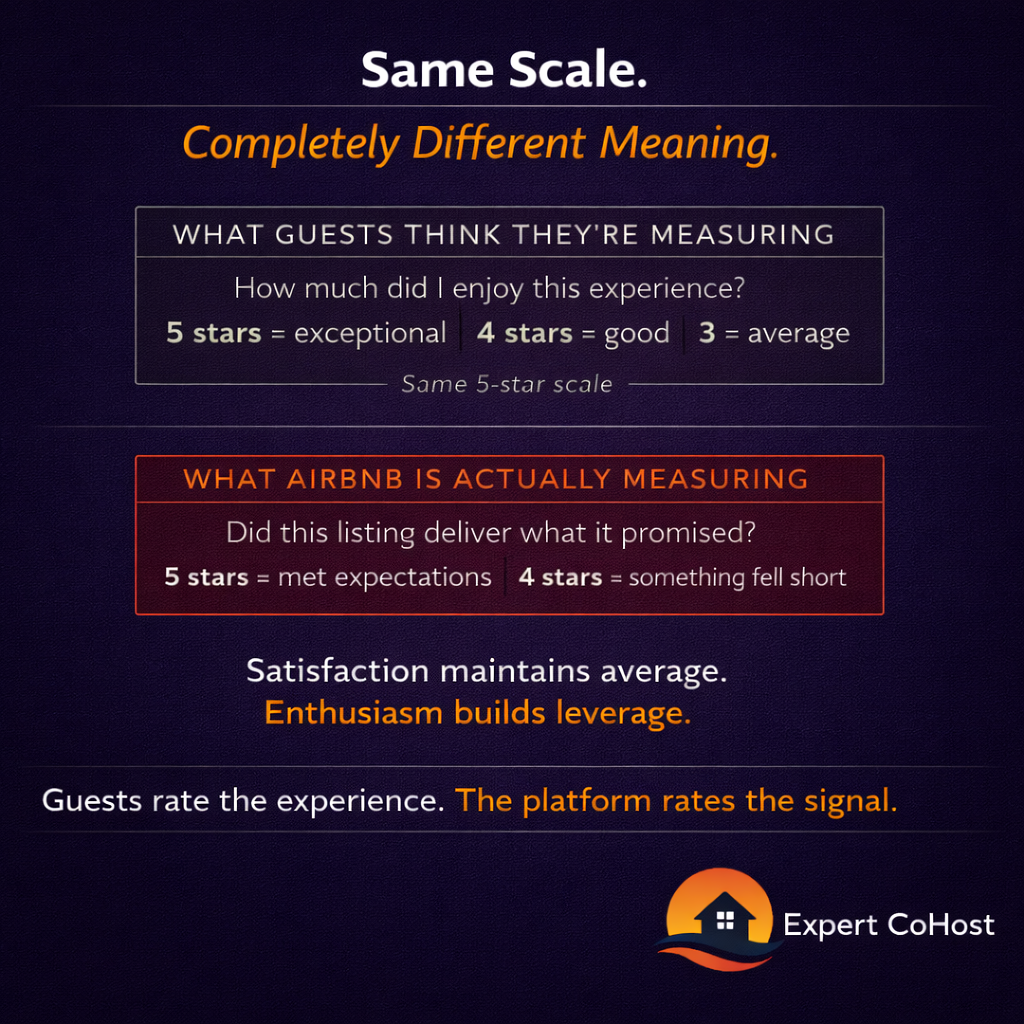
Most guests think they understand star ratings.
Five stars means excellent.
Four stars means good.
Three stars means average.
This mental model is almost universal. It comes from decades of how ratings have been used across industries.
Restaurants, hotels, ride-sharing apps, and online shopping platforms all follow a similar pattern: five stars represents something exceptional, and four stars represents a solid experience.
But Airbnb’s rating system operates differently.
That difference is why many guests — and even many hosts — find the platform confusing.
The Scale Looks Familiar, But Behaves Differently
On the surface, Airbnb uses a simple five-star scale. It appears straightforward.
But because Airbnb is a competitive marketplace where listings are ranked and filtered based on performance, the meaning of each star shifts slightly.
In practice, the platform tends to interpret ratings more like this:
| Rating | What Guests Often Mean | How the Platform Interprets It |
|---|---|---|
| 5 stars | Excellent | Stay met expectations |
| 4 stars | Good | Something fell short |
| 3 stars | Average | Significant issues |
| 2 stars | Poor | Major problems |
| 1 star | Bad | Unacceptable stay |
The gap between what guests mean and how the system interprets ratings creates confusion.
A guest may believe they left a positive review.
But the platform may treat it as a signal that something went wrong.
Why Platforms Design Ratings This Way
To understand the system, it helps to understand the marketplace.
Airbnb is not just a review platform. It is a search and ranking engine for accommodations.
The platform must decide which listings appear first when travelers search.
To do that, it evaluates many signals, including:
-
Guest reviews
-
Response times
-
Booking patterns
-
Cancellation history
-
Listing accuracy
Ratings are one of the strongest signals.
When thousands of listings compete in the same market, even small rating differences help determine which listings are surfaced more often.
This is why the system tends to treat five stars as the expected outcome rather than the exceptional one.
The Difference Between Satisfaction and Enthusiasm
Another reason the system feels confusing is that ratings measure two different things at the same time.
Guests think they are measuring satisfaction.
The platform is often measuring enthusiasm.
A satisfied guest might say:
“It was a good stay. I’d come back.”
That guest may feel comfortable leaving four stars.
But from the platform’s perspective, the strongest signal comes from guests who feel enthusiastic enough to leave five stars and write highly positive reviews.
This difference means that the system quietly rewards experiences that generate strong enthusiasm rather than simple satisfaction.
Why Even Experienced Travelers Misinterpret It
The misunderstanding happens because travelers bring expectations from other rating systems.
In most contexts:
-
Four stars is positive.
-
Five stars is exceptional.
So when guests reserve five stars for only the most memorable stays, they believe they are being thoughtful reviewers.
But Airbnb’s structure encourages a different interpretation.
Five stars means the stay delivered what was promised.
Anything less suggests that expectations were not fully met.
Most guests simply are not aware of that distinction.
Why This Matters for the Guest Experience
Understanding the rating system helps explain why many hosts focus heavily on details.
Hosts know that small issues can quietly influence ratings, even if guests do not mention them directly.
Minor friction such as:
-
Slight confusion during check-in
-
Unclear instructions
-
Small expectation gaps
may not produce complaints, but they can influence whether a guest feels enthusiastic enough to leave five stars.
That is why experienced hosts often focus on refining the experience rather than simply adding amenities.
The Role of Clear Expectations
The most effective way to reduce rating confusion is not by asking for better reviews.
It is by aligning expectations clearly.
When guests know exactly what to expect — and the experience matches or exceeds that expectation — the rating decision becomes easier.
Guests feel confident that the stay delivered what was promised.
That clarity benefits everyone involved.
A System That Rewards Consistency
Ultimately, Airbnb’s rating structure rewards consistency.
Listings that deliver the experience they promise, every time, tend to accumulate strong reviews and maintain visibility in the marketplace.
Listings that create small mismatches between expectation and reality often see ratings soften slightly over time.
Those small differences compound.
This is why attention to detail plays such an important role in successful short-term rentals.
Final Thought
The Airbnb rating system feels confusing because it looks like a traditional five-star scale but operates more like a performance signal inside a competitive marketplace.
Guests often believe they are leaving a positive review when they leave four stars.
The platform interprets that rating differently.
Understanding this dynamic helps explain why hosts pay such close attention to the small details of the guest experience.
Because in a system where small differences matter, clarity and consistency make all the difference.