
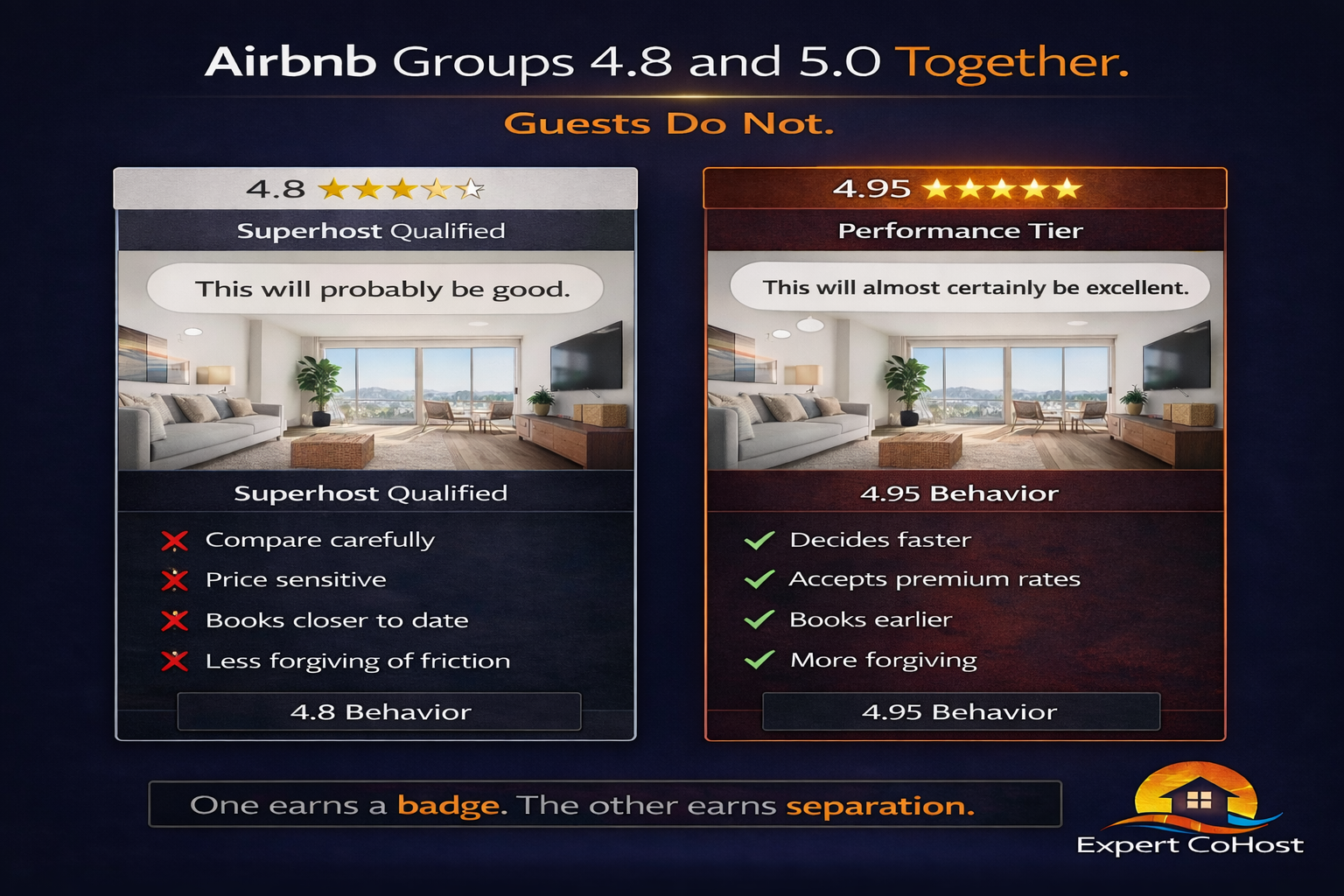
Airbnb treats a 4.8 rating as elite.
At 4.8, you qualify for Superhost.
You earn the badge.
You’re publicly recognized as reliable.
On paper, 4.8 and 5.0 live in the same neighborhood.
In practice, they do not behave the same.
And that difference has real economic consequences.
4.8 Is a Threshold. 5.0 Is a Signal.
Airbnb’s Superhost qualification begins at 4.8.
That makes 4.8 feel like a destination.
But from a guest’s perspective, ratings don’t function as thresholds — they function as signals.
A 4.8 says:
“This will probably be good.”
A 5.0 (or consistent 4.95+ performance) says:
“This will almost certainly be excellent.”
That distinction changes behavior.
And behavior drives performance.
The Psychology of the First Page
When guests search, they compare quickly.
They scan:
-
Ratings
-
Review counts
-
Photos
-
Price
In competitive markets, listings often cluster tightly between 4.7 and 4.9.
Inside that narrow band, small differences influence:
-
Click confidence
-
Conversion likelihood
-
Price sensitivity
A 4.8 competes.
A 4.95+ often separates.
The visual difference may be small.
The psychological difference is not.
Confidence Affects Pricing Power
Guests are more tolerant of premium pricing when:
-
The rating is near-perfect
-
Reviews feel enthusiastic
-
Consistency appears absolute
At 4.8, guests may still compare carefully.
At near-5.0 levels, guests often compare less and decide faster.
That shift impacts:
-
ADR resilience
-
Willingness to book earlier
-
Discount dependence
-
Overall leverage
Pricing doesn’t create that confidence.
Ratings help reflect it.
The “Almost Excellent” Plateau
One of the most common ceilings in short-term rentals is 4.8–4.85.
Nothing feels broken.
Reviews are positive.
Operations are stable.
But enthusiasm is uneven.
Small friction points remain.
Communication is good — not exceptional.
Arrival is smooth — not effortless.
Guests are satisfied — not delighted.
Those small differences accumulate.
And in a winner-take-most marketplace, accumulated differences matter.
The Forgiveness Factor
Listings operating closer to 5.0 often benefit from something subtle but powerful:
Forgiveness.
Guests who expect excellence are often more generous when minor issues arise — because their overall confidence remains high.
Listings hovering around 4.8 may not receive the same grace.
Small issues feel more material.
Review language softens more easily.
The gap widens over time.
Airbnb May Group 4.8 and 5.0 — Guests Do Not
From Airbnb’s qualification standpoint, 4.8 is enough.
From a guest’s decision standpoint, it is not identical.
Guests don’t think in terms of program requirements.
They think in terms of risk.
Near-perfect ratings reduce perceived risk dramatically.
Reduced risk increases conversion and pricing tolerance.
That is where disproportionate uplift begins.
The Compounding Effect
Small rating improvements produce:
-
Slightly stronger conversion
-
Slightly better visibility
-
Slightly higher pricing confidence
Each of those reinforces the next.
Over time, the listing that moves from 4.8 to 4.95+ experiences:
-
Earlier bookings
-
Less reactive pricing
-
Stronger review enthusiasm
-
Reduced operational stress
The listing that remains at 4.8 may remain stable — but not advantaged.
Why This Matters More for Premium Properties
Higher nightly rates increase expectations.
The difference between “very good” and “exceptional” becomes more meaningful when:
-
Guests are paying premium rates
-
Larger groups are involved
-
Trip stakes are higher
At higher price points, confidence matters more.
And confidence lives in small rating differences.
The Strategic Implication
This is not about obsessing over perfection.
It’s about recognizing that in a concentrated marketplace, small gaps produce structural consequences.
4.8 qualifies you for recognition.
5.0 (or near-perfect performance) qualifies you for separation.
Those are different goals.
Final Thought
Airbnb may treat 4.8 as elite.
The marketplace does not.
If your goal is simply to maintain Superhost status, 4.8 is sufficient.
If your goal is to unlock real pricing power and compounding performance, “almost excellent” is not close enough.
Because in today’s Airbnb environment, the difference between good and exceptional isn’t emotional.
It’s economic.