
Most hosts improve their listings reactively.
A guest complains.
A review mentions an issue.
A rating dips.
Then adjustments are made.
But by the time feedback appears publicly, the friction has already cost you.
The strongest operators do not wait for complaints.
They audit proactively.
And they do it without asking guests what went wrong.
Because guests rarely articulate what actually lowered their internal score.
Why Guest Feedback Is Incomplete
Guest reviews are:
-
Polite
-
Compressed
-
Emotionally filtered
-
Written quickly
They capture outcomes — not process.
They tell you how the stay felt.
They rarely tell you where friction occurred.
A guest might write:
“Great place. Would stay again.”
But still rate 4 stars overall.
The explanation for that 0.1 star rarely appears in text.
Which means you need a different system.
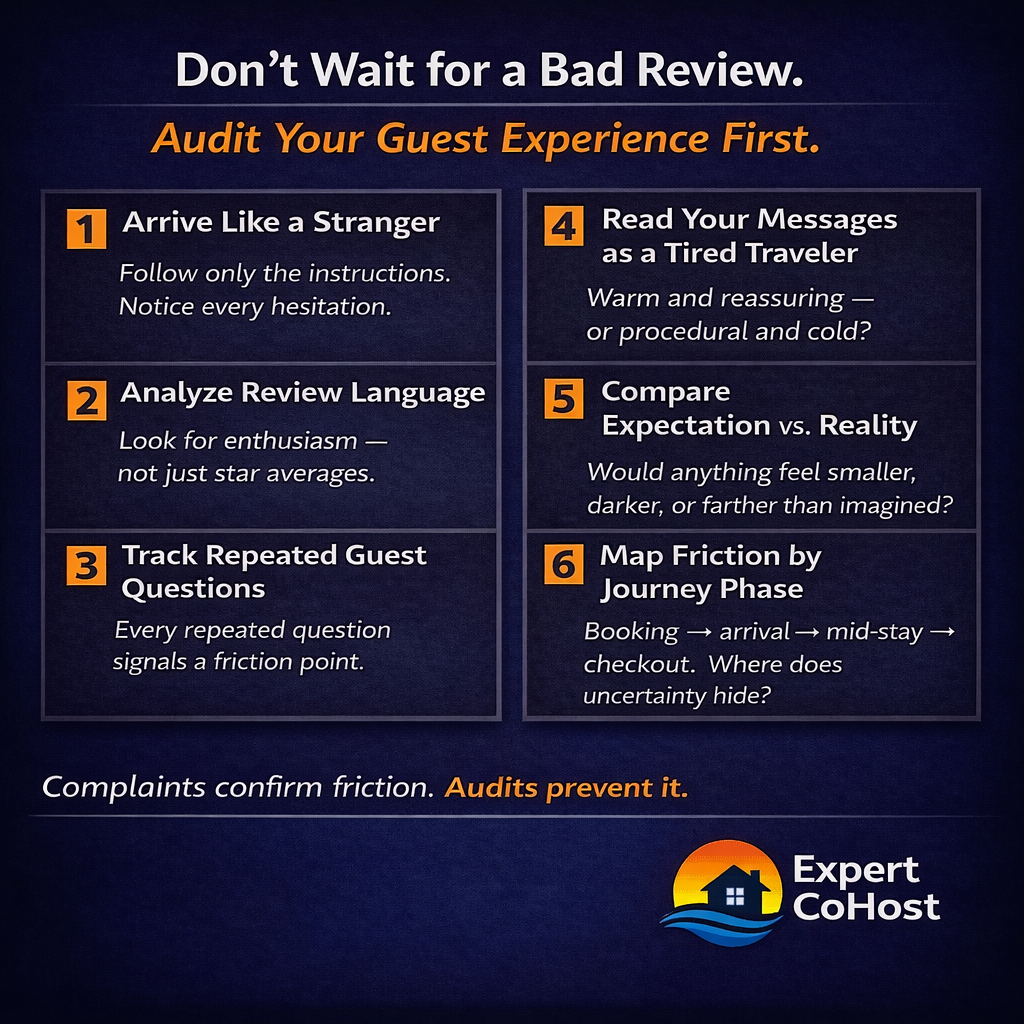
Step 1: Audit the Arrival Like a Stranger
You are no longer objective about your property.
You know where the light switches are.
You know how the driveway curves.
You know how the thermostat behaves.
Your guest does not.
To audit properly:
-
Arrive after dark.
-
Follow only the instructions provided.
-
Pretend you have never visited.
-
Bring luggage.
-
Notice every hesitation.
Where do you pause?
Where do you reread instructions?
Where do you adjust immediately?
Those are friction points.
Not dramatic — but influential.
Step 2: Analyze Review Language, Not Just Ratings
Do not just look at your star average.
Look at patterns.
Are reviews filled with:
-
“Amazing”
-
“Perfect”
-
“Flawless”
-
“Incredible stay”
Or do they say:
-
“Nice place”
-
“Good overall”
-
“As described”
Polite language often signals missed enthusiasm.
Enthusiasm drives leverage.
Neutrality caps it.
Step 3: Track Micro-Questions
Pay attention to repeated guest questions.
If multiple guests ask:
-
“Where do we park?”
-
“How does the hot tub work?”
-
“What’s the WiFi password?”
-
“Are we supposed to take out trash?”
Your instructions are not frictionless.
If guests need clarification, the experience requires effort.
Effort reduces confidence.
Confidence influences ratings.
Step 4: Review Message Tone Objectively
Read your automated messages as if you were exhausted from travel.
Do they feel:
-
Warm
-
Clear
-
Reassuring
Or:
-
Transactional
-
Overly directive
-
Defensive
Hospitality is not only operational.
It is emotional.
Tone shapes perception long before checkout.
Step 5: Compare Expectation vs. Reality
Re-read your listing description carefully.
Ask:
If I had never stayed here, would anything feel smaller, darker, louder, or farther than I imagined?
Expectation gaps do not produce complaints.
They produce softened enthusiasm.
And softened enthusiasm compounds.
Step 6: Conduct a “Friction Heat Map”
Mentally divide the guest journey into phases:
-
Booking
-
Pre-arrival communication
-
Arrival
-
First night
-
Mid-stay
-
Checkout
In each phase, ask:
Where might uncertainty occur?
Mark those moments.
Most listings do not fail in obvious ways.
They leak confidence at multiple small points.
Mapping those points reveals where uplift is being lost.
Step 7: Evaluate Pricing Resilience
Pricing can also serve as a diagnostic tool.
If small increases stall bookings immediately, friction may be present.
If bookings continue steadily at target rates, confidence is likely stronger.
Pricing does not create uplift.
It reveals it.
Why This Matters at 4.8
At 4.8, nothing feels broken.
That is precisely why refinement slows.
But the difference between 4.8 and consistent 4.95+ performance often lies in:
-
Reduced hesitation
-
Clearer communication
-
Tighter expectation alignment
-
Seamless arrival
-
Visible care
These are not dramatic upgrades.
They are incremental refinements.
And incremental refinements compound.
The Strategic Advantage of Proactive Auditing
Waiting for complaints means:
-
You improve after friction spreads
-
Ratings soften before correction
-
Momentum slows before adjustment
Auditing proactively means:
-
Friction is removed before it appears in reviews
-
Confidence strengthens quietly
-
Performance compounds over time
This is the difference between maintenance and refinement.
Maintenance protects stability.
Refinement builds leverage.
Final Thought
Guests rarely tell you exactly what lowered their rating.
They adjust internally.
They soften enthusiasm.
They move from five stars to four without explanation.
If you want to move beyond the middle tier, you cannot rely on complaints to guide improvement.
You must look for hesitation.
You must study tone.
You must refine details.
Because in a concentrated marketplace, the listings that separate are not the ones that wait for feedback.
They are the ones that remove friction before it is ever named.