
A lot of property managers do not know what to do with Booking.com.
Some avoid it.
Some dismiss it as “more of a hotel platform.”
Some add it simply because it is a major travel site and assume that more visibility must be better.
None of those approaches is especially strategic.
Because Booking.com is not a channel that should be ignored casually, and it is not a channel that should be turned on casually either.
That is exactly why owners should pay attention.
Booking.com can be a valuable part of a vacation-rental distribution strategy. In some cases, it can be a very important one. But it also requires more intentionality than many property managers bring to it. It has a different operational feel, a different kind of travel reach, and a different set of management implications than platforms many owners are more familiar with.
That matters.
Because when a property manager treats Booking.com like just another duplicate listing destination, the owner is often the one absorbing the consequences.
Booking.com Is Important for a Different Reason
One of the biggest mistakes in vacation-rental distribution is assuming that every major platform should be judged by the same standard.
That is lazy thinking.
Airbnb, Vrbo, Booking.com, Google Vacation Rentals, Furnished Finder, direct bookings, and specialty channels are not all trying to do the same job.
Booking.com is a good example of that.
It often operates less like a classic vacation-rental marketplace and more like a large-scale global travel booking platform. That difference is important because it shapes everything from guest expectations to payment structure to operational rhythm.
In other words, Booking.com is not just “another place to list the property.”
It is a different kind of channel.
That is why the right question is not simply:
Should my property be on Booking.com?
The better question is:
What role would Booking.com play in this property’s distribution strategy, and are the systems behind the property strong enough to support it well?
That is a much more serious question.
And many property managers are not answering it.
What Booking.com Is Best For
Booking.com is especially strong when broad travel visibility matters.
It can expose a property to travelers who may not be searching the way traditional vacation-rental shoppers do. It can also help a property participate in a much larger travel ecosystem rather than relying only on vacation-rental-native channels.
That can be valuable.
For some properties, Booking.com may widen the top of the funnel. For others, it may bring useful international reach, urban-travel overlap, or broader demand beyond the usual short-term vacation-rental audience.
That is one reason some experienced operators take it seriously.
But that does not mean it is automatically a fit for every property.
A real manager should be able to explain why Booking.com belongs in the mix for a specific home or portfolio. Is it helping diversify demand? Is it useful because of the market? Is it supporting occupancy in ways the other channels are not? Is the property operationally strong enough to support the type of booking flow the channel may create?
If the manager has no thoughtful answer to those questions, that is a warning sign.
What Many Property Managers Miss About Booking.com
This is where the gap usually becomes obvious.
A lot of property managers think of Booking.com in one of two shallow ways.
Either they avoid it because it feels unfamiliar.
Or they activate it because it seems like a major site that should probably be included.
Neither approach is impressive.
Because Booking.com requires actual thought.
It often comes with different expectations around payments, guest communication, reservation controls, and operational handling. That means it should not be treated like a simple copy-and-paste extension of what is already working elsewhere.
A lot of managers miss that.
They assume the same listing logic, same communication logic, and same channel logic automatically carry over.
They do not.
That does not mean Booking.com is bad.
It means management depth matters more there than many people realize.
Booking.com Can Reward Strong Operators — and Expose Weak Ones
This is one of the most important points owners should understand.
Booking.com can be a useful channel.
But it tends to be less forgiving of sloppy systems.
That is because the platform often fits into a more structured travel-booking environment. When a property manager is not strong operationally, that structure can expose the weakness faster.
Weak settings.
Weak payment controls.
Weak messaging.
Weak guest handling.
Weak expectation management.
Weak follow-through.
Those problems do not always stay hidden.
And that is why some managers quietly dislike Booking.com. Not because the channel has no value, but because it demands more discipline than they are used to bringing.
Owners should think carefully about that.
If a property manager complains vaguely about Booking.com without being able to explain what specifically makes it harder, there is a decent chance the real issue is not the platform.
It is management capability.
Booking.com Is Not Just About Reach — It Is About Readiness
A lot of managers love to talk about reach.
Your property will be seen by more travelers.
Your listing will be in more places.
You will have broader exposure.
That all sounds good.
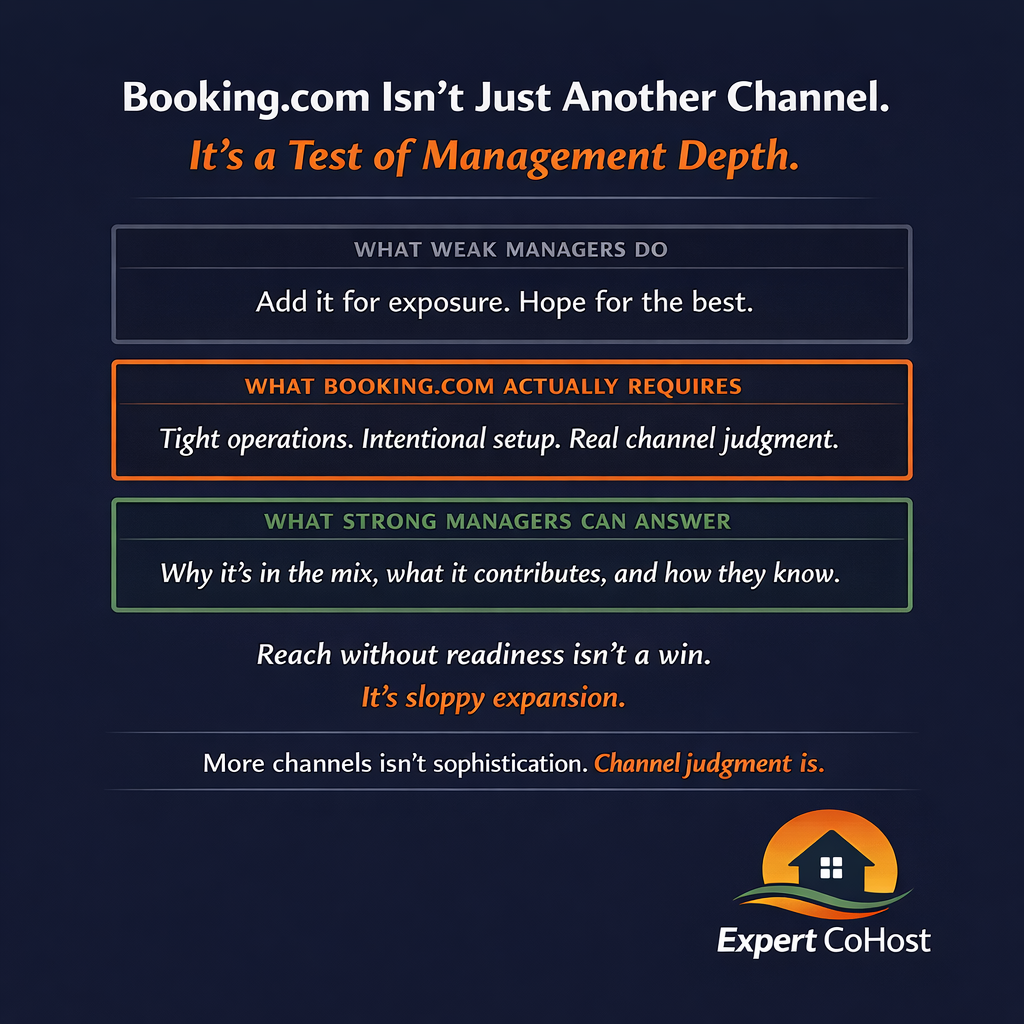
But reach without readiness is not very impressive.
A real strategy does not just ask whether a channel can bring more booking opportunities.
It asks whether the property is ready to support those opportunities well.
That is especially important with Booking.com.
If the property manager does not have strong communication systems, tight operational execution, and a real understanding of how the channel works, then broader reach may simply create more complexity, more avoidable issues, and more stress.
That is not a distribution win.
That is just sloppy expansion.
Booking.com Can Be Valuable for the Right Properties
This does not mean Booking.com should be avoided.
Quite the opposite.
For the right property, the right market, and the right operator, it can be a meaningful part of the booking mix.
That is what makes the platform worth understanding.
Some homes benefit from broader travel-platform exposure. Some markets benefit from tapping into a larger booking ecosystem. Some managers have the systems and operational maturity to use Booking.com well and capture real value from it.
That is the point.
The issue is not whether Booking.com is “good” or “bad.”
The issue is whether it is being used thoughtfully.
A good manager should know the difference.
Where Owners Get Misled
Owners often assume that if a property manager offers broad channel distribution, that means the manager is sophisticated.
Sometimes that is true.
Often it is not.
In many cases, “broad distribution” simply means the manager knows how to connect software and push listings live.
That is not the same thing as understanding channel strategy.
Booking.com makes this especially easy to spot.
A manager who really understands it should be able to explain:
Why the property is there.
What role it plays.
What operational demands it creates.
What kind of bookings it is expected to contribute.
How the team is prepared to handle it well.
How they know whether it is helping or hurting.
Those are not advanced questions.
They are basic strategic questions.
And yet many managers do not answer them clearly, because they are not really managing the channel at that level.
Booking.com Is a Test of Management Depth
This may be the clearest way to think about it.
Booking.com is not just another booking source.
It is a test.
A test of whether the manager actually understands distribution.
A test of whether operations are tight.
A test of whether the systems behind the listing are real.
A test of whether the manager knows the difference between more channels and better strategy.
That is why owners should not evaluate Booking.com based only on whether a few bookings come through.
That is too shallow.
The better question is whether the channel is being used intentionally, supported operationally, and managed with enough depth to make its inclusion worthwhile.
That is a much better standard.
What Owners Should Ask Their Property Manager About Booking.com
Owners do not need to know every technical detail.
But they should ask sharper questions.
For example:
Why is Booking.com part of my distribution strategy?
What kind of demand is it expected to bring?
How does it differ from the other major channels?
What operational risks or complexities come with it?
How is my property being set up to perform well there?
How do you know whether it is adding value or just adding complexity?
What systems do you have in place to support it well?
Those questions matter because they force the manager to reveal whether there is real thought behind the channel decision.
A weak manager usually hides behind generalities.
A strong manager can answer directly.
The Bigger Point
Booking.com is not a problem.
Shallow management is the problem.
The platform itself can be useful, strategic, and valuable.
But it is also one of the easiest places to see the difference between a property manager who understands real channel strategy and one who simply knows how to syndicate inventory.
That is the distinction owners should care about.
Because if a manager does not really understand Booking.com, there is a good chance they do not understand the rest of the channel mix very deeply either.
And if the channel mix is not being managed strategically, the owner is probably leaving performance on the table.
Final Thought
Booking.com should not be dismissed.
But it should not be added casually either.
It is a serious channel that can play a useful role in the right distribution strategy, especially when the property, market, and manager are a good fit for it.
The best property managers do not treat Booking.com like a box to check or a channel to fear. They understand what it is good at, where it fits, what it requires, and how to use it deliberately.
That is what owners should be paying for.
Not just broader exposure.
Real channel judgment.