
Most hosts think difficult guests arrive difficult.
Demanding people.
High-maintenance personalities.
Guests looking for problems.
And sometimes that’s true.
But in many cases, something else is happening.
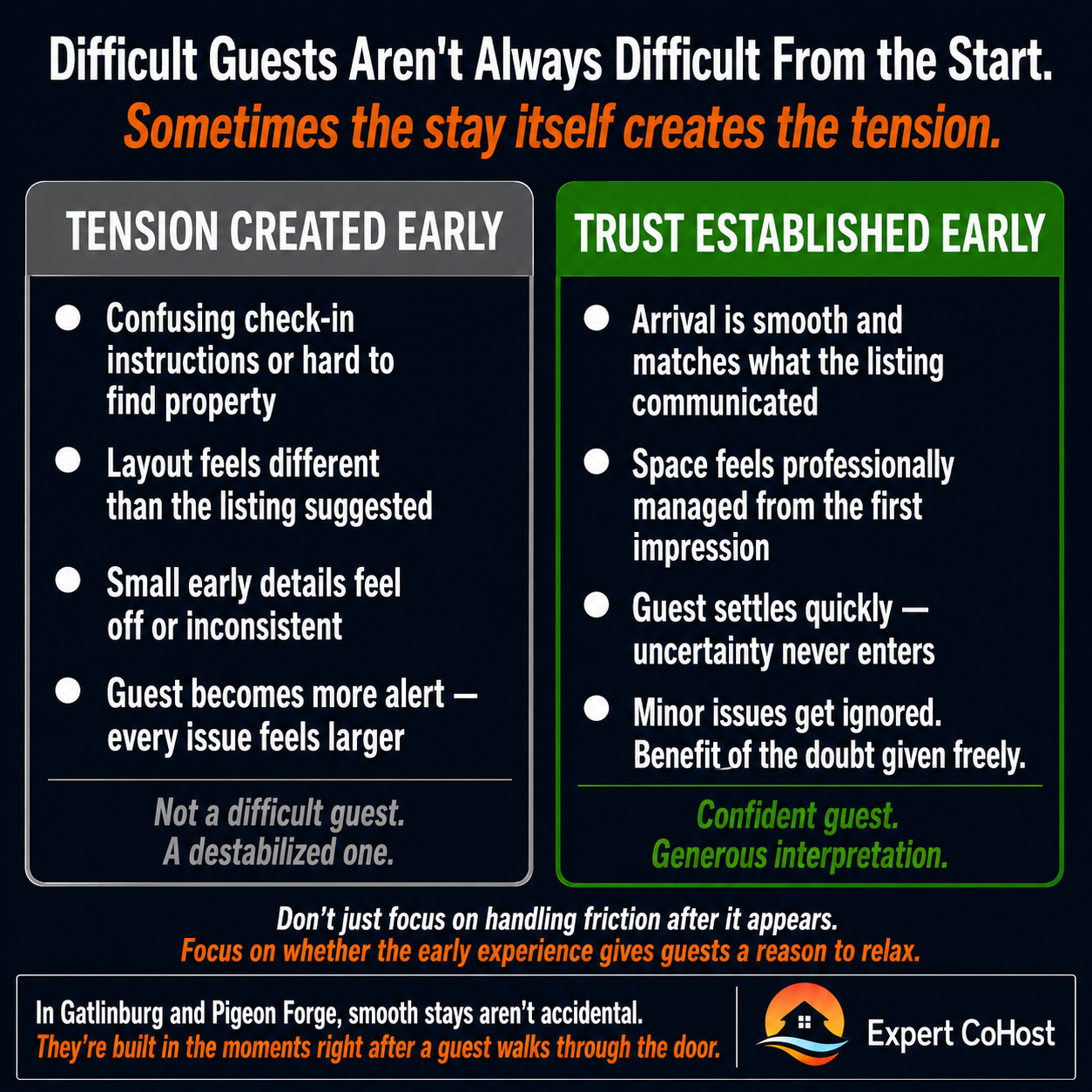
The guest experience itself begins creating tension after check-in.
Not necessarily through major failures.
But through small moments where the emotional experience starts drifting away from what the guest expected.
Guests Arrive With Emotional Expectations Already Formed
By the time guests check in, they already carry assumptions about:
- comfort
- cleanliness
- ease
- professionalism
- emotional atmosphere
- how smooth the experience will feel
Those expectations were shaped long before arrival.
Through:
- photos
- descriptions
- communication
- reviews
- pricing
- overall presentation
The listing creates an emotional promise — whether intentional or not.
And guests arrive expecting reality to match it.
Small Friction Changes Guest Psychology Quickly
Many difficult guest situations don’t begin with major operational problems.
They begin with smaller moments of uncertainty.
Things like:
- confusing entry instructions
- difficulty finding the property
- a layout that feels different than expected
- inconsistent cleanliness details
- unclear communication
- small maintenance issues
Individually, these may seem manageable.
But emotionally, they can quickly change how guests interpret the stay.
Because once uncertainty enters the experience, guests become more alert to additional problems.
Trust Is Fragile During Early Moments
The first part of the stay matters disproportionately.
Guests are subconsciously asking:
- “Did I make the right decision?”
- “Can I relax here?”
- “Will this experience feel easy?”
- “Can I trust the rest of the stay?”
When early moments feel smooth, guests usually settle emotionally.
But when confusion or disappointment appears immediately, trust weakens quickly.
And once trust drops, guest sensitivity tends to rise.
Emotional Disappointment Amplifies Small Problems
Interestingly, the same issue can feel dramatically different depending on the guest’s emotional state.
For example:
- a minor maintenance issue
- slightly slower communication
- a small cleanliness oversight
may feel insignificant to a guest who already feels confident and comfortable.
But to a guest who feels uncertain or disappointed early, those same issues may feel much larger.
Because emotional disappointment changes interpretation.
Guests stop evaluating the stay generously.
They begin evaluating it cautiously.
Guests React to Expectation Mismatch More Than Imperfection
Most guests do not expect perfection.
What they do expect is alignment.
They want the experience to feel consistent with:
- the listing
- the pricing
- the emotional tone created before arrival
When the stay feels emotionally aligned, guests usually tolerate small imperfections well.
But when reality feels different than expected, even small issues can create frustration quickly.
Stress Changes Guest Behavior
As guests become more uncertain, their behavior often changes.
They may become:
- more sensitive
- more demanding
- less patient
- more reactive
- more focused on problems
Not necessarily because they are unreasonable people.
But because the emotional foundation of the stay no longer feels stable.
That instability affects how every additional detail gets interpreted.
Strong Operations Create Emotional Stability
High-performing short-term rentals do more than provide a clean property.
They reduce uncertainty early.
The experience feels:
- clear
- smooth
- predictable
- emotionally reassuring
Guests quickly feel:
- “I’m in good hands.”
- “This feels professionally managed.”
- “I can relax now.”
That emotional stability changes the entire tone of the stay.
The Real Shift
Most hosts focus heavily on solving operational problems after guests become frustrated.
But often, the deeper issue began earlier.
Because many difficult guest situations don’t start with major failures.
They begin when the emotional experience guests expected no longer matches the one they believe they entered after check-in.