
One of the most confusing aspects of hosting is this:
A guest encounters a relatively minor issue.
Yet their reaction feels surprisingly strong.
Meanwhile, another guest experiences a larger inconvenience and barely mentions it.
From the host's perspective, it can feel inconsistent.
But from the guest's perspective, it often makes perfect sense.
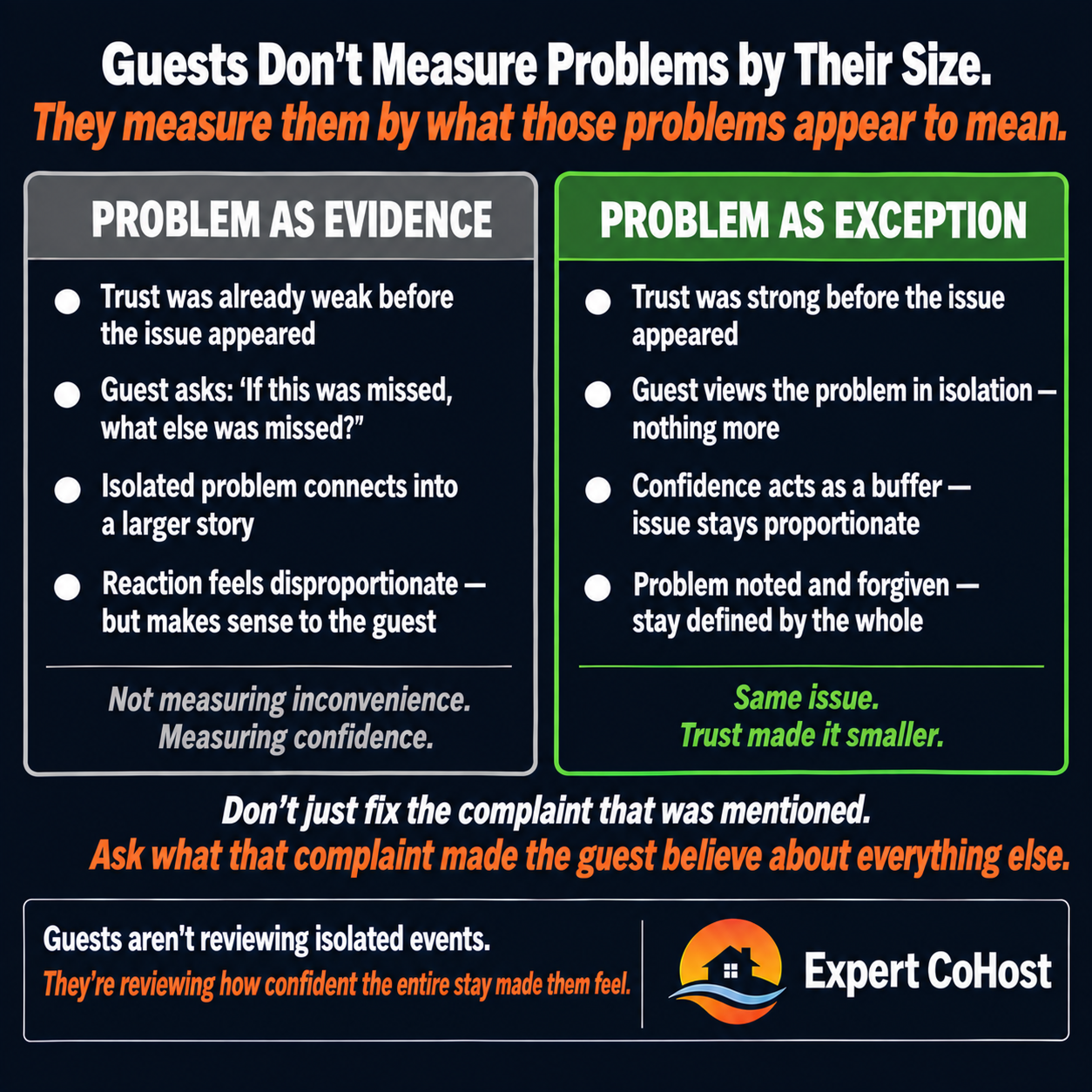
Because guests don't react to problems based solely on their size.
They react to what those problems appear to mean.
Guests Interpret Problems, Not Just Experience Them
Many hosts assume guest satisfaction is determined by what happens during the stay.
But interpretation often matters just as much as reality.
A loose cabinet handle isn't always just a loose cabinet handle.
A delayed response isn't always just a delayed response.
Guests naturally look for meaning behind what they encounter.
And that meaning shapes their reaction.
Small Problems Can Signal Bigger Concerns
Most guests understand that no property is perfect.
Minor issues happen.
But some issues trigger a deeper question:
"If this was missed, what else might have been missed?"
At that point, the problem becomes symbolic.
It no longer stands alone.
Instead, it begins influencing how guests view the rest of the experience.
Trust Determines Scale
One reason identical problems produce different reactions is trust.
When guests trust the property and host, they tend to view issues in isolation.
A problem remains a problem.
Nothing more.
But when trust is weak, guests often connect individual issues into a larger story.
The issue becomes evidence.
And evidence feels more significant than inconvenience.
First Impressions Amplify Everything
Many guest perceptions are established early.
If arrival feels smooth:
- instructions are clear
- expectations are met
- communication feels organized
guests begin with confidence.
That confidence acts as a buffer.
Small issues feel smaller.
But if the stay starts with uncertainty, guests become more sensitive to additional friction.
The same problem suddenly carries more weight.
Hosts Often Focus on the Wrong Thing
After receiving disappointing feedback, hosts naturally focus on the complaint itself.
But the complaint may not be the root cause.
For example:
A guest may mention a missing kitchen item.
But their frustration may actually stem from several earlier moments that weakened confidence.
The missing item simply became the moment that confirmed their concern.
Fixing the item doesn't necessarily solve the experience.
Why Some Reviews Feel Disproportionate
Every host has encountered a review that feels harsher than expected.
The temptation is to assume the guest overreacted.
Sometimes that's true.
But often the review reflects accumulated perception.
Guests aren't reviewing isolated events.
They're reviewing how the stay felt as a whole.
And once confidence begins slipping, small problems can start carrying disproportionate influence.
High-Performing Properties Reduce Interpretation Risk
The best-performing Airbnbs don't eliminate every issue.
That's impossible.
Instead, they consistently reinforce trust.
The property feels:
- organized
- predictable
- intentional
- well managed
As a result, guests are more likely to interpret problems as exceptions rather than patterns.
That distinction matters.
The Real Question
When a guest reacts strongly to a small issue, hosts often ask:
"Why did this bother them so much?"
A more useful question is:
"What did this issue make them believe?"
Because guests rarely respond to the problem alone.
They respond to the story they attach to it.
Final Thought
Some Airbnb problems feel larger than they are because guests aren't measuring inconvenience.
They're measuring confidence.
When trust is strong, small issues stay small.
When trust weakens, even minor problems can take on outsized importance.
The issue itself isn't always what matters most.
It's what the issue appears to say about everything else.