
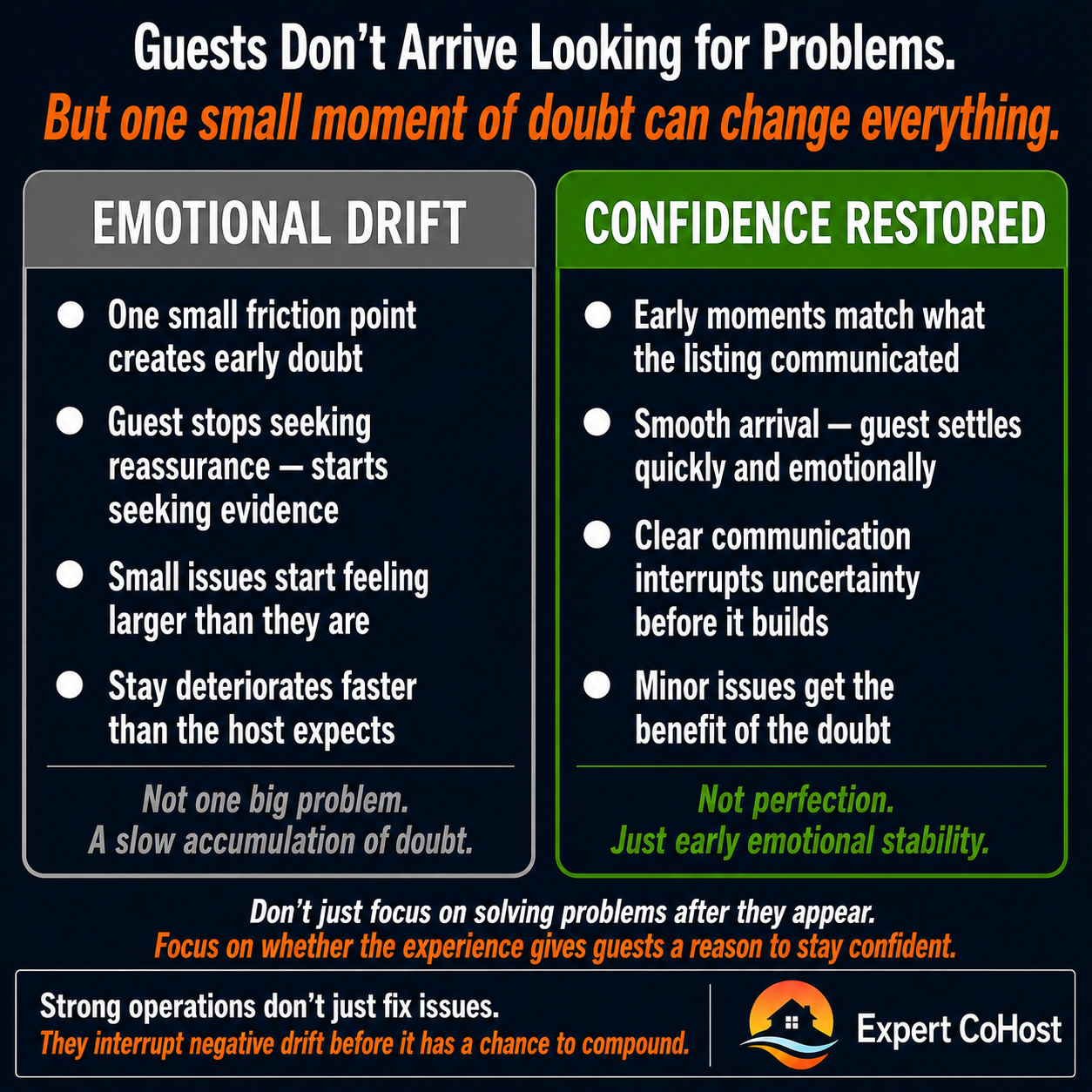
Most Airbnb guests do not arrive looking for problems.
They want the stay to feel:
- relaxing
- easy
- enjoyable
- worth the decision they made
In fact, most guests begin a trip hoping everything goes well.
They want confirmation they chose correctly.
But sometimes, after one moment of friction or disappointment, something shifts psychologically.
Guests stop looking for reassurance.
And start looking for evidence that something is wrong.
Guests Want Emotional Confirmation Early
When guests first arrive, they are subconsciously evaluating the experience.
Not just the property itself.
But the feeling surrounding it.
They quietly ask themselves:
- “Did I make the right choice?”
- “Can I relax here?”
- “Does this feel like what I expected?”
- “Will this stay feel smooth and enjoyable?”
When those questions get answered positively, guests usually settle in emotionally very quickly.
But when uncertainty enters early, the emotional tone of the stay can change fast.
Small Friction Creates Mental Re-Evaluation
The trigger is often surprisingly small.
Things like:
- confusing entry instructions
- a cleanliness inconsistency
- missing details from the listing
- unclear communication
- a space that feels different than expected
may seem operationally minor.
But emotionally, they can create doubt.
And once doubt appears, guests often begin mentally re-evaluating the entire experience.
Trust Changes How Guests Interpret Everything
One of the most overlooked realities in short-term rentals is that trust shapes perception.
When guests feel emotionally confident:
- small issues feel manageable
- imperfections feel understandable
- communication feels reassuring
But once confidence weakens, the exact same issues can feel much larger.
Because guests are no longer interpreting the stay through trust.
They’re interpreting it through caution.
Guests Become More Observant After Disappointment
Once emotional confidence drops, guest attention changes.
They begin noticing:
- additional imperfections
- inconsistencies
- missing details
- operational friction
Not necessarily because the property suddenly became worse.
But because the brain naturally starts scanning for confirmation.
Guests subconsciously look for evidence that supports the feeling:
- “Maybe this wasn’t the right choice after all.”
That shift changes the entire experience psychologically.
Negative Momentum Builds Quietly
One issue rarely creates a negative stay by itself.
The bigger problem is emotional momentum.
A small disappointment creates uncertainty.
Uncertainty increases sensitivity.
Increased sensitivity makes additional issues feel larger.
Those larger emotional reactions create more frustration.
And suddenly, a stay that could have recovered early starts feeling consistently disappointing instead.
This is why some guest experiences deteriorate much faster than hosts expect.
Guests React More to Emotional Drift Than Single Problems
Interestingly, many negative stays are not caused by catastrophic operational failures.
They’re caused by gradual emotional drift.
The experience slowly stops feeling:
- easy
- trustworthy
- relaxing
- emotionally aligned with expectations
And once that emotional drift begins, guests often become more critical overall.
Even when individual problems remain relatively small.
Strong Operations Interrupt Negative Drift Early
High-performing short-term rentals are often excellent at restoring reassurance quickly.
Not just solving problems mechanically.
But restoring emotional confidence.
That can happen through:
- calm communication
- clarity
- responsiveness
- proactive reassurance
- smooth operational systems
The goal is not perfection.
It’s helping guests feel emotionally stable inside the experience again.
The Real Shift
Most difficult guest experiences do not collapse all at once.
They slowly shift emotionally.
Because guests rarely begin a stay actively searching for flaws.
But once trust weakens and uncertainty enters the experience, the brain naturally starts looking for confirmation that something is wrong.
And from that point forward, even small problems can start feeling much bigger than they actually are.