
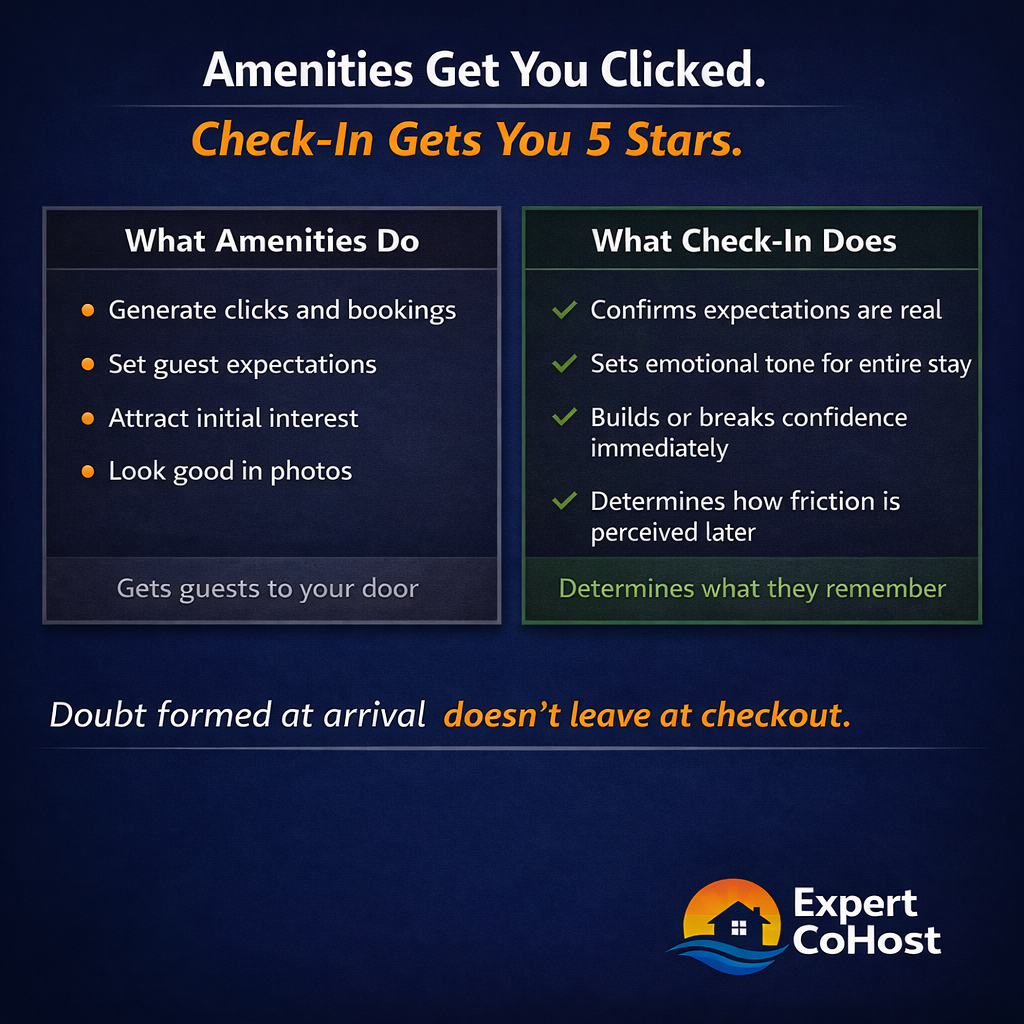
Amenities attract attention.
Check-in shapes perception.
Most listings compete by adding:
-
Hot tubs
-
Game rooms
-
Fire pits
-
Smart TVs
-
Coffee bars
-
Decorative upgrades
Those features help generate clicks.
But they do not determine how the stay feels.
Check-in does.
In a competitive Airbnb marketplace, execution matters more than novelty — and nowhere is execution more visible than the arrival process.
Amenities Create Expectations. Check-In Confirms Them.
When guests book your property, they have already been sold on the features.
They’ve seen the photos.
They’ve read the highlights.
They’ve imagined the experience.
Check-in is the moment those expectations are tested.
If the arrival process is smooth, confidence rises.
If it is confusing, delayed, or unclear, enthusiasm drops — regardless of how impressive the amenities may be.
A property can have a hot tub and still feel frustrating.
A property can be modest and still feel exceptional.
The difference is ease.
Guests Judge Professionalism Immediately
Within minutes of arrival, guests form conclusions about:
-
Organization
-
Attention to detail
-
Care
-
Reliability
They do not wait until the second day to evaluate these things.
They decide quickly.
If the door code works immediately, instructions are clear, and the space feels ready — the host feels competent.
If they must reread instructions, guess at parking, or troubleshoot entry — doubt creeps in.
Doubt affects reviews more than décor ever will.
Amenities Are Used Later. Friction Is Felt Immediately.
Most amenities are not used within the first 15 minutes.
Guests do not:
-
Turn on the hot tub immediately
-
Play pool instantly
-
Start a fire
-
Explore every feature
But they do:
-
Unlock the door
-
Turn on lights
-
Adjust temperature
-
Connect to WiFi
-
Look for bathrooms
-
Assess cleanliness
The first emotional imprint is operational, not recreational.
That imprint influences how the rest of the stay is interpreted.
Seamless Check-In Builds Forgiveness
One of the most overlooked benefits of strong check-in execution is forgiveness.
When arrival feels effortless:
-
Minor issues later feel smaller
-
Guests interpret problems more generously
-
Review tone stays positive
When arrival feels frustrating:
-
Guests become more observant
-
Small inconveniences feel amplified
-
Enthusiasm softens
Check-in does not eliminate imperfections.
It shapes how imperfections are perceived.
The Illusion of Feature-Based Differentiation
In saturated markets, many listings offer similar amenities.
Hot tubs are common.
Game rooms are common.
Mountain views are common.
When features become standard, experience quality becomes the differentiator.
Execution separates listings far more reliably than upgrades.
It is easier to buy amenities than it is to refine systems.
Which is why refinement creates competitive advantage.
What Strong Check-In Actually Looks Like
Effective check-in is not dramatic.
It is quiet.
It looks like:
-
Clear, concise instructions
-
Logical sequencing
-
Immediate WiFi clarity
-
Comfortable temperature on arrival
-
Intuitive lighting
-
No surprises
Guests should not need to think.
They should feel settled quickly.
If they are adjusting, troubleshooting, or clarifying, friction is present.
Why This Matters at 4.8
Many 4.8 listings are well-equipped.
They are not lacking amenities.
They are lacking seamlessness.
The gap between 4.8 and consistent 4.95+ performance is often not a new feature.
It is reduced friction.
Guests rarely leave four stars because there was no game table.
They leave four stars because something felt slightly off.
Check-in is where that feeling begins.
The Strategic Shift
Instead of asking:
“What amenities can we add?”
Ask:
“Where does arrival require effort?”
Effort is the enemy of enthusiasm.
When guests feel effort early, they lower their internal score slightly.
When guests feel ease, they elevate it.
Final Thought
Amenities attract attention.
Check-in determines tone.
In a marketplace where small differences compound, tone matters more than features.
A listing does not need to be extravagant to separate.
It needs to be effortless.
Because guests remember how a stay felt long before they remember what it included.
And how it felt begins at the door.