
One of the most confusing experiences for Airbnb hosts is this:
Two guests encounter similar problems.
One barely mentions it.
The other leaves disappointed.
Sometimes even a lower review follows.
From the host's perspective, the issue looks identical.
But from the guest's perspective, it often isn't.
Because guests don't evaluate mistakes in isolation.
They evaluate what those mistakes mean.
Not All Problems Carry the Same Weight
Many hosts assume guest satisfaction is determined by the number of problems that occur.
In reality, guests often care more about the type of problem than the quantity.
A guest may overlook:
- a slow Wi-Fi reset
- a missing kitchen tool
- a minor maintenance issue
Yet become highly frustrated by something that seems relatively small.
The difference usually comes down to expectations.
Guests Judge Broken Promises More Harshly Than Broken Amenities
Every booking creates a set of expectations.
Some are explicit.
Others are implied.
When a problem contradicts one of those expectations, guests pay far more attention.
For example:
A missing wine opener is an inconvenience.
A bedroom that doesn't match the listing photos feels like a broken promise.
One creates a temporary problem.
The other creates doubt.
And doubt spreads.
Trust Determines Forgiveness
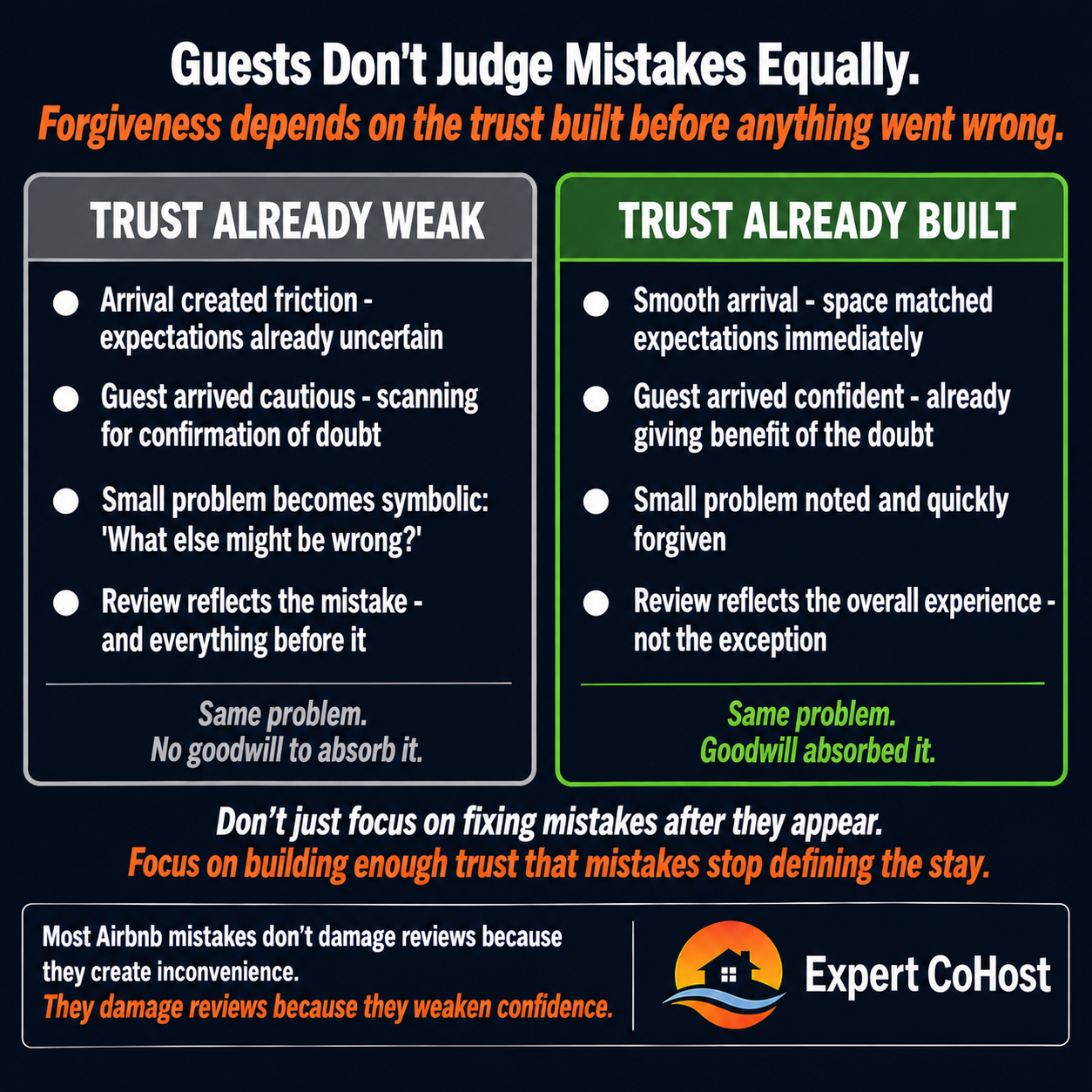
When guests trust the property, they become more forgiving.
When trust weakens, tolerance shrinks.
A guest who feels confident in the host may overlook a small issue.
A guest who already feels uncertain often interprets the same issue differently.
Suddenly the problem isn't:
"The coffee maker isn't working."
It's:
"What else might be wrong?"
The issue becomes symbolic.
Early Experiences Matter More Than Hosts Realize
Many guests begin forming opinions within the first moments of the stay.
If arrival feels smooth:
- check-in is easy
- instructions are clear
- expectations are met
guests often start with confidence.
That confidence creates resilience.
Small problems become easier to forgive.
But when arrival creates friction, every future issue feels larger.
The Real Cost of Friction
Most forgiveness is earned before the mistake occurs.
That's what many hosts miss.
Guests aren't deciding whether a problem happened.
They're deciding how much that problem should matter.
Properties that consistently remove friction create goodwill.
And goodwill acts like a buffer when imperfections inevitably appear.
Why Hosts Sometimes Misdiagnose Reviews
After receiving a disappointing review, many hosts focus on the issue that was mentioned.
But the issue mentioned isn't always the issue that mattered.
Often the review reflects an accumulation of small concerns.
The final complaint simply becomes the focal point.
Fixing that one complaint may not improve future outcomes.
Because the underlying trust problem remains.
The Best Stays Feel Reliable
Guests rarely expect perfection.
What they want is reliability.
They want to feel that:
- the property matches expectations
- communication is dependable
- problems will be handled appropriately
When that foundation exists, mistakes lose much of their power.
Final Thought
Most Airbnb mistakes don't damage reviews because they create inconvenience.
They damage reviews because they weaken confidence.
Guests forgive problems when trust remains intact.
And in many cases, the most important hospitality work happens long before anything goes wrong.